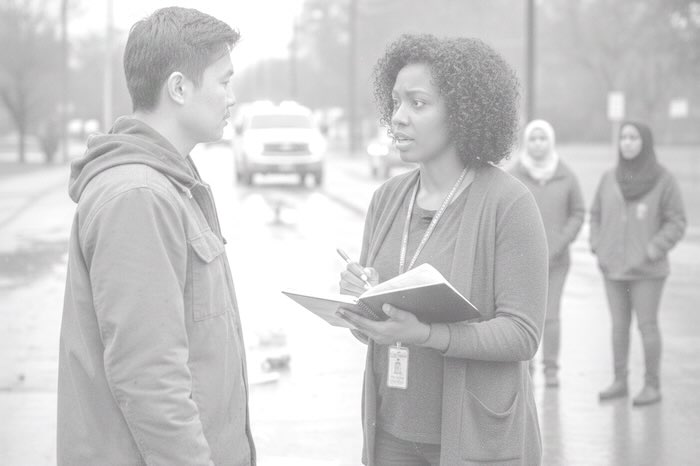
 Media Helping Media (MHM) has hundreds of free training resources designed to help young journalists starting off in their careers.
Most are in the form of articles written by professional journalists who have been responsible for training journalists during their careers.
We also have checklists and exercises which you can work through on your own. And there are workshops and lessons which you could go through with your colleagues.
Quick guide checklists
 Our quick guide checklists sum up the main points of selected MHM training articles so you can test what you have learnt.
Self-teaching exercises
 Our self-teaching exercises are designed to help journalists who don’t have access to training. They are about an hour long.
Workshops
 Our workshops – which are two and four hours long and designed for trainees who have limited time available.
Lessons
 Our lesson outlines are for group training, but there is no harm in going through them on your own or with a colleage.
The journalist’s mindset and role
All the above are based on training articles on the site. And all link to background material designed to help you grasp the develop the essential skills needed to be a journalist.
So, before you write a single word, you must understand your purpose and ethical responsibility. The following guides focus on the personal qualities, ethical framework, and community obligations required for the job.
- The qualities of a journalist: Details the personal characteristics of a successful journalist, such as curiosity, integrity, perseverance, and strong communication skills.
- Journalistic roles and responsibilities: Explains the journalist’s functions in a free society, including acting as a watchdog, providing reliable information, and setting the news agenda.
- Journalism and the public interest: Clarifies the distinction between what the public is interested in and what is genuinely in the public interest, guiding reporters to prioritise stories that inform democratic accountability and affect civic life.
- Unlock your journalistic potential: A motivational piece encouraging new journalists to identify and leverage their unique skills and passions to find their niche in the industry.
Foundational ethical principles
These are the core ethical tenets upon which all journalistic work rests. They must be applied before proceeding to reporting practice.
- Why editorial ethics are important: Explains that ethics protect credibility, build audience trust, and are vital for the media’s function in a democracy.
- Accuracy in journalism: The cornerstone of journalism: ensuring every detail, quote, and statistic is correct and verified, preferably from multiple sources, before publication.
- Fairness in journalism: Requires presenting all relevant viewpoints and ensuring reports are objective and fair in their overall portrayal of events.
- Impartiality in journalism: This means never taking sides. Maintaining neutrality and objectivity, particularly when covering political or controversial issues, by keeping the journalist’s personal feelings and biases out of the report.
- Integrity and journalism: Acting honestly and resisting external pressure or vested interests, ensuring the journalistic process is transparent and trustworthy.
Understanding news
This section teaches you how to identify, develop, and contextualise newsworthy events by applying professional judgment.
- Where does news comes from?: Examines the various sources of news, from official documents and press conferences to citizen tip-offs and social media, stressing the importance of cultivating diverse sources.
- How news value is assessed: Explains the factors (timeliness, proximity, prominence, impact, and conflict) that editors consider to determine if a story is newsworthy enough to be published or broadcast.
- Developing and applying news sense: Focuses on the instinctive ability of a journalist to spot a story, including being perpetually curious and understanding what resonates with the audience.
- How to spot a news story: Offers practical tips on analysing press releases, monitoring public meetings, and engaging in “shoe-leather” reporting to uncover stories before competitors.
- Why some news stories are rejected: Provides insight into editorial decision-making, covering common reasons for rejection such as lack of concrete evidence, poor writing, or not fitting the news organisation’s agenda or resources.
- Developing important news angles: Teaches how to identify the most relevant and impactful slant for a story, ensuring the report answers the audience’s “So What?” question immediately.
Language, grammar, and style
Your command of language is your primary tool. These resources are crucial for ensuring all you write is clear, accurate, and professional.
- The basics of writing:
- Essential elements of a news story: Outlines the basic structure of a news report, focusing on the inverted pyramid style, and ensuring all the “five Ws and H” are answered.
- News writing for beginners: A practical guide on crafting compelling leads (or intros) and maintaining a direct, objective tone throughout the article.
- Language and style – basics: Establishes the rule for a concise, accessible, and active voice preferred in all journalism.
- Grammar for journalists: A crucial module covering common grammatical pitfalls, such as subject-verb agreement and correct punctuation, to ensure professional polish.
- Refining your copy:
- Using the right words: Focuses on precision and avoiding vague or emotive language, emphasising that every word should contribute to clarity and accuracy.
- Adjectives and adverbs in journalism: Advises on the sparing and responsible use of descriptive words, encouraging reporters to use facts and verbs to tell the story instead.
- The active and passive voices in news: Explains why the active voice is usually stronger and clearer in news writing, making it easier to identify who did what.
- Clichés, journalese, and jargon: A warning against using tired phrases, professional slang, and overly complex technical terms that alienate the general audience.
Newsgathering and verification
This phase deals with the practical, hands-on skills of extracting information and ensuring it is verifiable before publication, which is the heart of credibility.
- Gathering information:
- Introduction to interviews: Covers the planning and preparation for an interview, including setting objectives and securing appropriate logistics.
- Preparing for an interview: Details the importance of thorough research on the interviewee and the subject matter to ask informed, effective questions.
- The questions every journalist should ask: Provides a checklist of essential follow-up and probing questions (e.g. “How do you know that?”) necessary to push past simple statements and establish facts.
- Shoe-leather reporting: Stresses the value of on-the-ground work, meeting people face-to-face, and developing sources through direct, proactive reporting.
- Verification:
- Fact-checking and adding context: Explains the crucial process of confirming all data points, quotes, and claims from multiple, independent sources before publication.
- SIFT for fact-checking: Introduces a memorable, modern verification framework: Stop, Investigate the source, Find better coverage, then Trace claims to original context.
- Lateral reading: Teaches the technique of verifying a source’s credibility by leaving the original page to check what other, authoritative sources say about the website or person.
- Attribution and plagiarism: Sets out the strict rules for citing the origin of all information and quotes, making it clear that using another’s work without credit is a serious professional breach.
Practical reporting
Once you have gathered and verified your information, you need to structure and deliver it effectively for specific platforms or beats, ensuring clear communication.
- General reporting:
- How to cover an event: Provides a workflow for reporting live from an ongoing situation, including pre-planning, securing media access, and choosing what details to prioritise.
- How to create a structured news report: A blueprint for ensuring articles are logically ordered, with transitions, clear topic sentences, and a strong summary conclusion.
- Editorialising is not for news: Reinforces the principle of keeping news coverage separate from opinion, ensuring the reporter’s personal feelings do not contaminate the facts.
- Tool: News story checklist: A utility for self-editing and final checks, ensuring all ethical, legal, and structural requirements have been met before submitting copy.
- Broadcast skills:
- How to write a radio news script: Covers the unique requirements of writing for the ear, including simplicity, use of sound, and writing in shorter sentences.
- Constructing a news package for radio: Details the process of combining a reporter’s voice, actualities (soundbites), and natural sound into a cohesive audio piece.
- Constructing a tv news package: Focuses on the visual storytelling aspects, including shot sequencing, script synchronisation with video, and letting the pictures do the work.
The advanced expertise
Once you have grasped the basics you can move on to our more advanced material which is designed to help journalists move from being proficient reporter to specialised professional, equipped to handle the complexities of modern digital deception, specialised reporting, and nuanced ethical dilemmas.
Deepening ethical practice and accountability
This section moves beyond the core ethical tenets, applying them to complex real-world situations, addressing subtle biases, and managing conflicts of interest.
- A journalist must not have an agenda: Explores the importance of retaining an open mind during interviews, warning against pre-judging outcomes or forcing issues.
- Avoiding manipulation: Provides practical strategies for journalists to identify and resist being used by sources, political actors, or corporations who seek to control the narrative.
- False equivalence and false balance: Teaches journalists to avoid giving two sides of an argument equal weight when evidence heavily favours one side, such as in the climate change debate.
- Conflicts of interest: Guidance on identifying and disclosing any financial, personal, or political relationships that could compromise a journalist’s independence and objectivity.
- Respecting privacy as a journalist: A careful look at balancing the public’s right to know against an individual’s right to privacy, especially concerning victims, children, or private citizens caught up in public events.
- Offence and journalism: Navigating sensitive topics, considering the potential harm or distress caused by publishing graphic or controversial material, and when to use warnings or restraint.
- Photojournalism and ethics: Sets out strict rules against manipulating images, staging scenes, and the ethical requirement for respectful depiction of vulnerable people in visual media.
- Unconscious bias and journalism: Recognising and mitigating ingrained prejudices (based on gender, race, etc.) that can subtly distort story selection, source selection, and overall coverage.
- Is your journalism ethical?: A self-assessment framework for applying all ethical codes to real-world scenarios and evaluating one’s own professional conduct.
Advanced verification and information integrity
The digital age demands expertise in spotting and counteracting misinformation. This phase focuses on advanced fact-checking, understanding the taxonomy of digital deception, and using technology for deep verification.
- Beyond basic fact-checking: Details an evidence-based, rigorous process that stresses the importance of adopting a “fact-checker’s mindset” and contextual analysis.
- Creating a strong fact-checking system: A guide for establishing robust internal protocols, including prioritising claims based on potential real-world impact and managing the workflow of verification and correction.
- Disinformation and misinformation: Provides definitions and clarity, explaining that misinformation is false information spread unintentionally, while disinformation is false information spread with malicious intent.
- Forms of information disorder: Maps the landscape of digital falsehoods, identifying and explaining various types such as fabricated content (100% false) and imposter content.
- The glossary of information disorder: A reference list defining the specialised vocabulary, including terms like malinformation (true information used maliciously).
- How to detect ai-generated images: A crucial modern skill, this resource focuses on observational analysis to spot visual clues—such as distorted hands, unnatural lighting, or smooth surfaces—when automated detection tools fail.
- Journalism and activism: Defines the sometimes-blurred line between reporting and advocacy, arguing for the necessity of maintaining an independent, non-partisan position.
- Journalists and politicians: Examines the complex, often symbiotic relationship between the press and political figures, outlining the ethical rules and professional distance necessary to hold power to account.
Specialised reporting and data journalism
Specialisation allows journalists to report with authority on complex subjects. Data and computer-assisted reporting (CAR) skills are essential for modern investigative work.
- Specialisms in journalism: Makes the case for moving beyond general reporting to developing expertise in areas like health, technology, or finance to provide deeper, more authoritative coverage.
- What is data journalism?: Defines this discipline as the process of using numerical data to find, analyse, and visualise stories, moving beyond traditional interviews and documents.
- Data journalism – resources and tools: Lists and explains some of the software, databases, and online platforms available for collecting, cleaning, and presenting large datasets effectively.
- Computer-assisted reporting (car): Explains the use of computers and digital tools (often spreadsheets and databases) to sift through large volumes of public records and extract investigative leads.
- Covering climate change: A guide to the scientific, political, and economic angles of this complex, long-term story.
- Climate change – tone and language: Focuses on the specific vocabulary and factual accuracy needed to describe climate science responsibly.
Advanced production and digital delivery
This phase covers the production skills for longer-form content and the critical editorial judgment needed to manage news flow across digital platforms.
- Creating a current affairs programme: Details the planning, structure, and pacing required to produce an in-depth, magazine-style TV or video show.
- How to make a documentary: A step-by-step guide to the entire process, from pitching the story and securing funding to shooting, editing, and distribution of the finished video.
- Making documentaries for radio: Focuses on the specific challenges of audio storytelling, emphasising soundscaping, natural sound, and interview techniques.
- Presenting news content online: Discusses how to adapt traditional storytelling structures for the web, using elements like SEO, multimedia integration, and interactive features.
- Managing a news website’s front page: Explores the editorial decisions, traffic analytics, and strategic placement of stories.
- Old news is no news, updates are essential: Stresses the digital-first imperative to continuously refresh stories rather than treating them as static publications.
Newsroom mastery and resilience
The final stage involves understanding the institutional structures, legal constraints, and personal pressures within a professional newsroom.
- Handling breaking news: Outlines the triage and verification protocols necessary when a major, developing event occurs, stressing the need for speed without sacrificing accuracy.
- Handling story leaks and tip-offs: Addresses the sensitive and often legally complex process of protecting sources, verifying anonymous information, and using leaked material responsibly.
- The role of the media lawyer: An introduction to legal concepts like libel, copyright, and contempt of court, teaching the journalist when and how to seek legal counsel.
- The importance of keeping records: Emphasises the professional need for meticulous documentation of interviews, sources, and evidence, which is vital for defending work against legal challenges or libel suits.
- Journalism, trauma and stress: An important resource addressing the psychological impact of covering traumatic events and providing advice on managing stress and seeking support.
- Systems thinking for journalists: Encourages journalists to look beyond individual events and analyse the interconnected forces and structures (political, economic, social) that cause problems.
Conclusion: The essential mandate for public service journalism
The material contained in this order of learning is essential for ensuring that journalism remains a vital public service. The lessons collectively create a journalistic professional who is not merely competent, but ethically fortified and digitally empowered.
By understanding and applying the core principles of accuracy, impartiality and fair dealing, the journalist maintains public trust – the only currency that matters in the news industry.
By mastering the material published on MHM a journalist will equip themselves to challenge complex power structures, debunk sophisticated disinformation, and translate complex data into accessible public knowledge.
Ultimately, the material set out above ensures that the trained journalist will consistently produce work that is rigorously verified, contextually rich, and independent of any external agenda. This is the highest form of public service: providing citizens with the reliable, unbiased information they need to participate fully in a functioning democracy.