Journalism is a demanding profession that requires a unique combination of intellectual curiosity, linguistic skill, and a deep understanding of the world.
At its core, journalism is about uncovering and sharing stories that matter. However, effective journalism is not just about presenting facts – it is about crafting narratives that engage, inform, and sometimes even challenge audiences.
To achieve this, a journalist must develop and refine a distinct set of qualities that define their craft.
The following suggestions have been compiled using contributions from senior journalists in the Media Helping Media network who responded to the question “What are the essential qualities of a journalist”. They are listed in no particular order.
Curiosity and the drive to uncover stories
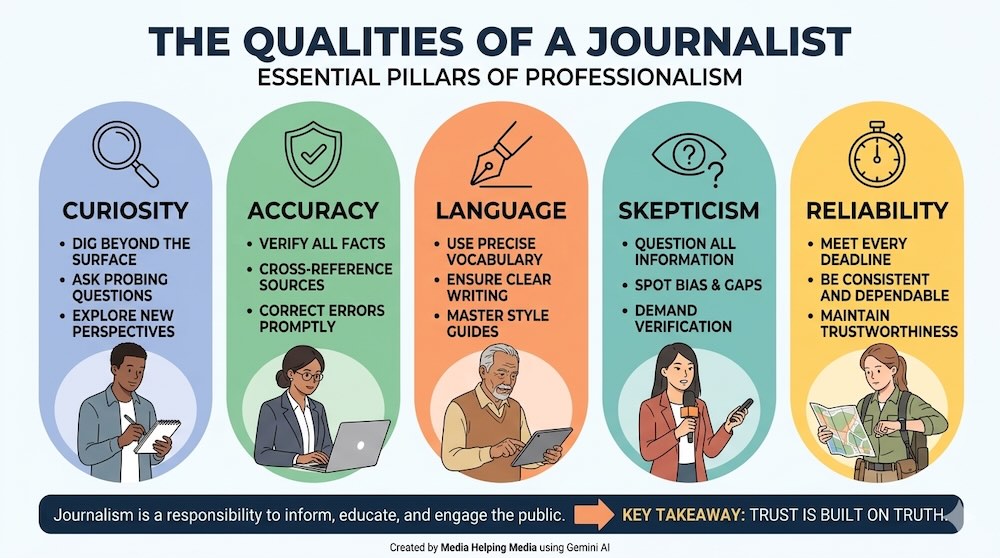
A journalist’s work begins with curiosity – a relentless desire to seek out the truth and explore stories that may otherwise remain untold. This inquisitiveness drives them to ask questions, probe deeper, and investigate angles that others might overlook. It is this quality that ensures journalism remains a dynamic and essential force in society, constantly evolving with new discoveries and insights.
Mastery of language and communication
Journalists must have a strong command of language, both written and spoken. The ability to construct clear, concise, and compelling narratives is fundamental. A journalist’s writing should be direct yet engaging, avoiding unnecessary complexity while still capturing the essence of the story. Achieving clarity in writing is often more challenging than producing verbose prose, making mastery of grammar, spelling, and vocabulary crucial.
For those new to the field, learning the basic structure of news writing is an essential first step. Only after mastering the foundational elements can a journalist develop their own unique style. Whether writing for print, digital media, or broadcasting, effective communication ensures that stories resonate with their intended audience.
Accuracy and attention to detail
Trust is the cornerstone of journalism, and accuracy is what upholds it. A journalist must be meticulous in verifying information before publication. Even a small factual error can erode credibility and damage reputations. Ensuring accuracy requires diligent note-taking, fact-checking, and cross-referencing sources. A well-prepared journalist always has a notebook or recording device at hand to document events and interviews precisely, minimising the risk of misinterpretation.
A keen news sense
The ability to recognise what constitutes ‘news’ is a skill honed through experience. A good journalist knows how to sift through vast amounts of information to identify the most important elements that will capture the interest of the audience. This news sense allows them to spot emerging trends, detect underreported issues, and understand the broader implications of a story. It is this instinct that distinguishes impactful journalism from mere reporting.
Skepticism and critical thinking
Journalists encounter information from a variety of sources, each with their own agendas. A healthy skepticism is necessary to separate fact from fiction. Being able to assess the reliability of sources, detect bias, and identify misinformation and disinformation is essential. This skepticism must be balanced with an openness to uncovering the truth, even when it challenges preconceived notions. A journalist’s determination to get to the bottom of a story requires persistence – sometimes even in the face of opposition.
Interpersonal skills and relationship building
Building rapport with a diverse range of people is a crucial aspect of journalism. A journalist must engage with individuals from all walks of life, regardless of personal feelings or biases. Effective storytelling often depends on trust between the journalist and their sources. This trust is built through respectful communication, active listening, and a genuine interest in people’s experiences.
Additionally, asking tough questions is a necessary part of the job. While it may be uncomfortable at times, journalists must balance persistence with politeness, ensuring they obtain valuable information without alienating sources.
Reliability and professionalism
Journalists operate in a fast-paced environment where reliability is essential. Missing an interview, failing to meet a deadline, or submitting inaccurate information can have serious consequences. Colleagues, editors, and audiences depend on a journalist’s professionalism. Timeliness, organisation, and a strong work ethic are non-negotiable traits for success in the field.
Adherence to deadlines and efficiency
In the world of journalism, deadlines are sacrosanct. News organisations function on strict timelines, requiring journalists to produce high-quality work quickly and efficiently. Meeting deadlines is not just about speed, it’s also about delivering well-researched, accurate, and well-written content in a timely manner. The ability to work under pressure while maintaining accuracy is a defining trait of a successful journalist.
Conclusion
Journalism is more than just a profession; it is a responsibility to inform, educate, and engage the public. The best journalists possess a blend of curiosity, linguistic precision, analytical thinking, and interpersonal skills. They uphold the principles of accuracy, integrity, and timeliness, ensuring that the stories they tell make a meaningful impact. Whether uncovering hard-hitting investigative reports or sharing human-interest pieces, journalists play an indispensable role in shaping public discourse and keeping society informed. Mastering these qualities is not just an asset, it’s a necessity for journalists.