
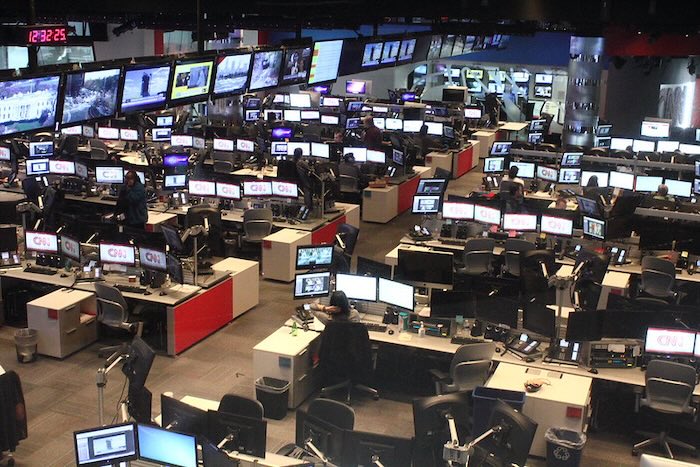
Operating a newsroom that works across all time zones is relentless. Learn how to optimise your global service to deliver reliable and timely news coverage.
The challenges of running a global news operation which is covering breaking and developing news worldwide are many. Here we look at how journalists can fine-tune their newsrooms in order to provide comprehensive news coverage on a global scale.
The following suggestions are based on my work in international broadcast newsrooms in the US, the UK, and Switzerland; all the stations I worked for had radio and TV departments as well as their respective online staff. That means they could rely on the following resources:
- Content: Self-generated, for example video/audio packages, written stories, and social media posts.
- Media: Audio, video, text, graphics (visuals)
- Staffing: Correspondents, freelancers, writers, producers, experts
- Distribution: Radio/audio, TV/video, online, social media, podcasts, newsletters.
Although all these stations had large numbers of production staff, the points set out below also apply to smaller or mid-size international newsrooms.
Characteristics of an international newsroom
The demands of an international newsroom operation vary significantly from those of a domestic newsroom. A newsroom that focuses on international news and current affairs – maybe even a global news operation – needs a different organisation and staffing levels; even more so if the news operation covers global affairs and not just your own time zone.
Time zones, therefore, matter. Be aware of that when you define your target audience(s), editorial choices, and journalistic production. Let us go over some critical points you should be aware of when working in an international news and current affairs environment:
Time zones and their impact
Team size: News coverage extending over several time zones needs a large number of staff for newsgathering and production. You are working with colleagues who either sit with you in the same office or – more likely – work with you from abroad (regularly from different countries). Be aware that there is no downtime: the sun never sets on a 24-hour global newsroom, and there is always an important story to cover somewhere.
Team organisation: Covering international news stories across time zones means you have to work shift hours. This is particularly important when working in a 24-hour news operation. Most of those organisations tend to rotate their journalists across the standard three to four shift schedules. See the Media Helping Media 24-hour newsroom rota which you are free to download, adapt and use.
Typical roles you find in international news operations are desk journalists, assignments and coordination editors, international correspondents, and freelancers. Depending on your organisation, you might also have colleagues on the TV/audio, radio/audio, web, social media, and visuals side.
Team know-how: You and your team need special skills: you must take a keen interest in the people and their stories in the countries and regions you cover. The more you know about these countries, the better the quality of your editorial offering. This know-how can and should be developed over time, but make sure minimum standards are in place so that working with your correspondents and freelancers runs smoothly. See our article on specialisms in journalism.
Worth remembering:
An international newsroom is not just a bigger version of a domestic one. Build shift-based staffing to cover time zones round the clock, invest in correspondents and freelancers with genuine regional and language knowledge, and put minimum know-how standards in place from day one.
Audience
Decide who your audience is, where they live, and what their information needs are. This is not an easy task and, ideally, you need the support of an audience research team; barring that, you should look for access to reliable data you can base your news agenda on. See our articles on knowing your audience.
Keep in mind that the mental picture you have of your audience should not only be defined by the usual metrics, such as age, gender, or purchasing power. The very nature of covering international stories is that you are regularly dealing with foreign languages, cultures, or political systems, and maybe even different distribution and consumption platforms. See our article on audience research and segmentation.
Because of that, try to avoid assumptions. Naturally, you can’t and won’t be able to verify everything you would like to know about your audience. But you should make an effort and base your production on trustworthy sources for research and related data.
Over time, you will hopefully get feedback from your audience. It should be part of your work ethic to build on audience feedback and thus improve your journalistic production to meet audience needs and expectations. Most of the time, audience feedback will affect your content strategy and story selection, but it may also reshape your distribution channels.
Worth remembering:
Resist the urge to assume you know your international audience. Base editorial choices on the most reliable research you can get, and treat audience feedback as an ongoing correction mechanism for your content strategy and distribution channels, not a one-off exercise.
Editorial challenges
Editorial agenda: How you define your editorial agenda and planning, and how you select your stories, can make the difference between success and failure. The tried and tested wire services can help define the must-know stories for your audience. But more important than that, in my opinion, are your correspondents or freelancers. They should be people who live in those countries or regions you cover and, ideally, speak the language. They should be in sync with your news operation and work with you as a journalistic sparring partner. They help to make sure that you are not missing important stories – stories that matter from their perspective but also have a wider regional or international significance.
Culture: Critically, your international co-workers should give you a kind of cultural translation from the point of view of the regional audience. You need this guidance to make sure that you really pick the relevant stories for your audience, and it should spare you from embarrassing or problematic misunderstandings between the journalists who produce the content and the audience(s) who read, watch, or listen to those stories.
Trust (assignment point of view): You must be able to trust your correspondents and freelancers. If you cannot fully trust their integrity and professionalism, then don’t use them; because if things go wrong, the risk of serious reputational damage for your news organisation is real and can be detrimental. Your correspondents and freelancers – who are your cultural translators – should be vetted staff with a solid professional track record tested by your own organisation. If that’s not possible – say in the case of a new freelancer – then proceed carefully and work with them on some pilot projects first. In this day and age of AI, check carefully for mistakes or any kind of bias or shortcomings. See our article on unconscious bias in journalism.
Trust (audience point of view): Your audience needs to be able to trust your journalism – which means your correspondent reports, TV shows, radio programmes, newsletters, website, and social media posts. See our article on winning audience trust and loyalty. Journalism ethics on the production side – as described above – is one way of creating trust. See our section on editorial ethics. Also important in this context is transparency. Let your audience know who your reporters and correspondents are, what their background is, where they live, and why you think they are competent and trustworthy journalists. This can easily be done on a TV screen, in the introduction of a radio show, or, if you don’t want to clutter the screen or bloat the audio intro, you can use your website or social media presence.
The main purpose should be to convince your audience that your international news coverage is informed, accurate, fair, ethical, and transparent. This is particularly important if you are working for a startup or not-yet-established news organisation, as it can make or break your operation. Legacy media outlets often have established audiences which trust the organisation; but even so, transparency and openness about who works for you and how they work remains a relevant pillar of success.
Translations: As I mentioned earlier, your correspondent and freelance co-workers can help match your editorial intentions and agenda with the needs and expectations of your target audience. Regularly, this means translating a foreign language into your own language. In this case, words matter: good translations reflect cultural differences and similarities. See our article on translation in journalism.
For example, some words or language concepts may not exist in another language, and therefore you need to make sure the intended message is translated in a way that maintains the meaning of what you want to convey. See our article on clichés, journalese, and jargon in journalism. The often-quoted example of “one man’s terrorist is another man’s freedom fighter” is just one such case. But sometimes it’s simple things like political party names, titles of government officials, or city names that need mindful translation for the target audience. See our article on language and style.
Worth remembering:
Trust runs in two directions in international journalism: you must trust your correspondents’ integrity, and your audience must trust your journalism. Vet your contributors properly, translate language and context with care, and be transparent about who your reporters are and why they are credible.
Storytelling
Detail and context: The audience may know little or nothing about the country you are reporting on. Putting the news in context is important if your audience is to fully understand the story. One piece of news may equal two pieces of background information. This, of course, adds up and makes the story longer – and that can be an issue for your news shows or social media posts. See our article on fact-checking and adding context. So, be aware of the need for such background information and plan accordingly when assigning, editing, or planning stories with your correspondents. See our articles on story development and adding important news angles.
Not least because of this demand, you will often feel that you don’t have enough time or space to say everything you think should be told. Don’t let this frustrate you. Remain focused on what the absolute must-have messages in your news story are and drop the rest for now; you might be able to include the remaining facts or colour in another news report or a more general background context. It is always better to give your audience three important facts that they can recall than a longer piece which they will forget 10 minutes later because it’s too complicated or confusing.
Parachute journalism: A news organisation might decide to use their most prominent reporters to cover crisis spots across several countries, maybe even across the globe. This is often referred to as parachute journalism: journalists are dropped in at short notice and often leave soon afterwards. More often than not, there is no real before or after linking the reporter to the news event.
Parachute journalism is regularly used to signal that “we are here on location and we are authentic.” This kind of drop-in storytelling can sometimes work. But always remember that the story is not about you. There is a real risk of cultural misrepresentation or misunderstanding that comes with parachute journalism. So, make sure your news organisation gives the people in the story a voice. A simple and direct message to camera or microphone by the main people in the news item is often the best way of developing the story. Of course, the reporter should retain the role of a professional news narrator, but that only works if he or she knows the country they report from really well and, ideally, speak the respective language. See our article on ensuring the human angle is covered in news.
News wires: When and how to use international news wires will depend on the size and means of your media organisation: in principle, the more correspondents and freelancers or local voices you have access to in the country you are reporting from, the less there is a need for news wires to cover the story. In such a case, the storytelling tends to come across as more authentic and real for the audience. However, it’s probably fair to say that most newsrooms do make use of wire services for their international coverage to some degree.
Breaking news: Assuming you can fall back on good quality wire services, they can be very helpful, for instance, in the first few hours of a breaking news story when your own journalists cannot be on location yet – the news event might be happening hundreds of kilometres from where your staff live or work. This scenario happens quite often when you look at today’s global media scene.
Background coverage: Wire services can also be useful to help fill some gaps in your reporting, particularly by providing important and useful background information. Your own staff cannot and do not know everything, even if they are local staff. Wire services often build up relevant background information over several years, and that knowledge can really help fill in some background facts, help build a bigger picture, or make the story more relevant for your audience. Because no news organisation can have correspondents in every country, news wires are regularly used to help fill in for the blank spots around the globe. See beyond basic fact-checking.
Wire services only: There are some news organisations that use wire services only to provide international news coverage. From a journalistic point of view, this is obviously not an ideal situation. But because of financial restrictions – and sometimes the editorial profile of a media organisation – it’s a real situation in today’s media world. In all such cases, your organisation puts full trust in the journalistic quality and integrity of the international wires. If you are working in such an environment, try to make sure you are using more than just one wire service when writing about a news event; cross-check and confirm as much of the story as you can to minimise the risk of unintentional wire service mistakes creeping in. If that is not possible, then the best you can do is be transparent and make clear to your audience that you are giving them the wire service story, and that it’s not your own reporting.
Worth remembering:
International stories need context your audience will not already have, but keep it to the essential facts your audience can retain. Be wary of parachute journalism, let local voices speak for themselves, and be upfront whenever you are relying on wire copy rather than your own reporting.
Story production
Assignments and coordination: A must-do when laying the groundwork for efficient production is to establish an assignment and coordination desk. The assignment editor(s) plan and assign stories and topics for your news coverage across the respective time zones. They also liaise regularly with your correspondents and freelancers to shape a solid editorial agenda and implement efficient story production; this type of coordination and forward planning should apply to all journalistic production (i.e., TV, radio, social media channels, livestreams, and postings). Broadcast companies also employ bookers who work with show producers to plan and coordinate live interviews and livestream segments with correspondents, experts, guests, or other people relevant to the story covered.
Shift management: As mentioned earlier, covering several time zones around the clock inevitably means shift work. It’s important, therefore, that production details from one shift to the next are managed with care and diligence. This handover is often done by the shift lead person or a coordinator-planner staff member. The basic idea of the shift handover is to make the transition from one shift to the next as seamless as possible so that no stories fall through the cracks, no interview guests and livestreams are dropped, and no deadlines are missed.
Quality assurance: Assignment editors are the first line of defence when it comes to assuring the editorial quality of your international coverage. They must be in regular contact with your regional staff and ensure editorial and ethical standards across your coverage. They often vet new freelance contributors for their journalistic professionalism and integrity before these candidates are accepted as story contributors. You should not underestimate the importance of this role, particularly in this day and age of AI with all its positive and negative implications.
Newsroom convergence
Much of the coordination described above is, in effect, convergence in practice. A converged newsroom brings intake and output together around a central superdesk so that one set of sourced, verified facts reaches every platform, rather than each output team working in isolation and duplicating effort.
For an international operation running across time zones, that logic matters even more: your assignment and coordination desk is, in essence, your superdesk, and building a properly converged workflow is what keeps correspondents, freelancers, and shift teams scattered around the globe working from a single, consistent editorial line, rather than pulling in different directions on different platforms.
Worth remembering:
A dedicated assignment and coordination desk, disciplined shift handovers, and rigorous vetting of freelance contributors are what keep a round-the-clock international operation editorially sound, particularly as AI adds new risks around algorythmic bias and accuracy that need checking.
Story distribution
If your news organisation not only imports international news but also distributes it back to the respective region, then story distribution becomes key. Particularly in a global context where there are many countries with limited or varying degrees of radio, TV, and internet coverage; also, there might be censorship of the main media outlets. Story planning and assignments should be mindful of this situation whenever possible in order to ensure that stories reach their intended target audience via the most effective distribution platform.
Running an international newsroom well is ultimately about managing complexity: time zones, cultures, languages, and trust, often all at once and at speed. There is no single formula for getting this right, but the newsrooms that manage it consistently share the same foundations:
- correspondents and freelancers who genuinely know the countries they cover,
- an assignment desk that keeps the story flow moving smoothly across shifts,
- and editors who never stop asking whether they truly understand their audience.
None of this removes the pressure of covering stories that matter to people thousands of kilometres away, round the clock. But get the basics right – trustworthy people, clear editorial standards, and honest communication with your audience – and you give your newsroom the best chance of delivering journalism that is accurate, fair, and worth the audience’s time, wherever in the world they happen to be.
Worth remembering:
Running an international newsroom well comes down to people, trust, and structure: correspondents who genuinely know their patch, an audience you never stop learning about, and a production system built for continuous, cross-border coverage.