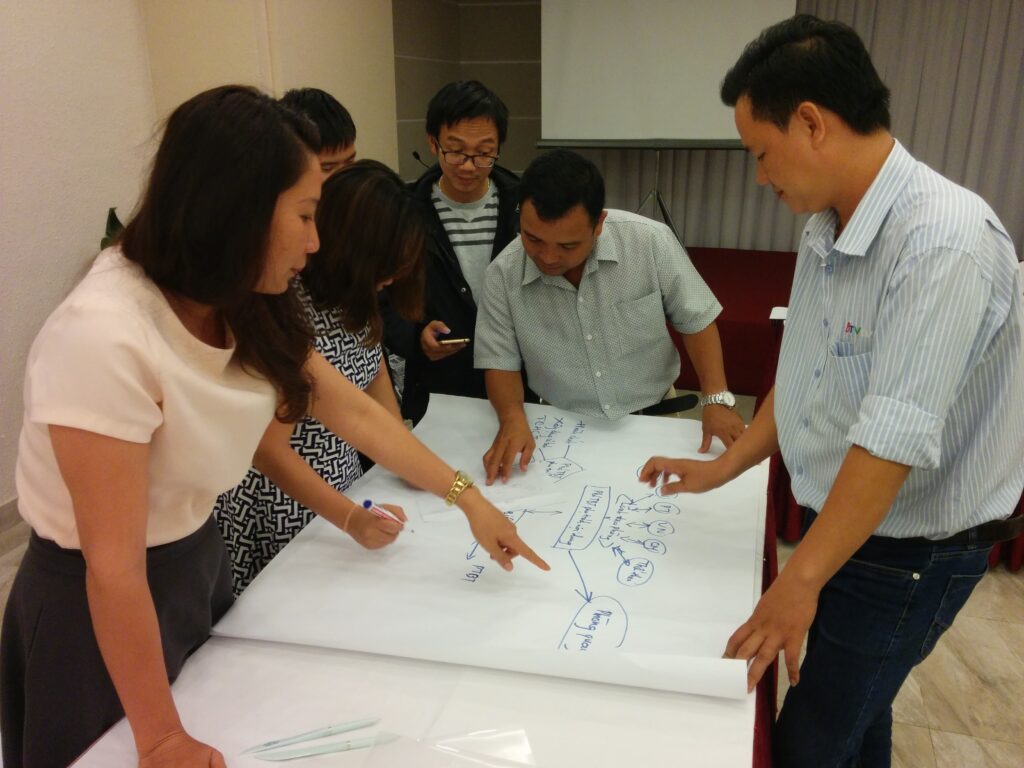
Big stories happen without warning. When they do newsrooms spring into action. Here we look at what happens next in order to ensure comprehensive coverage.
This scenario was set out by Bob Eggington in “Adopting the ‘big story’ approach”.
Some media organisations have a system for assessing what defines a big breaking news story.
Such a system can help editors decide how much editorial focus should be allocated to the coverage. You can find out more about this system by reading our module on how to create a story weighting system.
A big story might be a recurring story (such as seasonal flooding or earthquakes) or one-off, unexpected events (such as public disorder or industrial disputes) where there is significant local, regional, national, and international impact.
When a big story breaks
The first three points in this list apply to all stories, both big and small. Points four to 12 apply to a big story.
While immediate response reporters and crews focus on points 1-3, you might want to assign producers and researchers to look at points 4-12 in depth, if appropriate and if those resources exist.
- The story: This is fairly straightforward and is applied to all stories both big and small. We need to ask the basic journalistic questions of what, why, when, how, where and who.
- The facts: Again, this is common to all news coverage. Every detail must be examined, tested and proven to be accurate by confirming with at least two independent sources, except those filed by your own reporters or others you trust.
- Those affected: Personal accounts of how the story impacts on the lives of those involved is an essential element to all news coverage.
- The data: Where it comes from and whether it can be trusted.
- Responsibility: Who or what was responsible, and why did it go wrong?
- The promises: Made in the past and previous measures taken.
- The impact: Now and in the future.
- The consequences: Changes in lifestyle for some and what happens to those who can’t change.
- Accountability: Who knew and what preventative action could have been taken?
- The future: What changes need to take place?
- The follow up: Set a follow up date. Three or six months. List questions to ask.
- Engaging the audience: Public and expert debate to dig deeper and seek answers.
The list above, which is explored further in our module “Story development, ensuring all angles are covered” can’t be applied to every story; newsrooms don’t have the resources for that.
But if you apply the story weighting system for breaking news you will be better placed to decide what is a general news story and what is a big story.
Exploring all the editorial angles of a news story is only one part of the coverage.
If your news organisation has introduced a converged newsroom approach, which is always helpful, then allocating shared resources and setting out roles and responsibilities when a big story breaks is so much easier.
Summary
- A media organisation needs to have a system for dealing with a big breaking news story in order to fully inform the public debate.
- That system must set out the editorial, technical, and human resources requirements.
- A converged newsroom, with centralised command-and-control, with a multimedia newsgathering operation along with a shared planning unit will help streamline such a system.

Questions
- What is the primary role of planning in the news business?
- Describe the challenges that arise when a big story happens unexpectedly.
- Explain the importance of having a rapid response team in media organisations.
- What are the key components of a “big story plan”?
- How should media organisations handle communication during a big story?
- Discuss the role of the reporter as the “eyes and ears” of the audience in the context of a big story.
- Analyse the differences between traditional news media and “citizen journalism”.
- What strategies can be adopted for ensuring accurate and reliable coverage during a big story?
- Evaluate the significance of the production team’s role in adapting the news product for a big story.
- Sum up the overall approach to handling a big story highlighting the interplay between planning, reporting, and production.
Answers
- Planning is crucial for professionalism and good coverage in the news business.
- Big stories require immediate action, and there is pressure to provide quick, accurate information despite the lack of preparation.
- Rapid response teams ensure that media organisations can quickly mobilise resources and personnel to cover major incidents effectively.
- A big story plan involves ambition, organisation, and resource allocation, including people, equipment, and space in the news product.
- The text suggests using mobile phones, special WhatsApp groups, and backup plans like walkie-talkies for communication.
- Reporters provide valuable descriptive pieces that serve as the audience’s “eyes and ears” during the early stages of a big story.
- Traditional news media focuses on clarifying and establishing facts, while “citizen journalism” may lack this level of verification.
- Strategies include verifying social media content, using background researchers, and maintaining a coordinating figure for information flow.
- The production team adapts the news product to emphasise the big story’s importance, finding impactful visuals and facts.
- The approach involves thorough planning, quick and accurate reporting, and effective production to ensure reliable coverage.