
 For journalists, post-truth is a direct challenge to our mission to inform the public debate with verified facts. Here is how to handle post-truth content.
Post-truth refers to situations where emotional reactions and personal beliefs shape public discussion more powerfully than verified facts.
In journalism, it describes what happens when information becomes progressively separated from its factual origins as it circulates through social media, building up layers of subjective interpretation, emotional response, and unverified claims.
Social media distortion
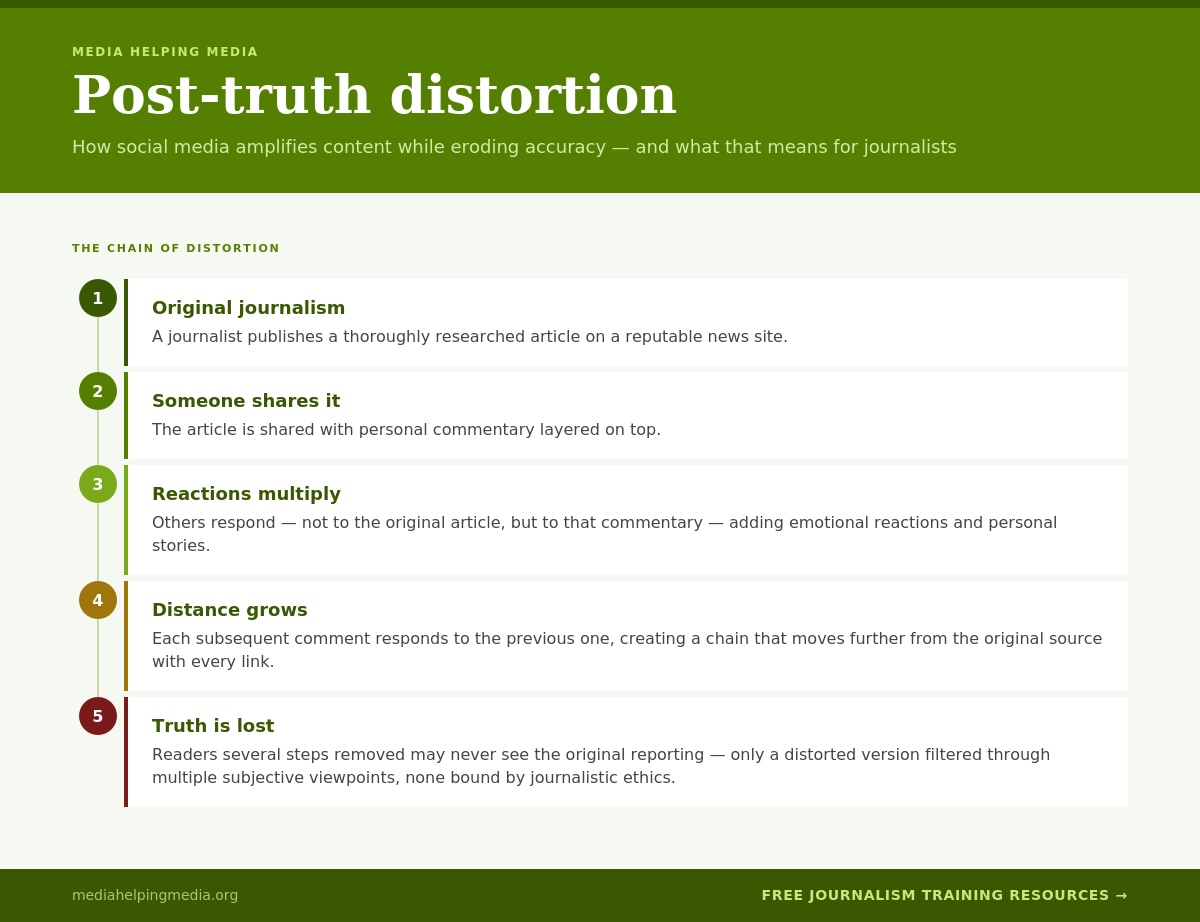
Social media’s structure creates a fundamental problem: as engagement increases, distance from the original source grows rapidly. Let’s look at the sequence of events:
- A journalist publishes a thoroughly researched article on a reputable news site.
- Someone shares it with their commentary.
- Others respond – not to the original article but to that commentary – adding emotional reactions and personal stories.
- Each subsequent comment responds to the previous one, creating a chain that moves further from the original source material with each link.
- Readers several steps removed may never see the original reporting, only a distorted version filtered through multiple subjective viewpoints, none bound by journalistic ethics.
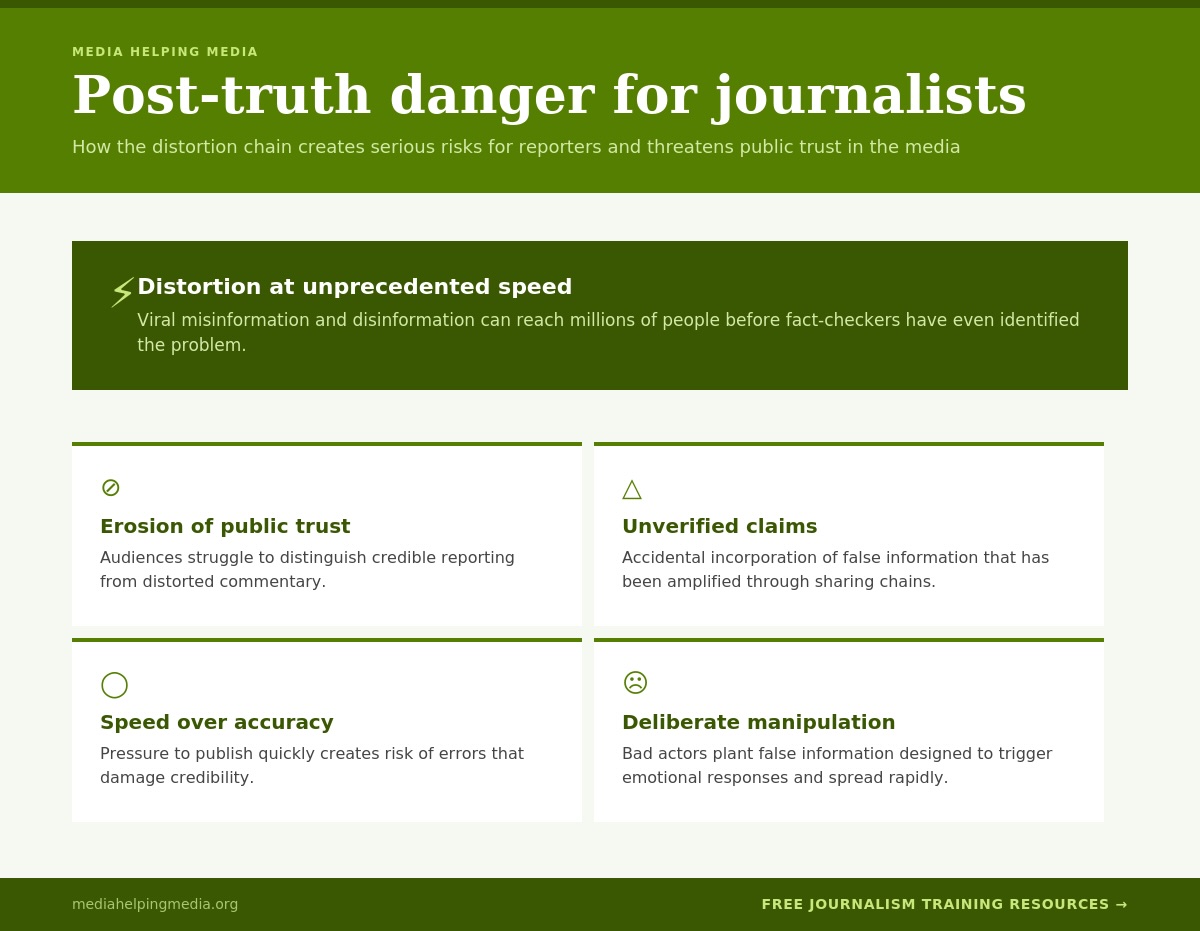
This distortion happens at unprecedented speed. Viral misinformation and disinformation can reach millions before fact-checkers have even identified the problem.
For journalists, this creates serious dangers: erosion of public trust, accidental incorporation of unverified claims, pressure to prioritise speed over accuracy, and manipulation by bad actors who deliberately plant false information designed to trigger emotional responses.
We have created infographics based on the information on this page which you are welcome to download and use in your training.
Warning signs of post-truth content
Journalists must recognise several key indicators that content has entered post-truth territory:
- Emotional intensity without evidence: When claims generate strong emotional reactions but lack factual support, the conversation has shifted from evidence-based to emotion-driven.
- Distance from primary sources: If you cannot easily trace a claim back to its original source, treat it with scepticism.
- Vague claims: Statements like “people are saying” or “many believe” without specific attribution are red flags.
- Resistance to contrary evidence: When corrections and fact-checks are dismissed or ignored, emotional investment has overtaken rational engagement with facts.
- Echo chamber amplification: Content circulating only within ideologically similar networks without critical examination operates in post-truth territory.
How to verify information
Journalists must follow clear steps in order to ensure accuracy:
- Trace content to its origin: Never rely on information discovered through social media without independently verifying it. Track claims back to their original source. If the source is unclear or inaccessible, treat the information as unverified regardless of how widely it has spread.
- Verify before amplifying: Even when correcting misinformation, journalists risk amplifying it. Before addressing false claims, ensure your verification is thorough and your framing makes the truth more memorable than the falsehood.
- Assess source credibility: Evaluate whether sources have relevant expertise, track records of accuracy, and potential conflicts of interest. Anonymous sources require additional scrutiny, particularly on social media.
- Cross-reference multiple independent sources: Confirm significant claims through multiple independent sources using different methods. If only one source makes a claim, acknowledge this limitation explicitly.
- Examine visual content carefully: Images and videos can be manipulated, taken out of context, or misrepresented. Use reverse image searches and verify the claimed context independently.
- Consult fact-checking resources: Established fact-checking organisations like Snopes, FactCheck.org, PolitiFact, or Full Fact have likely already examined widely circulating claims.
- Question your own biases: Be especially rigorous when verifying information that confirms your existing beliefs – you might have unconscious biases.
Essential guidelines for journalists
News organisations should implement clear protocols for engaging with social media content:
- Establish clear verification standards: Maintain explicit policies about what constitutes adequate verification before publication. These standards should not be compromised by competitive pressure.
- Create specialised roles: Employ dedicated social media journalists and fact-checkers who develop expertise in verification techniques and maintain awareness of current misinformation trends.
- Implement multi-step verification processes: Significant claims, particularly those generating strong emotional reactions, should undergo review by multiple journalists before publication.
- Develop transparent correction policies: When errors occur, correct them promptly and transparently. The correction should be at least as prominent as the original error.
- Educate audiences about verification: Occasionally make your verification processes visible to audiences, explaining how you confirmed key facts. This transparency builds trust.
- Resist false balance: Accuracy does not require giving equal weight to factual claims and baseless assertions. When evidence clearly supports one position, say so clearly.
- Maintain editorial independence from social media metrics: Editorial decisions should not be driven primarily by what generates the most social media activity. Virality and accuracy do not necessarily correlate.
- Cultivate expert sources: Develop relationships with credible experts in fields you cover regularly. These sources can provide rapid assessment of claims circulating in their domains.
- Document your process: Keep records of how you verified information, including sources consulted and reasoning behind editorial decisions.
By maintaining these standards even as information environments become more chaotic, journalists can help restore the connection between public debate and verified reality that post-truth dynamics have threatened to break.