
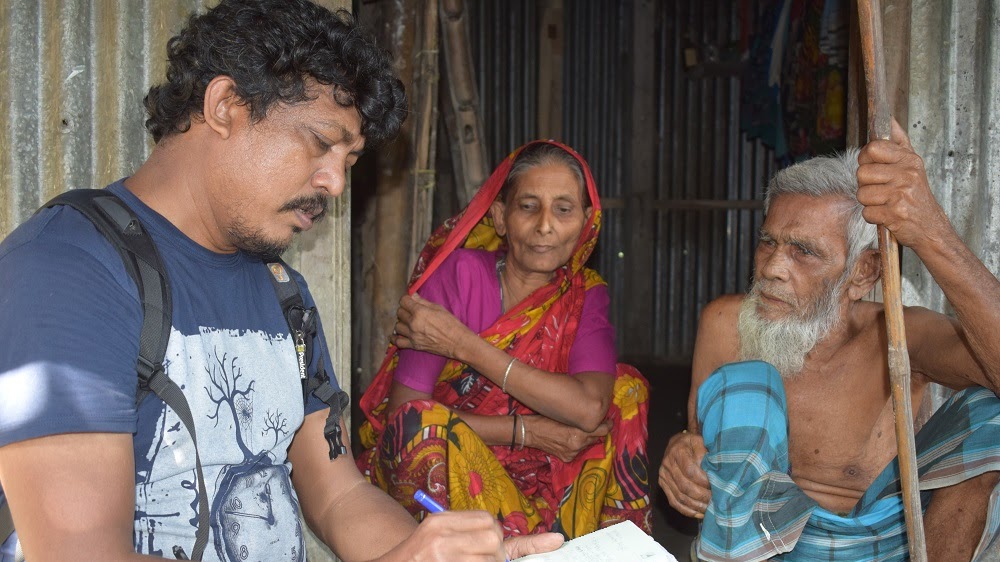
Climate journalist Rafiqul Islam Montu emphasises the importance of examining how people living in coastal areas are affected by global warming.
This is the second of two articles by Rafiqul. The first, Climate and coastal journalism – crafting compelling stories – looked at the practical aspects of covering stories that create impact. Here he focuses on the people affected.
Begin your stories by examining the impact of climate change on human life
Local journalists are essentially sitting on a goldmine of climate stories; one only needs to dig to bring them to light. Indeed, the coast of Bangladesh is the very birthplace of climate stories. The environment is rich with elements for such stories, yet they often go unnoticed by local journalists. To practise effective climate journalism, one must cultivate a third eye – a heightened sense of awareness.
A powerful voice from marginalised communities can truly bring a climate story to life. However, when we speak with such communities, we often miss out on their significant quotes. It is much easier for a local journalist to capture such powerful quotes, as they live in close proximity to the people.
A story idea is often more important than the story itself. A journalist who possesses a greater number of compelling story ideas is, in a sense, a richer journalist. Maintaining close ties with the field is instrumental in generating new ideas for climate-related stories. The more a climate journalist stays connected to the ground – observing and understanding the changes taking place – the more story ideas they will uncover.
When embankments collapse, tidal surges occur, or cyclones strike, local journalists are the first to reach the scene. While these may appear to be mere isolated events – and can certainly be reported as such – framing them as climate stories requires evidence.
Understanding science is crucial for climate journalism; in a way, climate journalism is also science journalism. It is the responsibility of a climate journalist to present scientific data to readers in accessible, simple language. One must build a bridge connecting scientific information, the voices of people on the ground, and the insights of local journalists. Climate journalism is not about concocting arbitrary explanations; it must be firmly rooted in evidence.
Focus on the impact on human life
When covering climate or coastal issues, it is essential to examine how these changes affect people’s lives and livelihoods. Below are several key areas that can help climate journalists develop story ideas:
1. Human Rights: Prioritising human rights is crucial when planning climate-related stories. The impacts of climate change often lead to human rights violations – a reality that becomes particularly stark during major natural disasters. Many families struggle to secure three meals a day, children are forced to drop out of school, and there is a widespread lack of nutritious food. Human suffering has intensified significantly. When seeking story ideas, I look at human rights issues; climate change acts as a driver for rights violations, forcing affected individuals to compromise on their fundamental human rights. It profoundly impacts people’s access to education, healthcare, food, and their overall quality of life.
2. Frequency of natural disasters: The frequency of natural disasters is a vital angle for climate reporting. In regions prone to frequent cyclones, human crises are particularly acute – offering a wealth of potential stories. Journalists can focus on high-risk areas, tailoring their narratives to specific locations. For instance, drought-prone and flood-prone regions each present distinct story angles.
3. Climate-driven changes: Climate stories can explore various environmental shifts – such as the drying up of rivers, the disappearance of forests, villages becoming uninhabitable, or vegetation perishing due to severe drought. Drought, in particular, can exacerbate food insecurity and disrupt access to essential sustenance. Investigate the specific environmental changes occurring on the ground. I personally monitor several climate-vulnerable areas in Bangladesh, which frequently serve as sources for my stories.
4. Displacement: Displacement is a critical theme for climate reporting. A growing number of people are being uprooted by various natural disasters; some remain displaced within the country, while many others have been forced to leave the nation entirely. Speak to displaced families for a climate-related story. These families are often forced to relocate, sometimes travelling by truck. Climate journalists should investigate where these people go and how they live; such situations often contain compelling climate stories.
5. Changing occupations: Losing one’s livelihood due to frequent natural disasters is a common occurrence – a crucial subject for climate journalism. Many farmers have been compelled to abandon their traditional work, and many fishers have had to give up fishing. Some farmers or business owners are forced to survive as day labourers. For instance, I have encountered a former owner of a prosperous shrimp farm who now earns a living by operating a boat – a scenario I observed in several areas of Bangladesh frequently struck by cyclones.
6. Economic crisis: Climate change exacerbates economic crises for affected families. These households face various needs, yet they lack the financial means to meet them. The constant need to relocate places an immense burden on these families. Many struggle to repay debts, which weigh heavily upon them – often to the point where repayment becomes impossible. How do these people survive? Climate journalism can help uncover the answers to such questions.
7. Adaptation initiatives: Climate storytelling can also focus on adaptation efforts. What adaptation initiatives has the government implemented? Have any policies been adopted to address climate change? What kind of adaptation measures are being taken by those affected by the climate crisis? To what extent has the use of fossil fuels been reduced? Are fossil fuel projects causing harm to the environment and to people? It is essential to examine these issues within the scope of climate journalism.
8. Seeking stories of solutions: Amidst the multifaceted climate crisis, there are stories of solutions – stories that are frequently overlooked. These narratives offer a path toward resolving the crisis; therefore, they should be prioritised. Even in places overwhelmed by crises, there are often individuals working to overcome these challenges. Perhaps these initiatives are leading some people toward a more comfortable life. Such initiatives can serve as the basis for stories about overcoming crises.
9. Field visits: There is no substitute for field visits for a climate journalist. It is impossible for a journalist to write effectively without witnessing the changes firsthand. Personally, I regularly visit areas vulnerable to climate risks, which often provides me with new story angles. Make it a habit to visit the field and speak to those affected. Stay updated on the overall situation on the ground; this will provide you with fresh ideas for climate-related stories.
10. Prioritising those on the front lines: Women, children, and ethnic or minority groups are often the first to be affected by climate change. It is crucial to tell stories about those who are on the front lines of this crisis. Despite being the most vulnerable, these individuals are rarely the focus of our reporting. I make it a priority to center my climate stories on these front-line communities.
11. Gender focus: A gender-focused approach is crucial for climate or coastal journalism. Women are disproportionately affected by climate crises; they are often on the front lines during disasters and face numerous challenges. Yet, they frequently remain overlooked in media coverage and climate discussions. Journalists should prioritise stories that incorporate a gender perspective.
12. Reading climate stories and staying updated on international issues: It is essential to read both national and international climate stories and stay well-informed. Keep an eye on global climate issues and look for ways to connect them to the challenges facing your own region.
13. Biodiversity: The loss of biodiversity is a major crisis. Due to the impact of climate change, biodiversity is disappearing in many places – creating crises for human populations and increasing risks to livelihoods. Climate journalists can explore stories centred on this issue.
Overcoming challenges
Almost every coastal district contains islands and chars (shoals/riverine islands), and there are numerous areas prone to erosion. I know of many critical, hard-to-reach areas where no journalist has ever set foot – places that government officials, private-sector representatives, and elected public officials have also failed to visit.
How are the people living in these areas faring? Gathering information firsthand in such remote, marginalised regions naturally requires significant time and financial resources. Nevertheless, for the sake of their own professional effectiveness, journalists working in coastal regions should strive to gain a thorough understanding of the areas they cover.
Knowing a region well makes the process of writing any report much easier; furthermore, visiting a location in person transforms the very nature of one’s writing, allowing for a more accessible presentation of information to the reader. Almost every coastal district contains areas that are, to varying degrees, difficult to access. If information from these places is to reach policymakers, it is the coastal journalists who must take the initiative to focus on them.
Certainly, there are challenges – gathering information from remote areas is inherently difficult. In fact, journalism itself is a profession defined by challenges; coastal journalism, in particular, is about moving forward while navigating risks and obstacles.
In the district of Bagerhat – situated along the western coast, adjacent to the Sundarbans – lies Dublar Char, an area comprising several smaller chars (shoals/islands). During the winter season, thousands of people gather there, primarily for the production of shutki (sun-dried fish), while others rely on the area for their regular livelihoods.
However, a journalist cannot simply decide to go there to gather news; because the area falls within the Sundarbans, permission from the Forest Department is required. Moreover, there is no established transport to reach these chars. Similarly, if one looks toward the island district of Bhola, one sees a landscape dotted with countless chars. How many journalists have actually managed to visit these islands to report on them? Many of these islands remain entirely unknown to the vast majority of journalists.
Looking ahead
The climate crisis is intensifying globally, and the importance of environmental and climate journalism is growing within major media outlets worldwide. Countries like Bangladesh are particularly vulnerable to the impacts of the climate crisis, with coastal and marginalised communities standing on the front lines. In the future, nations like Bangladesh will require more climate journalists – not just in name, but in practice. Therefore, it is imperative to strengthen preparations for climate journalism.
Summing up
Treat the local patch as a goldmine: Local journalists are close to the story, so they are best placed to spot climate stories and capture strong quotes. Develop a heightened awareness of what is changing around you.
Value story ideas: Staying close to the field is the best way to generate them. The more you see and understand on the ground, the more ideas you will have.
Back every climate story with evidence: A cyclone or a collapsed embankment is an isolated event until you can show the climate link. Understand the science and explain it in simple, accessible language.
Start with the impact on people: Look at how climate change affects rights, livelihoods, jobs, debts, homes and food. Displacement and changing occupations are rich sources of stories.
Put those on the front lines first: Women, children and minority groups are often hit hardest but rarely feature in coverage. Make them, and a gender perspective, a priority.
Report solutions and adaptation as well as crises: Ask what governments and communities are doing, and tell the stories of people who are overcoming problems.
Read widely and link local to global: Follow national and international climate coverage, and look for ways to connect it to your own region.
Go where others do not: Remote chars and islands are hard and costly to reach, but visiting in person improves your understanding and your writing. It also gets those stories to policymakers.
Related material
Climate and coastal journalism – crafting compelling stories
Covering climate change
Causes of climate change
Climate change – language
Climate change glossary