
 Free trauma support tool for newsroom managers helping field and desk staff handle work-related stress and the impact of traumatic events on mental health.
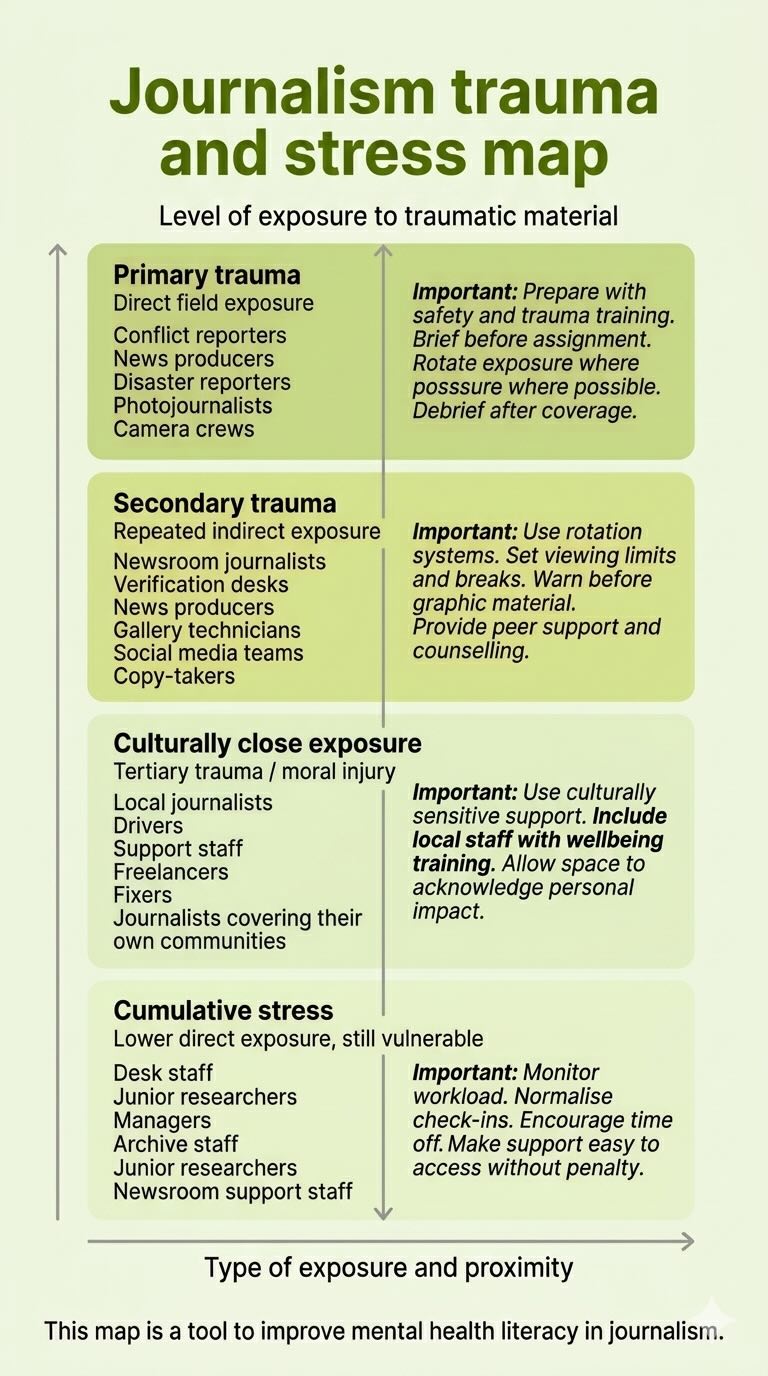
This tool, in the form of an infographic (below), maps how trauma and stress can affect journalists in different ways. It is designed to help newsroom managers, staff, trainers, and students recognise the risks, understand where they occur, and think about how to prepare for them.
The map is based on several articles in our Managing trauma and stress in journalism section, where we have training materials designed to help journalists cope with the impact of covering traumatic news events.
Trauma in journalism is not limited to frontline reporting. It can happen in the field, at the desk, through screens, and when covering one’s own community.
Types of trauma
Journalism can expose people to:
- Primary trauma: through direct field reporting — this is most likely to affect reporters, photojournalists, and camera crews who witness violence, disaster, or human suffering first-hand. See our article: Journalism, trauma and stress.
- Secondary trauma: through repeated exposure to graphic material — this often affects editors, verification teams, social media staff, gallery technicians, and copy-takers who must repeatedly view distressing material. See our article: Secondary trauma in the newsroom.
- Culturally close exposure: when news staff report on their own communities — this can be especially hard for local journalists, freelancers, and fixers whose work is tied to family, identity, language, religion, or community. See our article: Journalism trauma: why cultural context matters.
Each form of trauma can affect people differently, but all of them can take a serious toll if they are ignored.
The infographic below condenses much of the information in the articles mentioned above. Use the tool below to identify where trauma might arise, who is most at risk, and what support can be put in place before problems escalate.
Summary
Trauma in journalism is not limited to frontline reporting. It can happen in the field, at the desk, and through screens — and it can increase over time as stress builds. Newsrooms can reduce the risks by preparing staff before assignments, limiting repeated exposure, encouraging debriefing, and making support available as a natural part of the working environment.
Monitor workload, encourage time off when needed, and make support part of the newsroom culture.
A healthy newsroom recognises that care is part of professional journalism. When people are supported properly, they are better able to do their work safely, clearly, and with resilience.
Related material