 Use this tool to identify which groups shape climate policy, which are most affected, and which voices are missing from your climate change reporting.
The material for the map below is taken from articles in our Covering climate change section. All were created by Media Helping Media.
The tool is designed to help journalists in their source selection, as they try to:
- find out who the main influencers are,
- identify those with vested interests,
- understand who is most affected,
- reach those who are unaware or ill-informed.
How to use this tool in your reporting
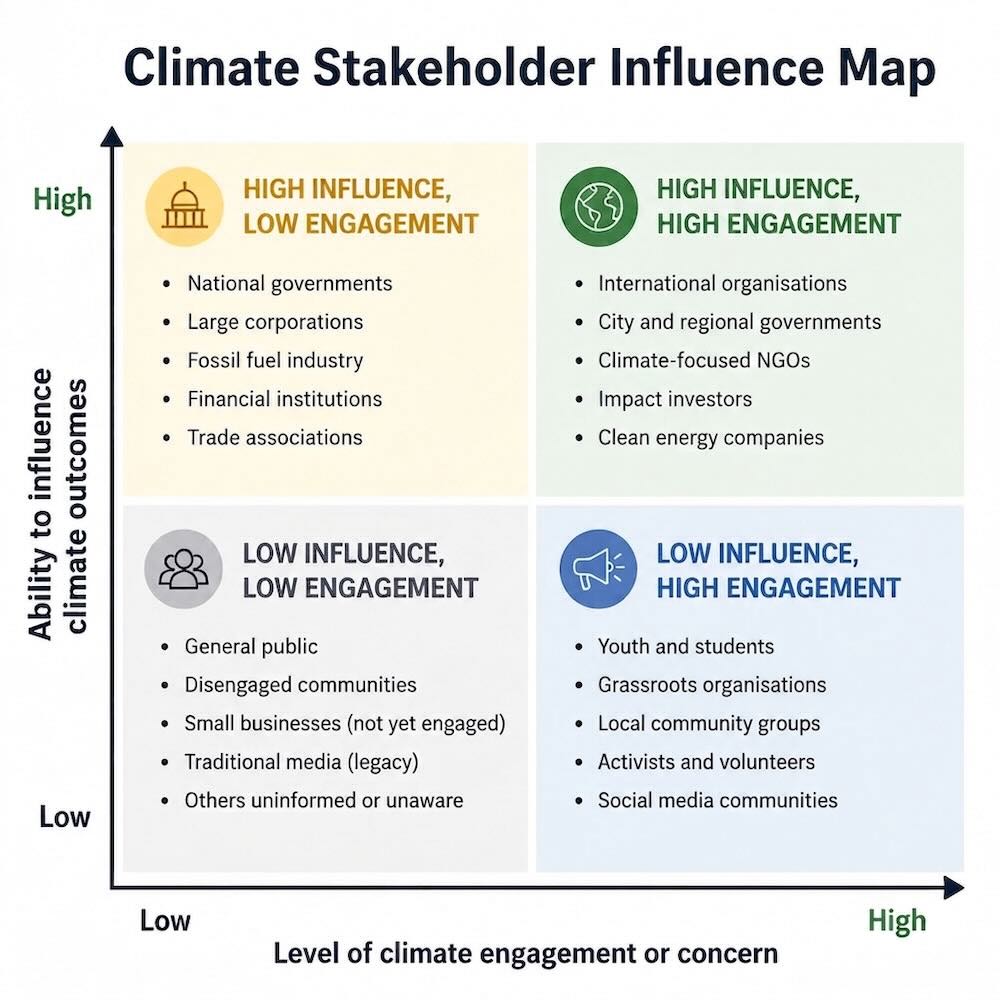
You will notice that the Climate Stakeholder Influence Map above has four boxes. Each includes stakeholders.
A stakeholder is any person, group, or organisation that has a vested interest in, or is affected by, the actions, decisions, and success of a business, project, or an initiative.
On the left you will see a line with the words ‘Ability to influence climate outcomes’ with the word ‘Low’ at the bottom and ‘High’ at the top.
Below the graphic you will see a line with the words ‘Level of climate engagement or concern’, again with the word ‘Low’, this time on the left, and ‘High’, on the right.
It’s important that you use the four boxes in the influence map to jot down those sources and voices that are directly involved in the global warming story in the location you are covering.
Media involvement
You will notice that traditional media is in the low category in our map – this might seem unfair if you are living in a region where the media is campaigning on climate change and global warming issues.
But the point is clear; the media needs to do more to cover the issue of global warming and climate change, and engage more with the audience. And this is the purpose of this graphic – to help you do just that.
What you should do with this influence map
As a climate journalist, you need to take the map above and rework it for your own region and circumstances.
Copy our graphic then fill in each of the four squares with groupings relevant to your region. Make this a personal tool for your future newsgathering and news production when you are covering climate change.
Localising climate stakeholders and their involvement
Once you have filled in the boxes, do the following:
- Source diversity and representation:
- Use the four boxes to check for any source blind spots in your coverage. See our article on Developing and handling news sources.
- If your reporting consistently draws from the top-right (high influence, high engagement) group only, you will probably be missing the perspectives of those who feel the direct impact of climate change in the bottom-right (low influence, high engagement) box.
- Mapping the power dynamics:
- When investigating a climate issue, use this map to visualise who is driving the policy conversation versus who is being affected by it.
- This will help you identify which sources are likely to benefit from the way things currently are (high influence, low engagement) and will also help you see which voices are being excluded from the decision-making process (low influence, high engagement).
- Reframing the available information:
- Journalists often focus on the key players who make the most noise.
- Use this tool to focus your coverage toward the low influence, high engagement groups, who are often the ones pioneering local solutions, adapting to change, and providing the most compelling, human focused stories about climate impact.
- Accessible language:
- Climate change coverage is often heavy in jargon, cliché, and journalese. Be aware of this, particularly when writing pieces.
- Try to unpick the complexity of the language used so that it resonates with those most affected. See our Climate change glossary for simple explanations of some of the most frequently used terms.
The aim of this tool is to enable journalists to identify the sources and voices they need to include in order to cover climate change responsibly and thoroughly. You will need to make sure that the lists in the four boxes are relevant to your own region. Keep in mind that the role of those involved will likely change depending on whether you are covering local flooding, national energy policy, or international climate finance. Always ask: In this specific story, where does this source fit, and whose voice is missing?
Related material