 Covering news often leads journalists to experience trauma and stress. Peer support offers a safe space to talk to colleagues who understand.
When trauma strikes in the field or the newsroom, the first line of defence isn’t always professional counselling – it could be the colleague sitting at the next desk.
Strengthening journalism through peer-led trauma support
Peer support is a low-cost, high-impact strategy that can help reduce the risks of emotional and psychological injury in high-pressure reporting environments.
This tool outlines how to create a positive newsroom culture that provides help for those affected, and offers guidance on personal post-assignment care.
It’s based on a presentation by Swedish psychologist Philippa Borgh. Philippa is a mental health trainer and coach who has extensive experience training journalists with the Fojo Media Institute.
What peer support in journalism means
Journalists who face trauma and stress can benefit from the support of colleagues who have had similar experiences.
It’s not therapy — it’s a voluntary conversation based on recognition, openness, and practical care, between people who understand the pressures of the job, including reporting from conflict zones, covering violent events, exposure to disturbing social media footage, working under tight deadlines, or dealing with intense and unsettling experiences alone.
Peer support does not replace professional help, but it can be an important first step — or a parallel form of support in everyday life.
The causes of stress in journalism
Journalism and in particular newsgathering, is a stressful job. Not only are you likely to cover stories that are traumatic, you and your colleagues will always be working under the stress of being accurate, getting it right, and filing your stories on time.
Journalism is all about deadlines and uncovering stories that, had it not been for you, the world would never have known. That is a massive responsibility. So it’s no surprise that stress is common amongst everyone working in the news business.
The stress cone
Stress affects how the brain works and how we react. The more stress there is, the less access we have to the brain’s functions that help us analyse, understand, and respond with sensitivity. And, of course, analysis, understanding, accuracy, impartiality, and integrity are at the heart of everything a journalist does.
In the diagram below, the brain is pictured as a cone with the impact of stress set out in terms of how the mind responds to different levels of stress.
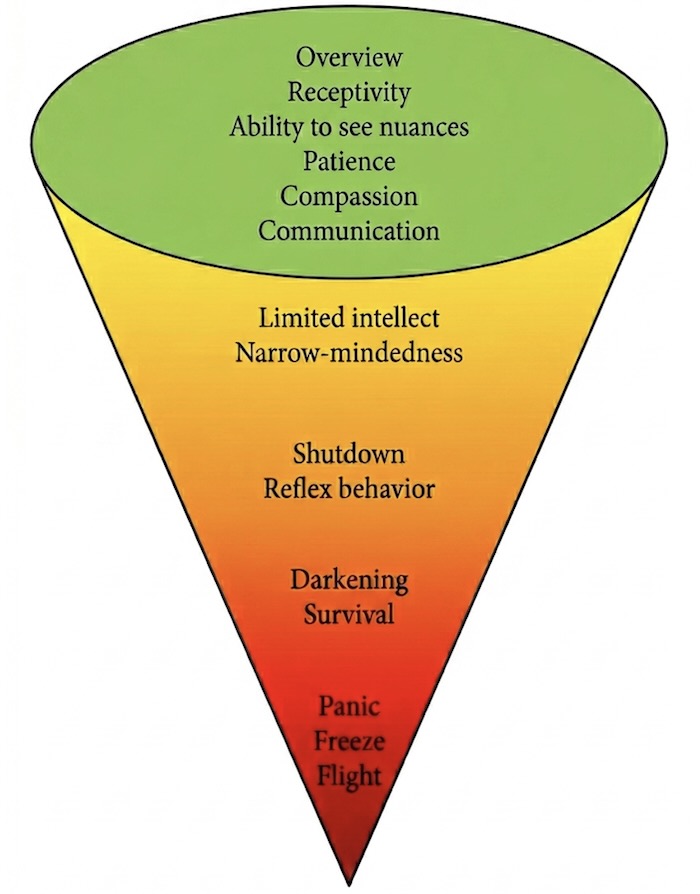
- Green zone: This is when we are managing normal newsgathering stress. We think clearly, communicate well, and can manage situations. We communicate properly, are receptive to new information, are able to take the overview in terms of the story’s importance, can see the various angles that need to be covered, and we operate with compassion, empathy, and understanding
- Yellow zone: Stress hormones affect the brain. Interpretations become black-and-white, we become less resilient, and we react more quickly. In terms of newsgathering, the fact-finding options and story angles might be reduced — we start to lose the bigger picture.
- Red zone: The body focuses on survival. We react instinctively, hearing and vision narrow, and thinking capacity decreases. The journalist is no longer capable of operating in a professional, logical, co-ordinated manner.
It’s important to understand that digital or emotional stress, such as hate and harassment, can activate the same defence mechanisms as physical threats.
Your role as a peer mentor
If a colleague is under stress or dealing with trauma, your job is to help them feel safe enough to talk. That means listening without judgement, not rushing to solve the problem, staying calm, giving the person time, using short and clear questions, and helping them feel heard. Below are some of the qualities needed to help a colleague who is struggling.
Listen actively
- Encourage: Show them you understand. Nod, use small sounds to show you are with them, say “tell me” or “go on” when needed.
- Reflect: Keep restating what the other person has said in your own words. Reflect facts, feelings, and understanding. Offer confirmation.
- Summarise: Recap from time to time, when the topic changes, at the end of a conversation, or when starting the next conversation. Keep it brief and do not take over.
- Ask: Use open questions when possible. Closed questions can be answered with yes or no. Ask because you want to help, not to steer the conversation.
What to look out for
There are four important areas of mental ill-health: depression, PTSD, anxiety, and thoughts of suicide.
- Depression: Depression is more than feeling low. It is an illness that affects emotions, thoughts, and the body. It may involve a lack of energy, feeling hopeless, self-criticism, poor sleep, changes in appetite, and difficulty managing everyday life.
- PTSD: Post-traumatic stress disorder can arise after experiencing or witnessing difficult events. It may involve flashbacks, nightmares, avoidance, increased alertness, and physical stress reactions.
- Anxiety: Anxiety is more than everyday stress. It may involve strong worry, panic, heart palpitations, breathing difficulties, and fear of losing control.
- Suicidality: Suicidality means thoughts, plans, or preparations to take one’s own life. Warning signs could include hopelessness, feeling like a burden, or putting affairs in order as if preparing to disappear.
Understanding reactions
- Mentalisation is the ability to understand your own thoughts and feelings, and to consider what others may be thinking or feeling. It helps us interpret social signals, understand why people act as they do, and manage conflict more constructively.
- Emotional contagion is when we unconsciously take on the emotional state of others. It can spread through tone of voice, body language, facial expressions, and vocal cues.
Simple reflection tool
Reflecting on an experience is a helpful way of coming to terms with it. Use these four steps to help someone who has suffered from a difficult experience.
- Describe: Encourage them to tell you what happened. It might be difficult to recall traumatic memories but it also might help them face up to what they have experienced.
- Interpret: Help them to talk through what happened so that they and you have a better understanding. It is important for them to express what they think and feel about the situation.
- Reflect: Discuss why they feel and think the way they do about any traumatic event they have witnessed and any stress they are feeling. What did the experience mean for them? How can they use this insight now or in the future?
Supporting recovery
Recovery from trauma and stress in journalism is different for everyone. But it is something the individual needs to do, not just hope will happen. Short breaks several times a day, recovery activities suited to the individual, and training in the ability to recover can improve health and performance.
- Lack of recovery is a bigger problem than stress itself.
- Recovery does not happen by itself.
- Recovery can be trained.
- Recovery should be meal-like rather than holiday-like.
- Contrast creates recovery.
- Recovery is highly individual.
- Small efforts can have rapid effects.
Two paths to resilience
The two paths to resilience are coping strategies and evidence-based crisis support.
- Coping strategies
- Active coping: the person needs to face the problem instead of avoiding it.
- Social support: their family, friends, and colleagues can be a great help.
- Optimism: looking ahead with a positive mindset helps problems feel more manageable.
- Meaning: understanding helps people see value and lessons in adversity.
- Exercise: helps regulate stress and improve well-being.
- Evidence-based crisis support
- Safety: the person needs to feel the threat is over.
- Calm: clear communication and reassurance help.
- Trust: confidence reduces helplessness.
- Social support: feeling seen and understood matters.
- Hope: helps people believe life will return to normal.
Action plan for newsroom managers
If you are helping to build a peer support system for journalists, these are the key questions to ask:
- Needs: What needs exist in the organisation, or in the context in which you operate if you are freelance?
- Purpose: What can an organised peer support system contribute, and is there anything to be cautious about?
- Getting started: What needs to be done to get started, and what is the first step?
- Roles: Who needs to do what?
- Practicalities: How can the support be organised in practice?
- Timetable: When should different parts be implemented?
- Building trust: How can trust and safety be created in the system?
- Assessment: How do we follow up and assess whether it works?
- Development: How can we develop and adapt the support system over time?
- Inclusion: How to ensure the support system involves all staff.
Consider whether you need to create a Journalist Wellbeing Charter to act as a tool for protecting the psychological wellbeing of staff who encounter trauma and stress.