Issue-led journalism produces original, exclusive reporting — stories that shape public debate, hold power to account, and build lasting trust with audiences.It’s a style of reporting where the journalist starts with a social issue they want to explore, rather than responding to a breaking news event.
- Issue-driven: the journalist identifies an issue such as health, education, transport, then seeks out stories, data, and voices that illuminate it.
- Proactive: instead of covering what just happened, the journalist goes looking for the story. See: In-depth proactive journalism.
- Data and research: because there’s no single news peg, the journalist assembles the context using statistics, studies, and expert contributions. See: Data journalism.
- Human interest: complex issues are partly explained by including the voices of those involved and affected. See: Including the human angle in news.
- Well-planned: issue-led journalism needs to be woven into your news organisation’s forward planning department and made available on every platform. See: Forward planning for a media organisation.
Examples of issue-led stories:
- A reporter decides to investigate a local housing shortage and finds families to profile, rather than waiting for a housing story to break.
- A news outlet runs a series of features on hospital waiting lists, commissioning polls, interviewing experts, and researching the causes and possible solutions.
Issue-led journalism also enables a news organisation to produce hundreds of original news stories a year, all from existing resources. It’s just a matter of changing focus.
How issue-led journalism works
When I have been carrying out journalism training around the world, I often start the session by asking participants to list the issues that their audience is most concerned about.
And, interestingly, whether I ask the question in Vietnam, Zimbabwe, Lebanon, Guatemala, or Serbia, the answers are similar. Below is a list of common responses.
- Jobs
- Homes
- Health
- Education
- Crime
- Environment
- Security
- Future
- Technology
- Transport
Expanding the list into original news stories
In some countries the issues will be in a different order, but they almost always feature most if not all of those listed. The job of the journalist is to cover these issues, not only as stories break, but before and after they happen.
Notice that politics is not in the list. It’s always mentioned by course participants – as is the issue of corruption – but we soon agree that politics and corruption are involved in every issue in the list, and so they don’t require their own category for the exercise of deciding what most concerns the target audience.
Searching for angles
So, now we have the list, we need to be aware of the background to these issues, the story angles that spin off covering the news, and then develop that background knowledge — the context — so that we can report authoritatively when required. Below is a slide from a course I often run about issue-led journalism.
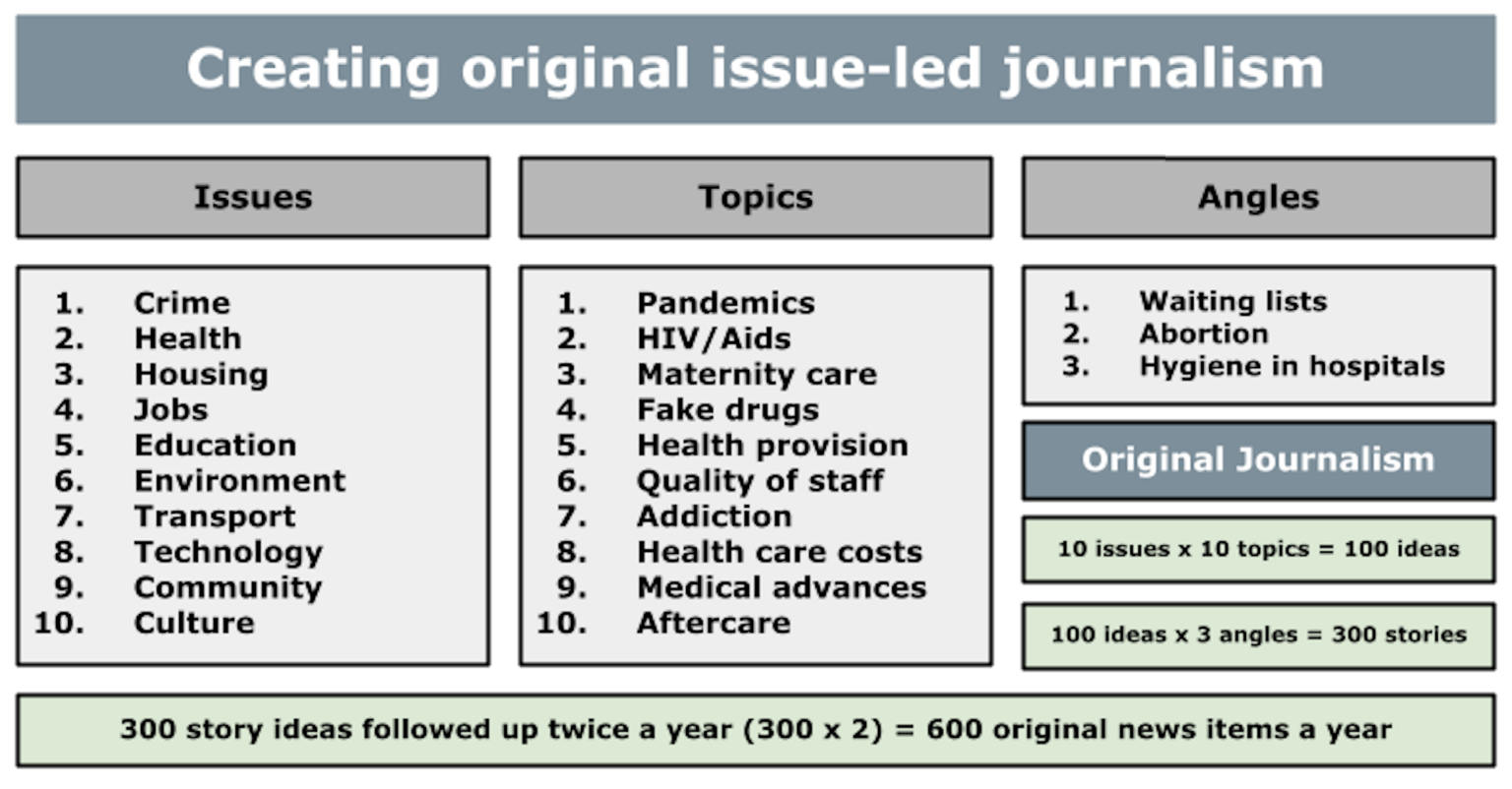
The graphic above shows how adopting issue-led journalism can lead to the creation of 600 original news items a year. That is more than 10 exclusive news stories a week. Here is how it’s done.
Introducing issue-led journalism
- Issues: List the 10 most important issues for your audience.
- Topics: Take each of the 10 issues then make a list of 10 topics that relate to each issue.
- Stories: Take each topic then think of at least three related stories.
And that’s it. Feed this into your forward-planning desk so that it is woven into the daily news meeting as a series of prospects, all exclusive and all original.
- Exclusive: This is about ownership and access. It means a reporter or news outlet has secured an interview, been leaked documents, or has uncovered a breaking news story that no other competitor currently has. It is a competitive advantage designed to break news and inform the public debate.
- Original: This is about ingenuity and effort. It refers to specialist reporting, in-depth investigations, or unique angles on an issue. While other news outlets can — and often do — follow up on or report on what you are working on, the original piece is the foundational, first-hand reporting that sparked the wider coverage.
Involving the whole newsroom
When I have helped news organisations introduce an issue-led journalism strategy, I have always broken it down so as to involve the whole newsroom.
- Step one – identifying the issues: Draw together senior editorial figures. It doesn’t need to take long, certainly no more than an hour of their time. You will find they quickly agree on the 10 most important issues facing their audience.
- Step two – identifying the topics: Hand the list of 10 issues — which has been drawn up by the senior editorial figures — to news and programme producers to flesh out.
- Step three – finding the stories: Hand the list of 10 issues and 10 topics to the reporters then ask them to come up with at least three story ideas on each topic.
Issue-led journalism is all about story development and ensuring that our journalism is proactive and relevant to the lives of our audience. And, because responsible journalists follow up on the news they have covered, that could result in 600 original news items a year.
This strategy offers newsrooms the chance to create a unique editorial proposition and a market differential, which links the journalism we create (the news we cover) to the financial sustainability of the media house we work for, as well as ensuring that the journalism we produce informs the public debate.
Related material