The news changes fast. Journalists must constantly update stories to ensure accuracy, provide context, and stop fake news and post-truth reaction taking over.
Journalism is a continuous process of uncovering facts and keeping audiences informed in real time. It involves digging for related background information, and adding new details as the story develops. As soon as journalists publish anything in print, online, or on air, the information we deliver is likely to be out of date.
Updates come in two main forms.
- New developments: new information that has been gathered since the original story was published.
- Background research: existing information that has been uncovered as a journalists investigates the facts behind the story.
Here we look at the two forms of added-value information that keeps a developing news story fresh, relevant, and up-to-date.
How newsrooms managed archives in the pre-digital era
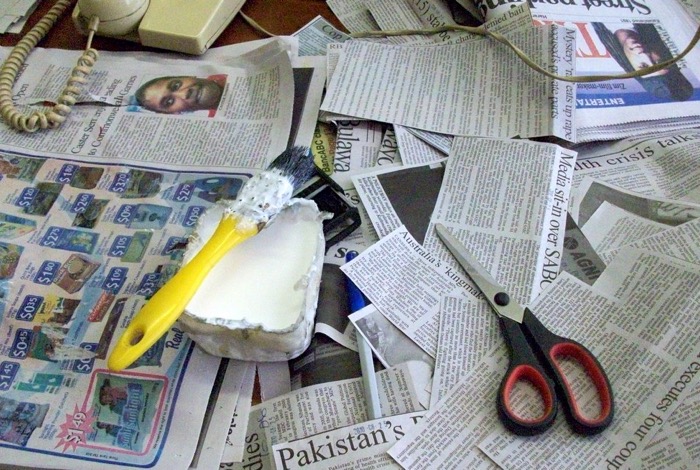
I started my career in journalism as a newspaper reporter. In the corner of the newsroom there was a desk with a pair of scissors and a pot of glue. You can see the sort of set up in the image above. The photograph was taken in the newsroom of The Chronicle in Bulawayo, Zimbabwe, where I was doing some journalism training in 2010.
The scissors are for cutting out articles from the day’s newspaper. The glue is for sticking them on a sheet of paper with the date and key words at the top. They were then filed in boxes stored on massive shelves. This was the newspaper’s archive. Every news story covered would involve a visit to the archive for background and context.
The same was true at my first newspaper, The Southport Visiter (correct spelling). We had a ‘diary-and-file’ area where our cuttings were kept. There was a line of metal filing cabinets with alphabetically-labelled drawers. Then there was the diary, a shared book where all important follow-up dates had to be recorded. It was every reporter’s responsibility to ‘diary-and-file’ their work.
This historic process indicates two things about journalism best practice at the time:
- Immediate archiving: The daily newspaper is – as soon as it comes off the printing press – archive material.
- Essential background context: It’s also essential material for background information. It is a document of record that will provide valuable information in the future.
At the BBC we had a department called News Information where journalists could order background information from a huge archive. All was old news, but it was also valuable news when it came to piecing together an update or covering a breaking or developing story about a topic that had been in the news previously. It was essential for adding context.
The discipline of the hourly broadcast refresh
My first job at the BBC was at the local radio station in my hometown of Liverpool, England. A few weeks after working as a reporter, getting out and about covering news stories and interviewing locals, I was asked to compile and read my first news bulletin.
I thought it went well and returned to the newsroom feeling quite proud of myself. I was about to make a cup of tea, sit down and put my feet up when the news editor came over and told me to rewrite everything. “We don’t deal in old news,” he said.
Even wonderfully crafted parts of my script that I felt couldn’t be improved had to be refreshed. I was struggling to think of any ways to update the material as the next hourly news bulletin approached.
My news editor, Ken, told me to get up. He sat in my chair, took over my typewriter (we didn’t have computers in those days), and, with a cigarette hanging from the corner of his mouth, refreshed the whole five-minute news script in what seemed like seconds.
I was told to put in fresh calls to find out new information. It wasn’t as big a deal as I thought. But it was essential work. The next bulletin was fresh, relevant, and, most importantly, updated.
The lesson forced me to think through all the elements in the story and how they could be developed. It forced me to be a journalist and not just a news reader.
The 1981 radio bulletin checklist for news updating
There was a strict checklist for tasks at Liverpool’s Radio Merseyside in 1981 to ensure content never stagnated:
- Check for updates: Write the bulletin and underline any facts in the story that need to be checked for updates.
- Rewrite immediately: Rewrite the bulletin immediately after leaving the studio and before thinking about making a cup of tea.
- Refresh the entire script: The rewriting should include both the introduction script and the piece itself.
- Re-voice out-of-date audio: If necessary, get any audio reports re-voiced if the information is out-of-date.
- Prepare alternative clips: If you are using an audio clip of someone in the news, always have a selection of at least three alternatives available: one talking about what has happened, another about what they intend to do about it, and a third about what will happen next.
- Limit audio repetition: Never run a voiced report or an audio clip more than three times, which would include the main morning, lunchtime or evening bulletins.
- Follow up with sources: Suspect that all those mentioned in the news bulletin might have fresh information to share after having heard your bulletin. Call them and see what has changed.
- Audit time references: Make a note of all the times and dates mentioned in the bulletin to ensure the newscast is not dated.
- Run continuous check-calls: Put in another round of calls to police, fire, ambulance, and anyone who features in a developing news story, such as union leaders, bosses, councillors, activists, sports personalities etc.
In other words, never repeat a bulletin hour after hour. It’s almost certain that, if you do, you will be delivering old news — and the motto was that old news is no news.
Updating news is timeless
We had a similar philosophy when we launched BBC News Online in 1997. We were continually checking for new developments, updating stories, and republishing the site.
The early training in print and broadcast that most of us in that BBC online newsroom had gone through had prepared us well for the BBC’s first move into 24-hour rolling news.
It’s interesting how some of those basic principles of journalism best practice appear to be timeless. And now we have the luxury of a steady stream of updates online — some trustworthy and some not — providing live coverage of events.
Many news organisations have adopted the online chronological approach to news. This means covering a story as a running sequence of time‑stamped updates, so audiences can see what is new since they last checked, rather than only seeing a single, finished article.
The problem with that format is that the longer the update grows, the further the reader is from the original source of the material, making it harder to read the context behind the development/event. To get around this, responsible news organisations often feature a link back to the original story so those following events can better understand when, where, why, and how the news item first broke as well as who was involved and why it happened.
But this ongoing reference to the background and context of the original story is often missing when news is shared on social media where emotional and subjective reactions to the original news take on a life of their own. This leads to a post-truth trap where emotional responses to events take over from the events themselves. Facts get lost in the quick-fire responses, and the chatter and noise of ill-informed reaction takes on a life of its own, eventually becoming more amplified than the original incident that began the news process.
Which means that journalists have a responsibility to continually rework and update the news we are providing so that all the new elements (reactions and new perspectives) are included, while also ensuring that the essential facts that began the news flow are not forgotten but are also included and updated where necessary.