
Failure to recognise and keep up with changing audience behaviour is one of the most common reasons why media organisations struggle.
Continually monitoring how content is being consumed by the audience, and responding quickly to technological and market opportunities, is essential.
The four scenarios
The four attitudes to digital news production, newsgathering and news dissemination are digital denial, digital parallel, digital enhanced, and digital first.
Some media managers refuse to accept that there is a digital audience which needs to be served.
Others become digital evangelists who make production decisions that are not always backed by firm business logic.
Some prefer to focus on the old ways of working, and give little consideration to the digital audience and market.
Of course, each newsroom will have a different approach, based on local business logic, legacy issues, and political and cultural factors.
However, one fact is clear: without a converged or integrated newsroom, it’s difficult to make the most of the digital opportunities that might exist.
And although the essential elements of newsroom convergence might be similar for all news organisations, each solution has to be crafted according to local needs, based on solid business data that informs and justifies every suggested change.
Please refer to our article “Creating a converged news operation”.
Let’s look at the four typical scenarios. As you do, try to work out which scenario best describes your media organisation.
Digital denial
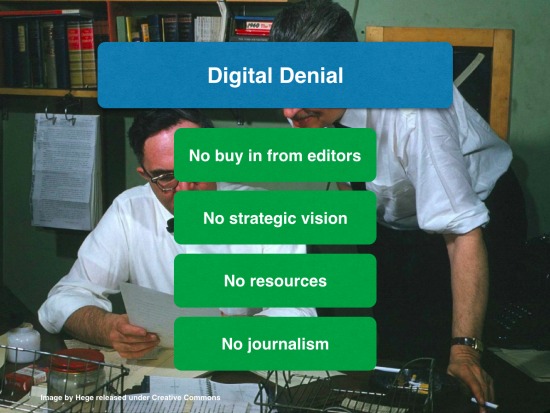
- This is when there is no clear vision from the senior management about why newsroom convergence or integration is important, which often results in no buy-in from senior editors and resistance from many.
- There will have been a failure to invest in the digital technology required to produce content for use on multiple platforms or devices, and there will be little awareness of audience needs and changing audience behaviour.
- Management and staff are stuck in a time warp, bogged down with legacy issues, doing what they have always done, and living in a false comfort zone.
Digital parallel
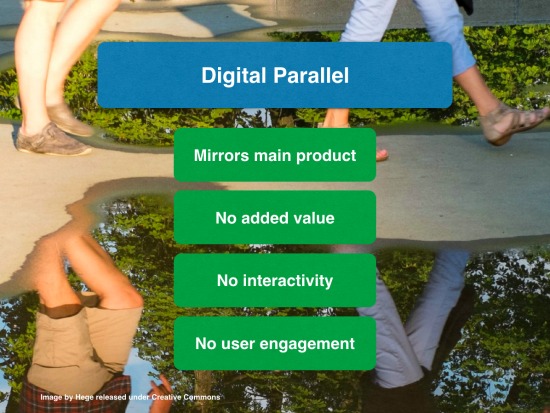
- Managers acknowledge the digital needs of the audience but fail to realise how important they are.
- They will usually ask a couple of people to build a website and upload video from the main TV shows.
- This operation will often not be connected to the newsroom. It might even be on a different floor. There might be little or no editorial supervision.
- At times, the online version will be a copy-and-paste version of what was broadcast. There will be no added value in terms of interactive assets that help explain the stories. There will be no user engagement.
- The result will be a rather dull repetition of the TV output, often text-heavy, updated once or twice a day, and offering no compelling reason for the audience to visit or return.
Digital enhanced
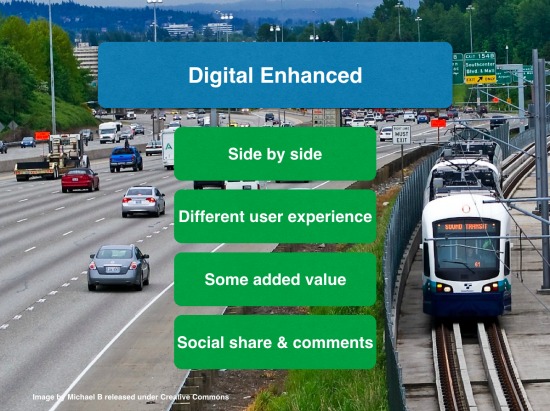
- In some cases there is an online, multimedia and social media team embedded in the newsroom made up of trained journalists who are part of the news operation. In these cases the on-air, online and mobile versions are all linked.
- There will be an attempt, often made during the morning meeting, to select the top three stories that require some added value online in terms of timelines, interactive maps, infographics, fact boxes, comments and so on.
- The source content will be much the same, but the user experience will differ depending on the platforms used by the audience.
- Social sharing and encouraging the audience to comment will be a central part of this strategy.
- There will be a healthy buzz in the newsroom. Journalists will be keen to see how the audience responds, and, after monitoring that interaction, will use the material to build on the interest generated.
- As a result, new angles will come to light and be developed. The output on all platforms or devices will feel fresh, relevant and timely.
Digital first
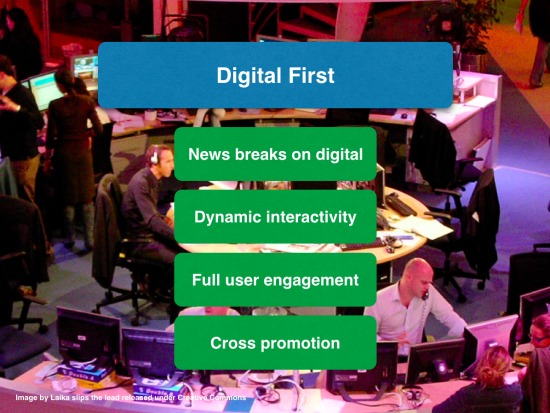
- This is where the newsroom operates around a central superdesk or hub acting as the main command-and-control unit for all output.
- There will be shared forward planning. Stories will be created in advance for all output areas with carefully planned cross-promotion.
- Interactivity will be dynamic, meaning that it will be controlled and updated from the newsroom’s central database.
- It will be built into detachable, shareable and embeddable multimedia assets, rich in links to background information, which the audience can take away to their own preferred social media space to extend the conversation.
- That total user engagement will be monitored by the social media team and fed back into the news production process so that the output continually reflects the changing needs, concerns and questions posed by the target audience.
- The digital-first converged newsroom will work closely with business development, technological development, and sales and marketing to ensure that any opportunities are fully exploited for the benefit of both the audience and the brand.
Digital evolution
I have worked with all four models in varying forms, helping them evolve to meet audience needs. Some media organisations, sadly, make a start on introducing convergence and then give up.
They sometimes blame the technology rather than their own inability to adapt. And there will be those who take comfort in retreating to the known and dragging others with them.
But the challenge for media managers is massive. To survive they need to ensure that they have a plan for remaining relevant to changing audience demands while protecting their existing business.
The best strategy for survival and prosperity is a fully converged or integrated news operation delivering content to whatever device the users turn to for information.
The principle is clear – but news organisations should accept that there is no quick, out-of-the-box, one-size-fits-all solution.
Yes, it is possible to learn from what other organisations have tried successfully. But every media business has its own particular problems and opportunities.
They will need a bespoke strategy, tailored to their exact situation, to meet the changing needs of their own target audience.