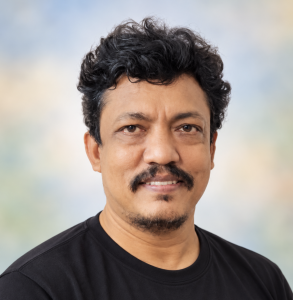
In part one of two, climate journalist Rafiqul Islam Montu shares the core principles for producing powerful reporting that delivers genuine impact.
Key considerations for coastal journalists
Why are major rivers turning into dead canals? Why is agricultural land left uncultivated? Why are farmers unable to access water for irrigation? Why do fisherfolk struggle to earn a decent living, even after immense hardship? Why are people migrating from coastal villages to cities? Why is riverbank erosion becoming so severe? Why are salinity levels in the water rising? Why are there such drastic shifts in biodiversity?
These are the questions that led me to become a journalist specialising in climate and coastal issues. As a child, I used to walk about three kilometres from my village home to attend school in the town. Along the way, various questions would cross my mind. A small river flowed right by my home, and not far away lay a larger river – the Payra – which eventually emptied into the Bay of Bengal. Another river, the Bishkhali, also converged there. I have many childhood memories tied to these rivers and the Bay of Bengal; consequently, I grew up with a mind full of questions.
That is when my interest in writing began. Seeking answers to these questions provided me with subjects to write about. My writing journey started during my school years. Initially, no media outlet would publish my work, so I began hand-writing my own “newspapers.” I continued this for a long time. Gradually, opportunities to have my work published in mainstream newspapers began to emerge. I hail from Barguna, a coastal district of Bangladesh, where I worked for several years. Later, I moved to the capital, Dhaka, to pursue a career in mainstream journalism. Today, I work for international media outlets.
Starting from the margins
The questions that sparked my interest in journalism during my childhood are the same ones I still encounter today. I find myself constantly returning to my roots. Whenever I speak with farmers or fisherfolk, scenes from my childhood come flooding back. I often try to compare the reality of today with the images I remember from 30 to 35 years ago. The scenes I witnessed in my childhood have shaped the scope of my work. I see the entire coastline reflecting the village of my youth – the same rivers, the same Bay of Bengal, and the same environmental crises – all present across the coastal region.
Barguna, where I was born, is highly vulnerable to climate change. I grew up observing the transformations within this district; the river in my village has since died, and agriculture has undergone significant shifts. The comfortable lives people once led have vanished, and their livelihoods have been fundamentally altered. From a young age, I have seen many people in my district become displaced. While the number of displaced individuals was relatively small back then, it has grown significantly today. People were not as severely affected by climate crises in the past; now, these climate-driven challenges have intensified.
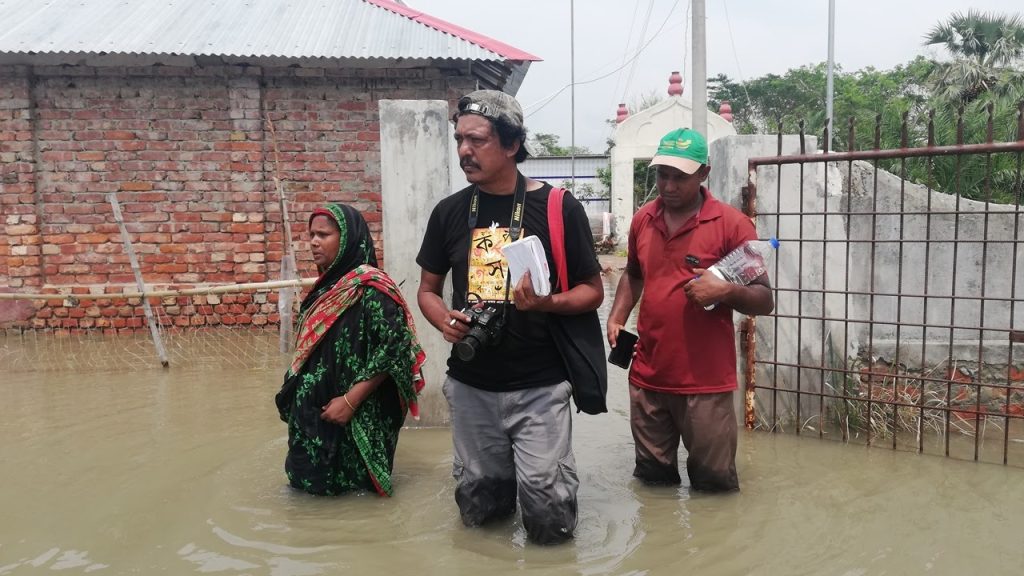
From the very beginning of my career in journalism, I have been driven by a desire to do something unconventional. While my colleagues often focus on covering ongoing, immediate events, I prefer to head toward coastal villages in search of unique stories. My primary approach is to gather information directly from the people through field visits. Engaging with them often shifts our own perspectives. While it is possible to write many reports from the city – and many do, especially in this age of enhanced information technology – uncovering the true story requires going directly to the people on the ground. That is exactly what I do.
Staying focused on the ground
Arshad Ali, a 60-year-old resident of the coastal island of Dhalchar in Bangladesh, once told me, “My ancestral home used to be in the middle of the river. We have moved a long way from there. We went from being a wealthy family to having absolutely nothing left.” As he spoke, Arshad Ali began to weep. He is not alone; I have encountered many such stories. Some families are forced to relocate eight or 10 times in a single lifetime, moving from one island to another just to survive. Their struggle for survival never ends. These stories of the people living along the coast of Bangladesh affect me profoundly.
Travelling across the entire coastal region of Bangladesh, I have uncovered many stories that had never before appeared in the media. The coastal belt comprises 19 districts – Cox’s Bazar, Chattogram, Feni, Noakhali, Lakshmipur, Chandpur, Bhola, Barguna, Pirojpur, Patuakhali, Barishal, Jhalokathi, Shariatpur, Khulna, Bagerhat, Satkhira, Jessore, Gopalganj, and Narail. I explore these districts in search of stories of change.
From the very beginning of my career in journalism, I have believed that stories from the ground are the only real stories. A story cannot truly come alive unless it reflects the voices of the people. I have always prioritised human voices in my work; the words of the people are the core elements of my stories. Their voices capture their suffering, emotions, laughter, and tears. Problems cannot be solved from the top down; solutions must emerge from the grassroots. Furthermore, many of my stories are deeply intertwined with climate change. To truly understand the impacts of climate change, one must engage with those on the front lines. Therefore, it is essential that stories begin on the ground.
Through the lens of journalism, I view the coast from a unique perspective – by seeing it through the eyes of the people who live there. I have forged a strong bond with the people living along the coast – a connection that helps me gather information from the region. I have built an extensive network across the coast, which bolsters my journalistic work. This allows me to develop stories even while sitting at home in Dhaka, should the need arise.
Although I produce most of my stories by visiting the field and speaking directly with people, my network proved invaluable during the Covid-19 pandemic. Leveraging this network, I was able to produce numerous stories from my home in Dhaka. My network in the field consists of five distinct tiers: 1. Professionals at the grassroots level; 2. Local communities; 3. Local journalists; 4. Local public representatives; and 5. Government officials.
The importance of follow-ups
When covering climate and coastal issues, I place great emphasis on follow-up stories. I track the evolution of specific islands, villages, or even individual people over time – a process that requires me to return to the coast repeatedly. Through these follow-ups, I can clearly observe and document changes as they unfold.
I have found that many of these stories remain unknown to policymakers. Consequently, I strive to bring these narratives to a broader media audience. Furthermore, I actively involve other journalists in these issues; it is within this context that I established the “Coastal Journalism Network.” I believe these coastal matters are of critical importance – it is impossible to safeguard the nation without protecting its 19 coastal districts. For these vulnerable districts to be protected, it is essential that policymakers are informed about the realities faced by those living on the margins.
There is no substitute for being on the ground when it comes to coastal journalism – and that is exactly what I do. By engaging in conversations with people, I discover the themes for many of my stories. The follow-up process serves as a source of inspiration for many of my new stories. Follow-up stories provide me with a clear understanding of change; I learn about people’s lives and the struggles they face. By staying alongside those on the front lines, I have myself become a frontline journalist. This has also made me a significant journalist in the eyes of international media. Being on the front lines means my notebook is filled with countless new stories – it is, in fact, essential to be on the front lines to uncover stories about climate change.
Staying regularly updated
The coastal region of Bangladesh stretches from Shahpori Island in Cox’s Bazar in the east to the Sundarbans in the west. Spanning a 710-kilometrecoastline, this region encompasses 15 vulnerable districts. These include Cox’s Bazar, Chattogram, Noakhali, Feni, and Lakshmipur on the eastern coast; Barishal, Bhola, Patuakhali, Barguna, Pirojpur, Jhalokathi, and parts of Chandpur in the central coast; and Khulna, Bagerhat, and Satkhira on the western coast. Additionally, four other districts =- Shariatpur, Gopalganj, Narail, and Jashor – are indirectly part of the coastal zone. Broadly speaking, journalism covering this entire area can be defined as “coastal journalism.”
I stay regularly updated on issues concerning the entire coastal region and maintain constant contact with the people living there. Another key part of my approach is following-up on news leads – tracking specific individuals, areas, and evolving situations. Through this process, I uncover new information, which in turn helps me develop fresh stories. I always have a structured plan for my reporting.
The coastal region of Bangladesh is rich with countless stories – far too many for a single journalist to cover in a lifetime. Often, one story gives birth to several others. Through my intensive work in this field, I realised that more journalists are needed to cover these stories; however, there was a lack of journalists specifically trained for this type of reporting. It was against this backdrop that I took the initiative to establish the Coastal Journalism Network. Through this network, I organise workshops for journalists working on coastal issues and provide support in planning and writing stories. As a result, the number of stories about the coast appearing in both local and national media is increasing, while simultaneously fostering the development of new journalists.
Summing up
Start with your own questions: The things that puzzle you about a place or a community are often the best source of stories.
Go to the people: Stories from the ground are the real stories. Field visits give you information you cannot get from a desk.
Put human voices at the centre: Let people’s words carry the suffering, the emotion, the laughter and the tears.
Look for the stories others miss: While colleagues chase the day’s events, head for the villages and margins where unreported stories sit.
Build a network: Mine has five tiers – grassroots professionals, local communities, local journalists, local public representatives and government officials. It lets you keep reporting even when you cannot travel, as it did during the Covid-19 pandemic.
Follow up: Return to the same islands, villages and individuals over time. It shows you how change unfolds and often leads to new stories.
Keep policymakers in view: Many ground-level stories never reach decision-makers. Reporting them gives those on the margins a voice where it counts.
Stay updated and plan ahead: Keep in regular contact with sources, track news leads and work to a structured plan.
Bring other journalists with you: One story often gives birth to several more, and no single reporter can cover them all. Training and supporting others widens the coverage.
Related material
Climate and coastal journalism – the impact on communities
Covering climate change
Causes of climate change
Climate change – language
Climate change glossary