
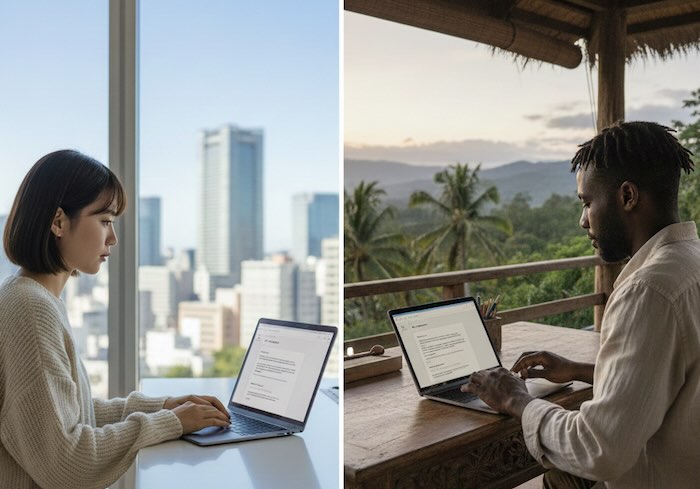
 Here we explore the key issues journalists face when interviewing sources via electronic media instead of face-to-face and in real time.
Interviewing remotely means not sitting or standing next to the interviewee but instead using technology to connect with the person you want to interview.

The interview could be in the next city, in another country, or on another continent. Your only connection is electronic, and mostly digital.
Interviewing is a vital skill that journalists practice every day.
You need to be good at talking to people, drawing newsworthy information and comment out of them – and then presenting the results in an interesting way.
Live face-to-face interviews are usually best, but sometimes it is not possible to meet your interviewee in person.
In these cases, a remote interview can be a good option, whether it’s carried out using email, text messaging (IM), video, or telephone.
Before we look at the particular issues that arise with each of these remote methods, let’s just consider the editorial methodology that is common to all forms of interviews.
Do the background work
- Read everything you can find about the interviewee and their subject.
- Make notes.
- Why is the person or the subject newsworthy?
- What are the current controversies, plans, challenges and tensions?
- What do you really want to know from your interviewee?
- What would your audience really like to know?
By the time of the interview you should have a sound grasp of the context and sufficient knowledge of the topic to be discussed to phrase intelligent and searching questions.
Establishing contact
As with all of your dealings as a journalist, you should be open and clear about what you expect of your interviewee.
- Treat them with respect and courtesy. Tell them:
- who you are,
- where the interview will appear,
- what you’re trying to get out of it,
- offer a timescale including any deadlines
Make it clear (it will usually be understood anyway) that the final decisions on what to publish and what to leave out will be taken by you and your editor and that the interviewee may not have any right of approval.
Confirm the terms of the interview
Is it ‘on the record’ (everything can be quoted and attributed), ‘off the record’ (cannot be used for publication), or ‘for background information’ (information can be used but with negotiated attribution, such as “a source familiar with the matter”). Assume everything is ‘on the record’ unless explicitly agreed otherwise.
At the beginning, ask the source to confirm the correct spelling of their name and their official title. Accuracy is paramount.
Media Helping Media has several training articles about interviewing which you might want to take a look at, including:
- Introduction to interviews
- Preparing for an interview
- Interviewing for video journalists
- Interviewing politicians
- Why would anyone want to talk to a journalist?
- Interviewing without questions
Remote interviewing
Let’s now take a look at the issues journalists need to be aware of when carrying out interviews remotely using the most common methods such as email, instant messaging, live video link, and telephone.
Email interviews
 The main problem with email interviews is that the journalist can never be sure that the person they are emailing is the person they hope to interview.
Yes, they might have the correct email address, but there is no guarantee that the person who opens the email, or the person to whom it might have been forwarded, is the person you thought you were communicating with.
So you need to establish a system for verifying that the person you are interviewing is who you think they are.
One way of doing this is to find a second way to reach the contact – whether it’s a text message or a phone number – which you can use to establish the true identity of the person you plan to interview.
Then there is the issue of delay.
The content of an email interview will be heavily influenced by the fact that conversations do not happen in real time. Your interviewee does not have to respond immediately to your questions. They can think about them, rehearse their answers, and take their time before replying.
So their answers might be more formal, more carefully considered, and more detailed than would happen in a live interview.
Also, written answers are not the same as the spoken word. They lack visual information, such as body language and facial expression, as well as variations in tone of voice which often offer clues as to the interviewee’s thinking.
They might not be well-suited to convey sensitivity or emotion. You need to be alert to the risk that emailed answers might be flat and uninteresting. It is your job to avoid that by skilful use of lively questions.
But, as in all interviews, the journalist must resist the temptation to ask leading questions – that is questions that try to encourage an interviewee to answer in a particular way or follow a particular line of thought.
The most important thing to bring to your preparation is focus. If you have done your preparation properly, you will have a long list of potential questions, covering every known aspect of the subject under discussion.
Do not even think of putting all these questions to your interviewee in one email. That would be likely to produce a tedious and rambling interview.
Instead, think through the subject carefully and decide what are the three most important things you want to know. These become your priority questions. You should also prepare a few supplementary questions in case a follow-up email is needed in order to extract more meaning and clarity if necessary.
In real-time interviews journalists do not customarily share their questions in advance with the interviewee. This does not apply to an email interview, since by definition you are providing the questions for the interviewee to think about before answering.
Face-to-face interviews have the benefit of spontaneity; the interviewer, who will be listening intently to the interviewee’s answers, can always ask a follow-up questions in a live interview. Such follow-up questions will typically be those they had not prepared earlier but which are pertinent to the topic being discussed and which build on the answers the interviewee gives.
Unfortunately, that is not possible with email interviews. So what you should consider doing is to reach an understanding with the interviewee that, if you feel their answers require follow-up questions, you are able to conduct a second or third email interview in order to clarify matters.
Pros of email interviewing
- Responses are recorded in the source’s exact words, significantly reducing the risk of misquoting.
- The interviewee can take time to reflect, look up facts, consult data, or get internal sign-off, leading to more polished answers.
- Interviews can be conducted regardless of time zones or the interviewees schedule.
- Email provides a vital channel for sources who are hard to reach, prefer written communication, or have speech/hearing disabilities.
Cons of email interviewing
- Answers can feel staged and lose the natural human voice and conversational spark.
- The back-and-forth dynamic of a live interview where the interviewer might ask crucial, spontaneous follow-up questions is lost.
- The journalist is unaware of essential non-verbal clues, such as body language and hesitation, which are valuable signals in a face-to-face, real-time conversation.
- It can be harder to build rapport and trust with an interviewee without real-time conversation. This can hinder future cooperation and in-depth reporting.
- Interviewees might answer only the questions asked and miss the opportunity to offer unexpected information or additional context that often emerges in a free-flowing discussion.
Interviews carried out via instant messaging (IM)
 As with email interviews, you can never be absolutely sure that the person you are messaging is the person you want to interview.
IM, as with any text messaging, including email, is frequently used by convincing scammers who are able to assume a fake identity and con a caller into making damaging decisions.
So, as with email communication, you need to establish some system for verifying that the person you are interviewing is who you think they are.
You also need to consider security and archiving issues (mentioned below). You will have no idea who is looking in on the conversation, who is prompting the interviewee, whether the material is being shared, and what others might do with it.
Pros of carrying out interviews via instant messaging
- The conversation is automatically saved and provides a verbatim text record, eliminating the need for manual transcription, which is a major time-saver for journalists.
- Interviewees can participate from anywhere and don’t need to be available at a specific time, making it easier to secure interviews with busy or geographically distant individuals.
- The interviewee has time to read, reflect, look up data, or consult notes before typing a response. This can lead to more precise answers.
- In some circumstances, IM might be the only practical way to interview sources who are uncomfortable speaking on the phone, have difficulty communicating verbally, or are in an environment where privacy or a quiet setting is hard to achieve.
- The lack of visual or auditory cues (such as tone of voice or body language) can make the source feel less guarded and more at ease, which may encourage them to share details on sensitive topics.
- Unlike email, an IM conversation unfolds closer to real-time, allowing for rapid, organic follow-up questions based on the source’s immediate response.
Cons of carrying out interviews via instant messaging
- The most significant drawback is the complete loss of body language, tone, and vocal inflection. This makes it difficult to gauge the interviewees sincerity, emotional state, or if they are being evasive.
- The back-and-forth flow is less natural and not as conversational as in a live interview. This can make it harder for the journalist to build rapport or for the conversation to take an unexpected, insightful turn.
- Interviewees have more time to craft and heavily edit their responses, potentially leading to answers that feel artificial, formal, or less immediate than spoken quotes.
- Both the journalist and the interviewee might be multitasking, which can lead to delays, disjointed responses, or a lack of focus on the interview.
- For complex, in-depth profiles or investigative pieces, IM is generally considered inferior. The lack of deep, flowing conversation can result in a more wooden or superficial question and answer flow.
- Standard instant messaging platforms may not be secure, raising concerns for journalists handling confidential or sensitive information. Conversations can also be easily copied and shared.
- Depending on the platform, saving and archiving the conversation can be challenging, and some systems may not be searchable later, risking the loss of valuable data.
Interviews via online video
 The video link interview is used to conduct live conversations remotely, capturing both verbal and visual information.
It is especially important for broadcast journalism (TV/online news), where usable video is required, but it is also widely used by print and digital journalists for efficiency and rapport-building.
The use of video platforms for journalist interviews presents a mix of significant advantages and notable drawbacks.
The overall effectiveness of the video interview often hinges on the quality of the technology and the preparedness of both the journalist and the source.
Don’t begin the interview until you’re sure you’ve got good quality pictures and sound.
Here are some of the pros and cons of carrying out an interview via online video.
Pros of carrying out interviews via online video
- Eliminates the need for journalists and interviewees to travel, saving considerable time and expense (travel costs, venue hire). This allows journalists to cover more ground and conduct more interviews in a day.
- Coordinating schedules is often simpler without the logistical constraints of physical location, especially across different cities or time zones.
- Journalists can easily interview sources located anywhere in the world, expanding the pool of experts and key figures they can access.
- Interviewees may feel more comfortable and less stressed conducting the interview from a familiar environment (such as their home or office), potentially leading to more candid and relaxed answers.
- Most platforms have built-in recording functions, which is more convenient than setting up physical recording equipment.
- Video and audio files can be easily transcribed, saving time and costs compared to manual transcription from traditional recordings.
- Allows for quicker, almost immediate interviews for breaking news situations where a physical meeting would be impossible due to time constraints.
Cons of carrying out interviews via online video
- Reliance on stable internet connections can lead to dropped calls, frozen screens, and frustrating delays, disrupting the flow of the conversation.
- Poor quality microphones, webcams, or lighting from the interviewee’s end can result in poor-quality footage and audio, which can be damaging, especially for video-first reporting.
- Building a strong, trusting rapport (crucial in journalism) can be more difficult through a screen than in person.
- The camera often only captures the head and shoulders, meaning journalists miss subtle, but important, non-verbal cues and full body language, making it harder to gauge credibility or discomfort.
- Interviewees’ environments can be noisy, busy, or visually distracting (for example family members, pets, background clutter), which can compromise the professionalism and focus of the interview.
- It can be harder to guarantee a private setting, as a source might be unintentionally overheard or have others off-camera feeding them information.
- The journalist misses the valuable contextual information and sense of environment that a physical visit to a source’s location (workplace, home, etc.) provides, which can enrich a story.
Telephone interviews
 Conduct the call in a quiet, private location to avoid background noise and distractions for both you and the interviewee.
Have your recording equipment (if applicable), pen, and paper ready for note-taking. Ensure your phone is fully charged and the connection is reliable.
You must inform the source that you are recording the call before you start taping. In many places, this is a legal requirement.
Confirm the terms of the interview. Is it ‘on the record’ (everything can be quoted and attributed), ‘off the record’ (cannot be used for publication), or ‘for background information’ (information can be used but with negotiated attribution, such as “a source familiar with the matter”). Assume everything is ‘on the record’ unless explicitly agreed otherwise.
At the beginning, ask the source to confirm the correct spelling of their name and their official title. Accuracy is paramount.
Pay close attention to their tone and what they are saying. Use their answers to generate meaningful follow-up questions.
While you should aim for a natural flow, it is up to you to steer the conversation. If a source avoids an important question, politely but firmly repeat it or ask why they can’t answer.
Allow the source to complete their thoughts. Don’t be afraid of a moment of silence; it often leads to the source offering more detail.
Speak in clear, professional language. Do not show your own opinion or ask leading/judgmental questions.
If the information is sensitive or complex, read back important quotes or details to ensure you have captured them accurately.
Always ask, “Is there anything else you’d like to add?” or “Is there anything we didn’t cover that you feel is important?” This gives the source a final chance to share crucial information or clarify a point.
Always thank them for their time and confirm if you can call them back if you have any follow-up questions.
Pros of telephone interviewing
- Phone calls are quick to arrange and execute, especially for tight deadlines. You can interview multiple sources in different locations in a short period without travel time.
- You can easily interview sources located across the city, the country, or even the world without incurring travel costs or time. This is often the only way to reach high-profile or distant sources.
- The interviewee can typically take the call from their office, home, or car, making them more likely to agree to the interview. This flexibility is a significant selling point.
- Without the distraction of visual cues, both the journalist and the interviewee must focus intensely on the spoken words, often leading to precise and clear quotes.
- A voice-only call can sometimes make sources feel more relaxed and willing to share sensitive or personal information than they might in person.
- Unlike an in-person interview where you must maintain eye contact, the phone allows the journalist to take extensive notes or manage recording software without seeming distracted or rude.
Cons of telephone interviewing
- The biggest drawback is the inability to read body language (facial expressions, posture, gestures). These cues often indicate sincerity, discomfort, or areas that require deeper probing.
- It can be harder to establish a genuine, personal connection with a source without face-to-face interaction, which may limit the source’s willingness to open up.
- You miss out on the colour or contextual details – what the interviewee’s office looks like, who is nearby, how they interact with their environment – all of which can enrich a story.
- The interview is vulnerable to poor connection quality, dropped calls, echo, or background noise on the interviewee’s end, all of which can compromise the recording and the flow of the conversation.
- An interviewee source can more easily and quickly terminate a phone interview by simply hanging up compared to walking out of an in-person meeting.
- The interviewee might be reading from prepared statements or multitasking during the call, which can result in less spontaneous or insightful answers.
Editing interviews
In your preparation for any interview you should make it clear to the interviewee that you and your editor will edit the piece before publication or broadcast. You should also make it clear to the reader of the finished article that it has been edited.
You are entitled to shorten the interview for presentation purposes but you are not entitled to:
- Use sections of the interview out of the order in which they were given
- Take words or sections out of context to amplify their impact
- Do anything to distort the meaning or effect of the interviewee’s words
If for any reason the interviewee takes issue with the editing you should treat such complaints seriously and if appropriate consider publishing a clarification, a correction or allowing a right of response.
Takeaway tips for remote interviewing
Email interview tips
- Design your email to be concise, focusing only on the three most important things you want to know.
- Always establish a secondary method of contact (like a text or phone number) to verify that the person you’re emailing is the one you intended to interview.
- Reach a clear understanding with the interviewee that you may need a second or third email interview to seek clarification or extract more meaning.
Instant messenger (IM) interview tips
- Take advantage of IM’s closer-to-real-time nature to ask rapid, organic follow-up questions immediately based on the source’s response.
- Be highly aware of security concerns for sensitive information and ensure you have a reliable method for saving and searching the full conversation transcript.
- Keep your questions conversational to counteract the tendency for sources to provide heavily edited, artificial, or formal written responses.
Video interview tips
- Make sure there is a stable connection on your end, and check the interviewee’s setup to ensure the lighting is good and that there is a clear background.
- Work harder to connect with the source through the screen, as building trust is more difficult than in person.
- Ask the interviewee to be in a quiet, non-distracting environment to maintain professionalism and focus for both parties.
Telephone interview tips
- Always inform the source that you are recording the call before you start taping, as this is often a legal requirement.
- Pay close attention to their tone and what is being said, using these auditory cues to generate meaningful follow-up questions.
- Allow for moments of silence after an answer, and politely but firmly repeat important questions if the source tries to evade them.
Related material