

This MPA tool lets journalists write a story once and publish across multiple digital platforms, ensuring editorial consistency for the news organisation’s audience.
The system has been used by international broadcasters to streamline production and reduce duplication of effort. It works best when used as part of a converged news operation.
Setting up an MPA system
For it to work efficiently, a newsroom’s content management system (CMS) need to be adapted in line with set rules. These rules are based on the space demands of the news organisation’s most frequently used platforms/devices.
The graphic below was created for an international broadcaster in 2002. It is based on the revenue-generating platforms the media house was publishing to at that time.
Once the system is set up according to business needs, journalists using the MPA-adapted CMS are able to write in character-limited fields which are based on the space demands of the various digital platforms the news organisation serves.
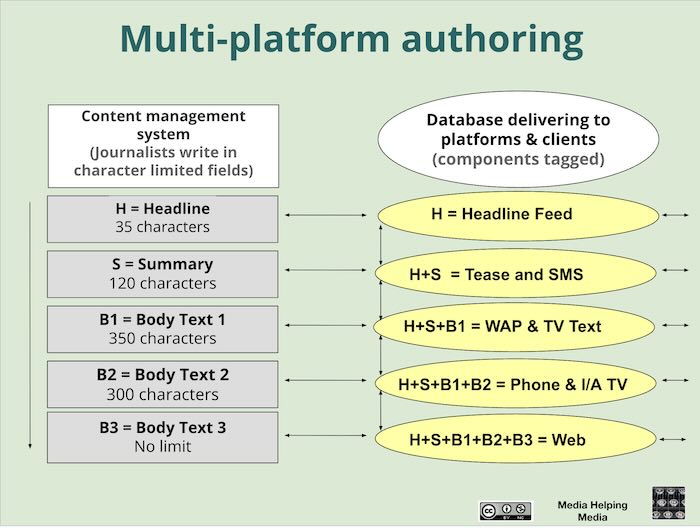
- The building blocks for multiplatform authoring: These are based on the inverted pyramid style of writing for news.
- Headline (H): Up to 35 characters; must carry the core news point so it can stand alone on headline feeds and tickers.
- Summary (S): Up to 120 characters; adds key detail or context to the headline and is used where space is tight, such as teases and SMS.
- Body Text 1 (B1): Up to 350 characters; the essential first paragraph that can work on its own on mobile or TV text.
- Body Text 2 (B2): Up to 300 characters; adds important detail, quotes, figures or attribution.
- Body Text 3 (B3): No character limit; carries the rest of the story, background, extra quotes and explanation mainly for web use.
- Write into the CMS fields
- Open the story template in the CMS and enter each element in its specific character-limited field: H, S, B1, B2 and B3.
- Edit tightly so each field can be published on its own if necessary and can also be combined to produce a complete news story.
- Check each field for standalone use.
- Read the headline alone and confirm it is accurate, clear and legally safe, because it will feed directly to headline-only services.
- Read H+S and check they work as a self-contained tease/SMS: they should make sense together, give the key update and invite the user to click or read more or watch/listen.
- Build for short-form platforms
- Ensure H+S+B1 together tell a complete, comprehensible story suitable for mobile pages and TV text screens, where users may only see this block.
- Make B1 front‑loaded with the newest information so that if B2 and B3 are not visible, the essential news is still delivered.
- Add depth for richer platforms
- Use B2 to provide extra verification, reaction and numbers so that H+S+B1+B2 can serve as the full script for shorter online stories and interactive TV.
- Use B3 for web-only depth such as background, analysis, sidebars and embedded media, giving the web user extra value beyond what appears on other devices.
- Let the system assemble and distribute
- Once all fields are saved, the tagged components in the database are automatically combined in different ways for each output: H for headline feeds; H+S for teases/SMS; H+S+B1 for TV text; H+S+B1+B2 for phone and I/A TV; H+S+B1+B2+B3 for the web article.
- Monitor how the item appears on each platform and, if any field truncates awkwardly or lacks clarity, adjust that single component in the CMS so all linked outputs update at once.
MPA writing checklist
The following checklist for newsroom staff follows the H / S / B1 / B2 / B3 structure in the graphic above.
- Before writing
- Clarify the single top line: what has happened, to whom, where, when, how and why it matters.
- Confirm essential facts, spelling of names, numbers, locations and legal/safety issues before you start filling fields.
- Headline (H – 35 characters)
- Express the core news point in one short, active sentence or phrase that can stand alone on feeds and tickers.
- Avoid ambiguity, puns, clichés, journalese, and jargon.
- Ensure there are no un-attributed details.
- Check the news story is accurate, specific and not misleading if read without any other text.
- Summary (S – 120 characters)
- Add one or two key details that deepen the headline: who is affected, scale of impact, or crucial verification.
- Ensure H+S together form a complete mini-story suitable for teases, alerts and SMS, and still make sense if B1–B3 are never seen.
- Body 1 (B1 – 350 characters)
- Write a tight first paragraph that updates the headline, gives main fact(s), attribution and immediate consequence or context.
- Check that H+S+B1 tell a coherent story that can be used unchanged on mobile front pages, TV text and other short-form services.
- Body 2 (B2 – 300 characters)
- Use this block for the next most important elements: quotes, numbers, reaction, “how we know” and key background.
- Confirm that H+S+B1+B2 work as a full, self-contained narrative that could be read on phone/interactive TV without B3.
- Body 3 (B3 – no limit)
- Add depth for the web: extra quotes, detail, timelines, sidebars, explanation, links, embeds and relevant multimedia cues.
- Ensure B3 does not repeat earlier blocks; it should reward the deeper reader with context, nuance and (clearly signposted) analysis.
- Language, ethics and formatting
- Use clear, precise language, short sentences and accessible structure; avoid jargon unless quickly explained.
- Attribute contentious information, check diversity of voices; flag any uncertainties or updates still to come.
- Apply house style consistently to dates, numbers, titles and spelling so reused blocks remain consistent across platforms.
- Ensure content is meets the demands of editorial ethics.
- Technical checks before publish
- Confirm character limits are respected in each field and that no word is truncated on key platforms. (Ideally the CMS should have preview options for each field and for the story as each field is completed.
- Preview how the story appears in each output combination (H; H+S; H+S+B1; H+S+B1+B2; H+S+B1+B2+B3) and adjust only the relevant block if something reads badly.
All the above needs to be used as a template. The exact character-limited fields will depend on the style of content created, the demands of the platforms the news organisation is delivering to. It’s important that business development staff are involved in this discussion along with editorial and technical staff. They need to work together in order to build the right tool.
Related material
https://mediahelpingmedia.org/category/modules/