
 Media organisations using AI should set clear newsgathering and production guidelines to protect journalistic integrity and maintain audience trust.
Those who rely on a media organisation for their news and information will expect the highest standards in how that material is gathered, processed, and disseminated.
At Media Helping Media (MHM) our use of generative AI began in February 2025. Up to that point, the site – which launched 20 years earlier – had been a random collection of 150 articles about journalism best practice, which had been written and donated to the site by professional journalists in the MHM network.
Tools used
Since then we have found ways to harness the power and benefits of AI to make our material more accessible. And our use of AI is developing all the time.
We are currently using a variety of generative AI tools including Google Gemini, OpenAI’s ChatGPT, Perplexity AI, and Anthropic’s Claude AI, to build on that original content.
In doing so, our free resources, which are available to journalists, educators, and managers – as well as anyone else who might stumble upon the site – have more than doubled to 405 items (as of March 2025). All are free to download, adapt for local circumstances, and use.
Human input
What is important is that all this new content has been created from material written by MHM contributors. AI has been integrated into the MHM workflow to add to the MHM-created content in the following ways:
- Learning structures: To provide structure for new learning materials based on MHM content – this includes short guides on essential journalistic basics, hour-long self-learning exercises, two- and four-hour workshops, day-long lessons, course modules, and refreshers.
- Brainstorming: To offer ideas for exploring existing MHM material in more depth.
- Proof reading: To check through new MHM-created content looking for typos and grammatical errors.
- Search engine optimisation: To rework headings for SEO purposes.
- Article enhancements: To produce Q&As (questions and answers) related to the MHM-created content, and a feature called ‘Further Thoughts’ where AI is used to expand on the MHM-created content at the end of selected pieces.
There are no resources on MHM that have been created with AI generated content only. Generative AI’s part in our output can be summed up as providing some structure to learning material and adding selected elements to MHM content created by our network of professional journalists.
Building our own tools
Some of the tasks listed above are repetitive and would take someone several hours or a day to complete. But now, AI is completing such tasks in seconds. To do this we have built our own MHM AI tools. They are called Gems.
This is a simple process which anyone can do with a free Google Gemini account. A Gem is designed to act as an expert assistant for specific, recurring tasks. The following walk-through will assist you in creating a Gem in a matter of minutes.
Below is a list of the Gems that we have created at MHM.
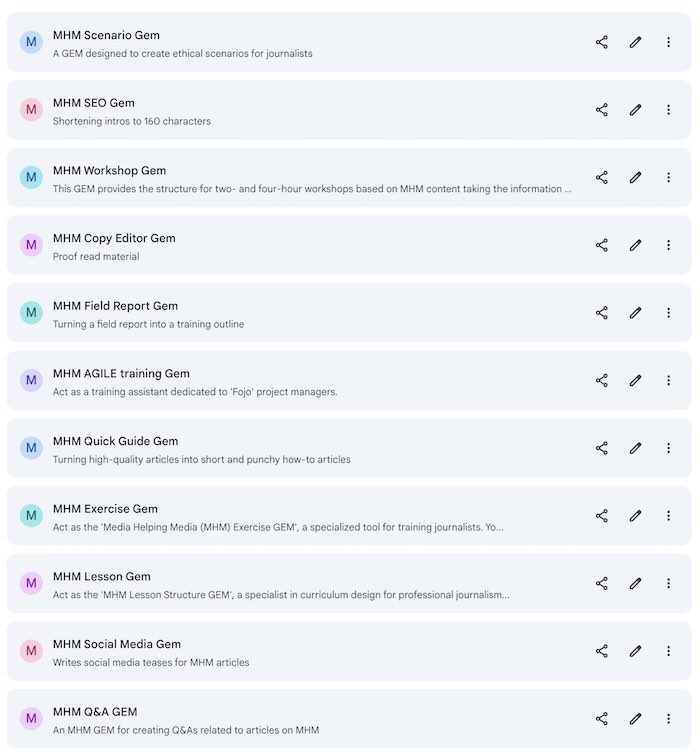
Gems are easy to build
To create a personal Gem you just need to:
- Name and role: Give the Gem a name and set it a role.
- Instructions: Write clear instructions for what you want the Gem to deliver.
- Knowledge: Upload examples of what you want, such as style guides, rules and regulations to its knowledge base.
You write the instructions
The Gem needs to be instructed with rules about what it should and should not produce. For example, if you want it to build a lesson outline based only on the material you have written, then you must tell it clearly that it must not stray from that brief.
If you want that lesson to start at 9am and contain two morning sessions and two afternoon sessions complete with a presentation, activities, and a discussion, then you must set all that out as you build your Gem.
Once the Gem is built you can keep it private or you can share it with work colleagues so that they can use it too. Who can access your Gem is up to you.
And, as you use the Gem you can continue to fine-tune the instructions. If the Gem makes a mistake you simple tell it what it did wrong and ask it to add a note to its instructions so that it doesn’t do it again.
The importance of prompts
The quality of your prompts is directly related to the quality of what the Gem produces. Well-thought through prompts will return higher-quality responses.
AI seems keen to please, which means that if your prompt is phrased badly or is in favour of a certain outcome, AI will oblige. Prompts have to be neutral in tone.
Quality control
AI makes mistakes, which it calls ‘hallucinations’. Hallucinations in terms of AI behaviour means that it generates a response that contains false or misleading information presented as fact.
Everything AI produces must be thoroughly checked to ensure it is factual and relevant.
Transparency with the audience
If you intend to use AI in your production process, whether it is designing training material or writing simple background information, you should consider telling your audience how you are using AI.
All large media organisations have a page where they set out how they currently use AI. This helps the audience understand how the content they are consuming is produced. They typically include three high-level rules.
- Humans remain responsible: AI is a tool to assist journalists, but editorial judgement, verification, and final responsibility must always remain with human editors and reporters.
- Check everything: AI output must never be treated as fact. All information produced with AI must be verified using normal journalistic standards before publication.
- Be open with audiences: News organisations should be transparent about when and how AI is used and must never use AI to mislead the public.
These three rules are often used as a simple foundation, with more detailed newsroom policies sitting behind them covering ethics, copyright, data protection, and editorial oversight.