
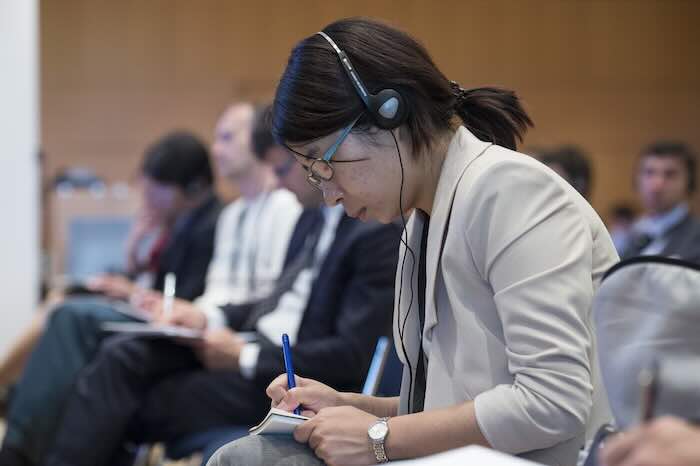
To combat self-censorship – a major hurdle for robust impartial journalism – journalists must first recognise why it happens and understand its root causes.
Self censorship is when a journalist deliberately holds back from properly pursuing a story that they believe should be told. It might take the form of softening the way they write a story, or failing to cover it at all.
It is usually because of fear of political, professional, social, legal or other repercussions, or perhaps because of the journalist’s biases or prejudices. It can happen on the most insignificant stories, and on the top story of the day.
Sometimes self-censorship happens when a journalist is under pressure from those higher up in the production process. At other times it can be unconscious, happening even when there are no obvious external pressures.
Commercial self-censorship
I first came across self-censorship when I was a junior reporter on my local newspaper. It was a paid-for tri-weekly newspaper published on Tuesday, Thursday, and Saturday (the running gag in the newsroom was that we all ‘tried-weakly’ to fill the pages).
The space for copy (stories written by the journalists) was dependent on how well adsales (the newspaper’s commercial team) had done in selling advertising space.
So you could have a great story, but, if space was needed for an advert, the story would be cut.
This is another reason for pyramid journalism – which we cover in another article on MHM ‘Essential elements of a news story’ by John Allen – where the most important parts of the story are at the top so that it can be cut and still make sense.
The newspaper’s survival depended on advertisements and the cover price, and we all knew who the main advertisers were.
Over time the journalists learnt what stories would get published and which would be spiked (rejected by the news editor by stabbing the paper they were written on with a large metal spike on his desk).
Journalists want to see their bylines in print, so we would gradually learn what subject matter was most likely to be published and the tone and language that needed to be used to get published.
If one of us wrote a story that reflected negatively on a local company that regularly paid for big block ads we knew it stood a chance of being rejected. We weren’t being told not to do it, we just understood from past experience. A culture of self-censorship around the news organisation’s business model had filtered down.
And, of course, those of us in the newsroom all wanted the newspaper to succeed in financial terms because our jobs depended on it.
Retaining contacts and sources
In another article on MHM ‘Developing and handling news sources’ we looked at the pressures journalists face when dealing with the people (we call them sources) who provide the information for news stories.
A journalist’s contacts book is precious. If a journalist has spent years building up a valuable list of news contacts they won’t want to lose them.
Some of the names in our contacts book might be less likely to result in a direct news story but might be useful names to be on speaking terms with for insight reasons.
People such as the leader of the council, the head of a local charity, the head of the chamber of commerce, the chief inspector of police, a football manager – the sort of big names that continually crop up in a local newspaper.
If we are on professional speaking terms with such people we are more likely to be able to contact them when we need to, and in return pick up news stories.
It’s human nature to want to avoid upsetting a good contact. You don’t want them to refuse to take your call or snub you when invitations to an event are sent out.
But this, too, can lead to self-censorship. It might be just the tone of your report, the angle you take, the language you use, but it can start to show in the stories you produce.
Newsroom culture and peer group pressure
Every newsroom develops its own culture. You become aware of it the day you arrive, and it gradually becomes apparent through the news meetings, the tone of the editorial discussions, the stories chosen to be covered, how they are covered, how they are followed up, and the chat amongst the journalists working on those stories.
All these factors lead to an understanding of the focus of the newsroom, which is often led by the editor and the news editor.
Every journalist wants their colleagues to like them and to feel part of the group. In such an atmosphere it’s hard to step out of line.
You might have a great original story that you have researched and which contains exclusive elements, but, if it goes against the culture of the newsroom are you going to push it forward at the news meeting?
Perhaps you will tone it down or find another way of getting it accepted? If you do, you are self-censoring.
When I was a parliamentary/political reporter I was awarded a lobby pass. A lobby pass in the UK parliament gives journalists access to areas, MPs, and ministers, not available to other journalists.
Having a lobby pass and becoming a ‘lobby correspondent’ is seen by many journalists as a career high. This meant that I could attend the prime minister’s press secretary’s briefings.
At my first lobby meeting I was keen to impress. So I asked the press secretary why so many businesses were closing in my home city of Liverpool resulting in job losses.
The room went quiet. I didn’t get an answer. Someone else filled the silence with what was clearly a more appropriate question.
Afterwards, my news organisation’s chief political correspondent and a senior print journalist who was ‘lobby chair’ took me to one side. “We don’t ask those sorts of questions here – never ask a question without first consulting one of your seniors”.
I was put in my place. From then on I did as I was told. I self-censored around the rules of the group I had joined. I had to or I would lose my lobby pass and within it access to stories.
Legal and safety concerns
In some countries, journalists self-censor because not doing so could get them arrested or hurt. This is totally understandable.
I delivered journalism training in Vietnam over more than seven years. One newspaper where I carried out my training had two editors on the desk; one editor responsible for all things editorial, and another editor responsible for all things political.
The two editors sat in separate areas of the newsroom and didn’t consult. The result was that stories sent up for approval would have two checks.
At another newspaper there was only the editorial editor; over time the news organisation had realised that journalists were self-censoring sufficiently well to enable the editor responsible for vetting the political content to move to another news organisation where, presumably, the journalists had not mastered the art of self-censoring.
Affinity self-censorship
Self-censoring because you are too close to a story is a really tough one. Most of us are proud of where we were born and grew up. I am proud of my home city of Liverpool. If anyone verbally attacks the city I want to defend it.
If people say that those I lived among for 19 years of my life are bad people, my instinct is to stand up for them. If someone takes a political stab at Liverpool, my inclination is to see the other side.
This self-censorship is a form of bias. We cover this complex issue of bias on MHM in Naomi Goldsmith’s article about ‘Unconscious bias and journalism’.
Many areas of journalistic self-censorship can be linked to unconscious bias. So it’s essential that journalists understand this and are aware of how their personal biases can have a negative impact on the quality of the journalism they produce.
Achieving the numbers
In an age of fake news, AI-generated content, clicks, shares, and associated revenue gain and influence, self-censorship takes on a new form.
It’s not about leaving stuff out that might offend or get the journalist in trouble with the authorities, it’s about making sure that whatever is produced captures the attention of the audience.
This form of self-censorship leads to dumbing down and the production of meaningless click-bait (stories with sensational and teasing headlines written to make people click the headline to open a page). This click-bait’s sole purpose is not to inform but to lead people to pages on which to serve adverts. Pages visited = revenue generated for many media organisations.
Over time, and perhaps without even meaning to, journalists start to write in a certain way, and about certain issues, that they know will get more clicks.
This sort of self-censorship avoids important news stories with trivia replacing information. It undermines robust public service journalism.
Publishing what the publisher wants
Self-censorship caused by a publisher’s political slant is a massive challenge. The news angles discussed in the newsroom meetings will all be expected to follow that slant.
So there is absolutely no point in the journalist writing in any other way – their stories just won’t make it. The newsroom becomes an echo chamber for a perspective that the news organisation is set up to deliver on all platforms.
I once sat in on the morning meeting at a UK national newspaper. I had been invited in because they wanted me to provide some consultancy on the creation of a new digital-first newsroom. I went along out of interest.
There were five blocks set out on the whiteboard alongside the news editor. Each had a topic heading but nothing written underneath. The point of the morning meeting was to decide which stories were going to be the top five for the next edition.
Each block had a political slant. There had to be a story about royalty, there had to be a story about those members of society who the newspaper’s staff considered were scrounging off the state, there would be a negative story about the European Union (breaking away was a big topic at the time), there would be an entertainment story and one from sport.
The newspaper had clearly carried out a thorough survey of its target audience, who they were, what they were interested in, and what type of news to offer them. See our article on ‘Audience research and segmentation’.
All the contributions to the morning meeting were along those lines. Nothing else was considered. All the journalists shouting out ideas were self-censoring around publishing what the publisher wanted.
Needless to say I didn’t take up the offer to join them as a consultant.
Career advancement
All journalists want to advance their careers. I started as a newspaper reporter, became a radio reporter, a bimedia political/parliamentary reporter, an editor of a regional political unit, and finally the managing editor of a couple of international news websites. To want to progress is normal. But how you progress is important.
Do you do it on merit, or do you work the system, give the editors and publishers what they want, or stick to your guns?
A career progression might involve some self-censorship along the way.
My early experience on my local newspaper was the start of a life-long learning curve. I benefitted from it because it opened my eyes to how the media works and how I had to operate in that environment.
When I was told I had to obey the rules of a parliamentary lobby group that I had joined, how I behaved from then on was really out of my hands if I wanted to stay in the group.
The experiences of the journalists working on the narrow-focused national newspaper mentioned earlier probably had a good idea what the newspaper’s slant was before they joined. It would certainly have come out during the interview process.
Operating in line with the editorial proposition set out by those who employ you is more a case of holding back rather than self-censorship.
When self-censorship needs analysing is when there is no pressure on you other than that you create yourself.
Types of self-censorship
The common thread through all of these types of self-censorship is that nobody actually tells the journalist to censor themselves. It probably never appears in any contracts. However, journalists learn self-censorship through experience, social pressure, and through a need to survive.
To recap, the following reasons why some journalists self-censor:
-
Commercial self-censorship: Avoiding negative stories about advertisers to protect the new organisation’s revenue stream.
Retaining contacts and sources: Softening coverage to maintain relationships with what are considered to be important sources.
Newsroom culture: Conforming to the established editorial focus and tone of the newsroom and doing what you think is expected of you in that culture.
Peer group pressure: Following unwritten rules about what questions to ask and stories to cover.
Legal and safety concerns: Avoiding topics that could get you into trouble and lead to arrest or physical harm.
Affinity self-censorship: Being unable to report impartially on your hometown, community, or identity group.
Achieving the numbers: Writing clickbait and trivial content to generate audience engagement, revenue, and personal exposure.
Publishing what the publisher wants: Following the political slant expected by the news organisation’s owners.
Career advancement: Compromising journalistic standards for personal progression.
Avoiding self-censorship
So, how can a journalist make sure they don’t self-censor? The first step is recognising it. Hopefully, this article has raised some red flags. Once we are aware of how self-censorship plays out we can resist.
We all need to acknowledge the pressures. That can come from those we work for, those we work with, our sources, advertisers, politicians – in fact anyone we talk to and anything we bump into during our careers.
When considering whether to cover a story or not, ask yourself:
-
Am I avoiding this story because it’s genuinely unimportant, or because it might upset someone?
Am I writing this way because it’s factual and in the public interest, or because it’s what my editor wants?
But don’t try to combat self-censorship alone. Consider talking to colleagues if you feel under pressure to self-censor. Even ask for a chat with your news editor or editor.
It could be that you have got the wrong end of the stick and you have been conditioned by the self-censorship carried out by your peer group. You might just find that the editor wants a journalist with integrity to take the news organisation in a new direction.

