
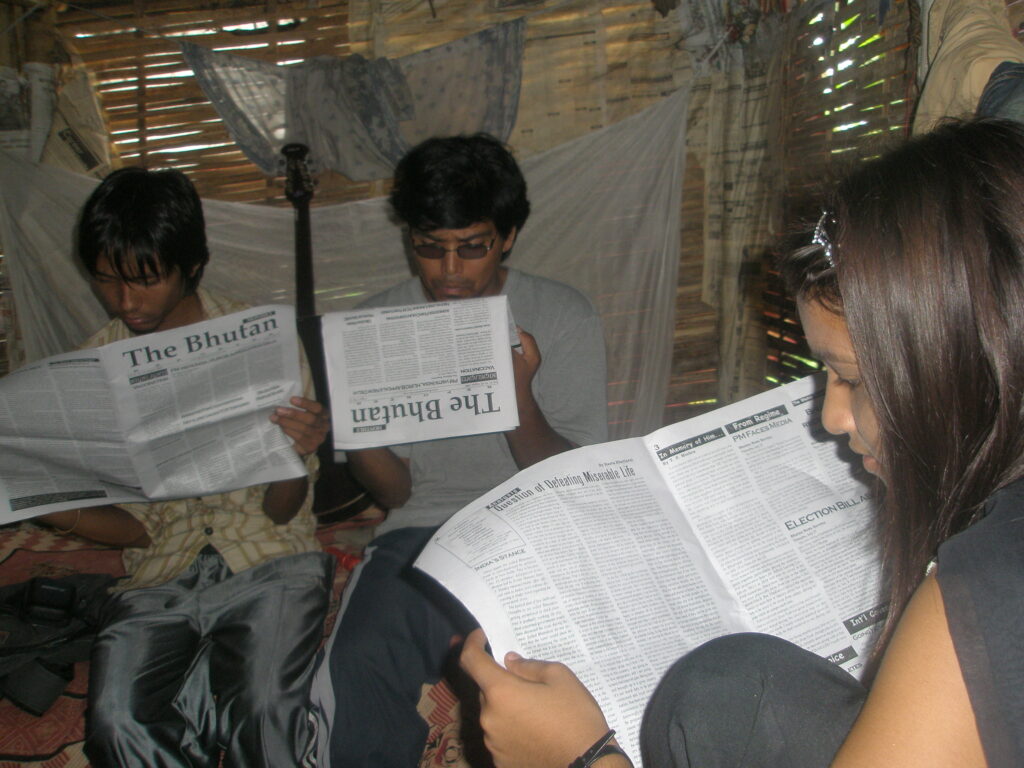
This article deals with how refugee communities can set up and operate a successful news organisation with limited resources.
The author, TP Mishra, is one of a small team that set up a media operation in the Bhutanese refugee camps in Nepal over an eight year period.
TP Mishra, who is the author of a book about refugee media, has put together a number of guides for those who want to follow his lead and set up and manage news operations run by the refugee communities.
Here, Mishra, who was the editor of The Bhutan News Service, shares the lessons he and his team learnt from starting their own media outlet while living as a refugees in Nepal.
The following may be of value to other refugee journalists who want to inform their community.
Starting a media operation
This article deals with getting to know the local laws, setting out your editorial proposition, building the right team, training staff, getting to know your audience, distribution, building networks, fundraising, running your finances, and the editorial ethics that are the foundations for your new media organisation.
Here are some points that might help refugees set up and run a media operation.
Know the local laws:
If you are considering setting up a refugee newspaper or news agency in your host country, be sure you are aware of and abide by the host country’s laws affecting refugees. You must research and understand all the legal provisions before you make the first step.
Once you are aware of any restrictions you should talk to the legal authorities near the refugee camps. You may find that any refugee media may be restricted to the refugee communities, the agencies that support refugees and well-wishers.
You need to know any restriction that could limit the reach of your newspaper. There may also be restrictions on advertisements; you must know this because this will affect your ability to generate revenue and cover costs.
Build the right team:
Once you are aware of and fully understand the legal position you need to build a team. Be sure to select the right people. They need to be dedicated, self-motivated, can-do and united in the objectives you together set for the publication.
No formal education or professional background is needed. This is an important point because you may find you don’t have a highly-skilled team; in such cases commitment is essential.
However if you can find one or two members of the team have some technical and design knowledge it will be a great help.
Also look out for others in the refugee community who have specialist interests, such as law, who are willing to join the team.
Set up a governing body:
Now you need to set up a governing body which will manage all financial issues, set out the editorial proposition for the refugee media house, oversee the content creation, production and the circulation of the newspaper within the refugee community and wider afield, if allowed by the host company.
Training your staff:
If you find that the members of your group lack journalism training consider setting up a training programme to ensure that all have the necessary skills.
Defining the editorial ethics that underpin the integrity of all you produce is an essential step.
All staff need to understand how to produce accurate content, that is impartial and fair.
They will also need to learn the technical skills needed to produce content and the basics for writing news stories.
If you lack the capacity to provide this training within your organisation you will have to do it yourself.
One way is to gather a collection of existing local, regional and national newspapers and study their house styles, sentence construction, layout etc.
If you have internet connectivity in the refugee camp you could search online for free resources, such as those provided here by Media Helping Media.
However, the likelihood is that you will have to do it yourself. This makes it all the more important for you to be clear on what you, and your governing body, want the media house to produce and the way it should be produced.
The office:
You will need some computers to get started. If you have no financial backing and can’t afford equipment you will need to seek out supporters who have a desktop or laptop in their home.
This could become the first newsroom for your publication. Don’t worry about it being a small start. Your main concern is writing content that reflects the needs of the community you serve and keep it informed.
Building a network:
If there are several camps for a particular refugee community it is important to try to build a network in order to share ideas, resources and information.
Try to find at least one like-minded person in each camp and try to convince them to work as a volunteer reporter/correspondent for your newspaper.
Their job could be to reflect the needs and concerns of their camp. The more people you manage to agree to help out in this way, the richer and more diverse your news coverage will be.
Initial fund-raising:
Your governing body is the first group to consult about finances.
Some may be able to help with small contributions to get things going, but the main reason for consulting them is to get their ideas and to foster a spirit of transparency from the start.
You may be able to approach other refugees in the community who have the means of generating income.
Editorial proposition:
While you are gathering funds, you should start to discuss the type of newspaper you intend to publish including its cost, its size, the language(s) it should be produced in, the frequency of publication and the editorial focus, for example what sections it should have and what should it focus on.
Encourage participation at this stage from any correspondents in each neighbouring camp; it is important to include as many perspectives as possible at this stage.
Newsgathering:
The first edition of your newspaper will always be the greatest challenge; you have new systems, a new team, new work flows and new working practices to become accustomed to.
To get your newsgathering machine rolling you should instruct all your reporters and correspondents to go out and about, introduce themselves to people, explain what the newspaper stands for and what you are looking for, talk about the benefits you hope your newspaper will bring and then ask them about the issues that most concern them.
Your journalists should be encouraged to ask open and searching questions based on When, Where, Who, What, Why and How.
Make sure they follow this process and you will find that the second edition of your newspaper will be a lot easier to produce.
Printing:
When you lack sound finance backing, you should always select an offset printing press that assists you to print the hardcopies at cheaper rates.
Once the paper is ready in softcopy, you can take that up to press in data transfer devices like the DVDs, flash drive or portable hard disks.
Keep checking if you can still go with cheaper costs in another printing press.
Distribution:
When you have a hard copy of your first newspaper you need to distribute it.
Your distribution strategy may look a lot different from that of the Times of India, the Washington Post, the New York Times, and the Guardian UK, but the principle is the same.
You need to get copies to the audience and leave them in places where they are going to be able to find them and read them.
For a refugee camp, your distribution strategy may be to drop a few copies off at places where people meet, such as the library, any local clubs and organisations, outside schools and on notice boards around the camp.
Send copies to your reporters and correspondents so that they can circulate them within their own communities.
Make sure all contacts you have spoken to have a copy so they can see how you treated their story; this will make it far more likely that they will return to you with more information in the future.
Cover price and sales strategy:
If local laws allow you to sell your newspaper you will need to set a cover price.
Your reporters and correspondents then sell copies in order to raise funds for them to continue to gather news for the next edition.
If you are not allowed to sell your newspaper it is worth setting out on the front page of the what it costs to produce each copy. This may help you raise funds in the future.
Building relationships:
Newspapers are all about relationships. There are three; Your audience, your contacts, and your peer group.
The most important is the relationship between the media house and those who consume the news. That relationship needs to be healthy with a strong element of trust.
The next relationship to build is with local contacts; those in the community who you are likely to turn to for comments. You need to be fair with these contacts. The relationship is two-way. You will need them for comments and they may, at times, need you to reflect their concerns.
Journalists must never do deals, but equally, you need to realise that strong relationships need two-way trust and respect.
The third relationship is with local, regional, national and international journalists. Again, this is two-way. You can feed them stories that they may otherwise never hear about, offering them content and pictures.
They may offer you training in terms of news writing, editing, technical issues and media management.
They may offer you some of their old, redundant equipment that, although no longer needed by them, could be a life saver for you.
Most of all, they may offer you visibility by writing and broadcasting about your situation; this in turn could help you reach donors in the Diaspora and NGOs offering media development training.
Keep learning:
The refugee journalist must always be learning. They should read the local, regional and national press regularly so that they can add to their knowledge in terms of current affairs and technical skills.
Raising funds:
Finance is a problem for most refugee groups. There may be ways of raising funds locally, but they are unlikely to provide enough.
Those setting up refugee media houses need to look further afield. It is important to seek out reliable funding that has no strings attached.
Funds from NGOs are the most appropriate. When the Bhutan Reporter was struggling to make ends meet in 2007, we made an international appeal via Media Helping Media resulting in funding from WAN, the World Association of Newspapers.
Financial transparency:
Once any funds have been secured, the media house needs to appoint at least two people to take responsibility for the organisation’s finances.
The funder will want regular reports stating what their funding has achieved. They will want details of activities and all financial outgoings and incomings.
It is important you get this right. If you report back in a professional and totally transparent way it is more likely that your funding will be renewed. It will also help build your credibility; word soon gets around and you want to be known as a professionally-run media house, even though you have started and probably continue to operate from humble origins.
Building your capacity:
You will find that your team of journalists, technical and admin staff have mixed abilities.
Some will be fast learners while some will be slow. Look out for those who pick things up quickly and consider working with them to organise training programmes to help the others.
In the media development world this is called ‘building capacity’ and some organisations will be keen to work with you if they feel you have a well thought through training strategy; especially if you have already identified those who can head up the training.
This is called ToT (training of trainers). Having such a system will build your credibility, make your staff feel you are serious and mean business, and encourage others to work for you.
Setting objectives:
You must set objectives for your media house, for each department and for each individual.
The first will probably be set by the governing body when it is established.
The unit objectives will be set by the editor-in-chief, the head of technology, and the person responsible for distribution, etc.
These are the objectives that will govern how their units are run.
The personal objectives are about how each individual is expected to do his or her job.
Then set up an appraisal system where each member of staff is assessed each quarter.
You may need to appoint an HR (human resources) person to help manage this.
And finally you need to tie in the training programme for the organisation with both the appraisals and the objectives.
By doing this you will be setting out some best-practice rules that will show you mean business.
Digital distribution:
As you build your print offering you should always be thinking about how to distribute your content online.
Your immediate audience in the refugee camps may not be online, but other parts of your target audience will be.
They include your Diaspora audience (those from your community who are living abroad), academics, NGOs, media watchers, politicians, local, regional, national and international journalists – all these are parts of the audience who will pick up what you are doing.
Your ultimate aim should be to deliver reliable content to whatever device your audience turns to in order to access information.
Have fun:
The job of a journalist is the most wonderful job in the world.
You are in a privileged position.
You have a great responsibility.
Your audience will begin to rely on you.
Take it seriously by all means, but have fun, too.
You are embarking on a great adventure and joining a global fellowship that will stand with you as you grow.What are the three types of relationships that are crucial for a successful newspaper, as mentioned in the article?