

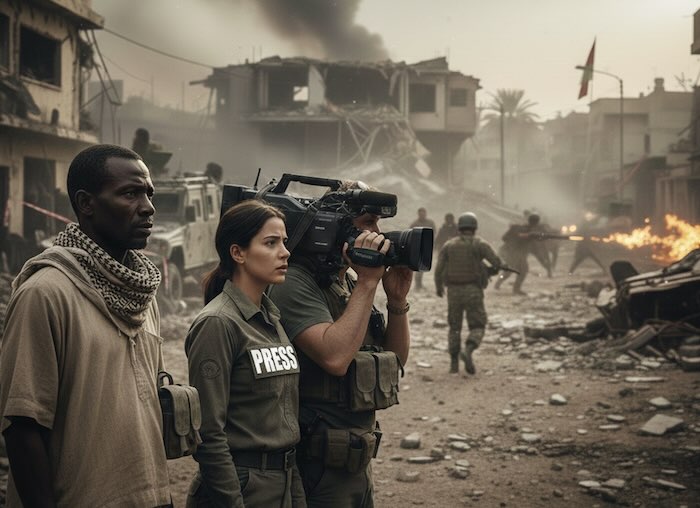
 Culture and community can have a significant impact on how journalists process and cope with trauma and stress when covering news.
We have already examined the impact of trauma on the frontline news teams as well as those in the newsroom who can suffer secondary trauma when handling raw footage and social media feeds.
However there are others who are involved in the newsgathering process who may not always have access to the support offered to their colleagues.
How a journalist processes witnessing suffering is deeply rooted in their cultural and community backgrounds. And these can differ significantly from the dynamics of the global news industry.
Support for all
Professional journalists who suffer from stress and trauma when covering news often have access to support systems set up by their management.
But freelancers, local fixers – those who help journalists set up interviews and deal with logistics – translators and drivers might not have the luxury of such understanding help.
Local staff are often used to gain access to the most harrowing sites but are left behind when the main news team leaves.
True duty of care needs to extend to all those involved in newsgathering, ensuring that those who cannot leave the story behind and move on receive the same mental health help as those who can.
Cultural stigma
In some cultures, admitting to mental health struggles can be seen as bringing shame or dishonour upon a family or a community.
In many regions, trauma is interpreted through a religious or spiritual lens rather than a clinical one. Support systems must be culturally sensitive, involving community leaders or peer-led groups where appropriate, rather than relying solely on a one-size-fits-all clinical model.
Journalists are taught to apply a professional distance when covering news. This means not getting too close in ethical and emotional terms to the events being covered.
That sounds good in practice, but is harder to apply when the journalist and their community are part of the story. In such cases, professional distance is difficult.
This can lead to moral injury – a specific type of trauma that occurs when a journalist feels they have betrayed their own values or community.
Journalists are taught to be impartial, and to avoid editorialising. However there will be cases where a reporter feels that covering news from a neutral perspective could devalue the suffering of their own people. In such cases, the resulting psychological harm can be profound.
Signs of stress and trauma
Post-traumatic stress disorder (PTSD) – which involves flashbacks, intrusive thoughts, and dissociation – is largely a Western assessment.
However, in many cultures, trauma is also expressed through somatic symptom disorder (SSD), which involves intense focus on physical symptoms – such as pain, fatigue, or dizziness – causing extreme distress and dysfunction, often regardless of whether a medical cause is found.
A journalist, fixer, translator, or driver might not say they are depressed; they might instead report chronic back pain, persistent stomach issues, or crushing fatigue.
If newsroom managers only look for psychological symptoms, they will miss the physical cries for help from staff – and those their staff work with – who lack the vocabulary (or the cultural permission) to speak about their mental state.
Identity-based trauma
Digital trauma is not just about witnessing graphic content; it is also about being the target of it. For women, LGBTQ+ journalists, and ethnic minorities, the trauma of the digital frontline often involves targeted, identity-based harassment.
Statistics from the International Women’s Media Foundation (IWMF) show that 73% of women journalists have experienced online abuse, with women of colour often facing a double burden of both sexist and racist attacks.
This isn’t just job stress; it is an assault on the individual’s right to exist in the public sphere.
Management strategies must recognise that a woman of colour monitoring a toxic comment section is facing a different, more personal type of trauma than a colleague who does not share those identity markers.
Universal support system
To move forward, news organisations must ensure their approach to wellbeing involves:
- Equity for local staff: Ensuring fixers and freelancers are included in trauma protocols.
- Recognising somatic distress: Training managers to look for physical signs of burnout.
- Validating lived experience: Acknowledging that although impartiality is essential, it is a concept that many journalists covering their own communities struggle with.
- Cultural sensitivity in counselling: Providing access to therapists who understand the specific cultural and religious contexts of the staff they are treating.
By acknowledging these cultural nuances, news organisations move from a reactive model of stress management to a proactive culture of care that protects every journalist, regardless of where they are in the world or the language they use to describe their pain.
Related material