
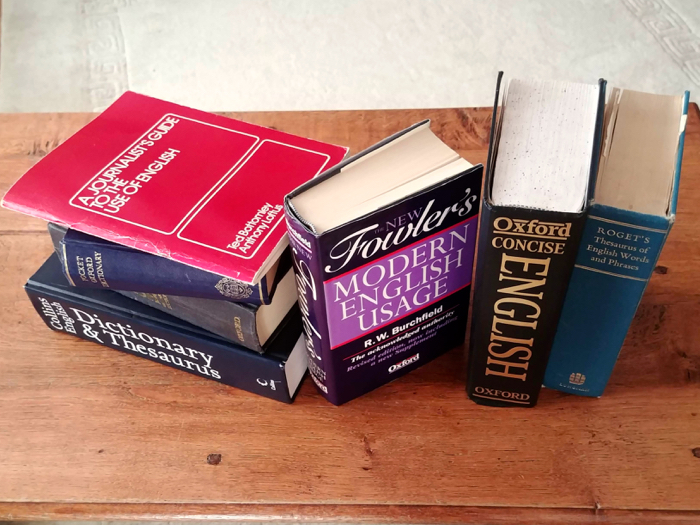
Journalists need to recognise and then avoid using journalese, jargon, and clichés. Their writing must be clear, easy to understand, and informative.
Clichés
It’s a cliché to advise writers to avoid clichés. Every time you have a story about a child being left unattended you can reach for the phrase ‘home alone‘; every time two motorists exchange angry words it’s obviously a case of ‘road rage‘; escapes from prison are always ‘daring‘ and inquiries always ‘in depth‘.

The regular use of these predictable words and phrases is numbing and indicates a lack of thought and effort.
In themselves, clichés are a form of shorthand and we would be hard pressed to do without them altogether.
There are probably some lurking within the pages of this site. However, in the final analysis, Clichéville is a town which bears all the hallmarks of the angry clashes which occur with monotonous regularity.
Journalese comes from newspapers, which have developed a particular style to meet their own needs. Some of them have moved a long way from standard English.
Some journalists assume that newspaper English is the language of all journalism. It is not.
Broadcast journalism, written for the ear, requires a different approach. Writing has to be simpler, clearer and more natural.
“Hello Tim. Have you heard that Matt’s job has been axed and he’s pledged to fight on in a bid to block the move.”
You do not often hear people in conversation use words like bid, probe, pledge, axe, plea and all the other short words in the headline writer’s sack. Good radio and television writers avoid them.
“One man’s meat is another man’s poison”, and one man’s list of clichés might be another man’s list of useful sayings and phrases.
However, if you find yourself including any of the following in your script or summary, take yourself to one side and ask yourself if it really is the best you can do.
- a question mark hangs over
- conspicuous by its absence
- the situation remains confused
- leaves much to be desired
- combing the area for clues
- leave no stone unturned
- grind to a halt
- point blank range
- quiet but tense
- moving the goalposts
- full-scale search
- level playing field
- the bottom line
- armed to the teeth
- blessing in disguise
- spread like wildfire
- calm before the storm
- horns of a dilemma
- wealth of experience
- in the final analysis
- in the pipeline
- hail of bullets
- shrouded in mystery
- reign of terror
- ripe old age
- last-ditch effort
- rushed to the scene
- vanished into thin air
- beginning of the end
- limped into port
- burn the midnight oil
- emotions ran high
- moment of truth
- riot of colour
This is a sample – there are lots more where these came from.
Uninspired journalists are also very fond of nouns and adjectives which go together so inevitably that they have lost any force or colour they might once have had. Feel free to add your own favourites to this list.
- glaring omission
- bated breath
- weighty matter
- blissful ignorance
- bitter end
- hot pursuit
- serried ranks
- breakneck speed
- sweeping changes
- true colours
- chequered career
- daylight robbery
- whirlwind tour
- brutal reminder
- marked improvement
- absolute rubbish
- foregone conclusion
- strife torn
- wreak havoc
- open secret
- luxury yacht
- cherished belief
- gory details
- deafening crash
- psychologically important
- blazing inferno
The words and phrases in these lists are not banned. There will be occasions when you choose to use some of them, but at least be aware that when you do you are straying into the superficially attractive word store which produces second-hand, second-rate writing.
A large part of your personal style comes from the vocabulary you use, so choose wisely.
Journalese
Journalese is a specialist form of cliché writing. People who use it presumably want to sound urgent, to make an impact and to be, well, journalistic.
Even though you are a journalist, whether in the field or in the office, try to avoid it. How often have you heard something like this?
“The beleaguered President Humboldt’s grip on power in strife-torn Benguela is weakening. The ailing leader of this oil-rich desert country is said to be literally fighting for his political life.”
“An uneasy peace was brokered after a marathon negotiating session with leaders of the breakaway Gulf rebels, but it’s almost inevitable that the once undisputed strongman of the region is heading for a bloody confrontation which will plunge Benguela into chaos.”
Please resist the temptation to write like this. It is a style that goes with a trench coat and a trilby hat with a card saying ‘Press‘ tucked in the brim.
Here are some examples of journalese for your consideration.
- Aim – rarely heard in real life except at shooting or archery clubs.
- Amid – does anyone ever use this, or its close relative amidst, in normal conversation.
- Axe – the jobs axe remorselessly falls in much journalism.
- Bid – another one straight from the Hack’s Book of Wee Words.When was the last time you said to a colleague: “Leaves on the line foiled my bid to get to work”?
- Blaze – a potentially useful synonym for fire, but not all fires are blazes.
- Blow – try setback or disappointment.
- Blunder – a word that seems to exist only in journalese, along with its close friend bungle.
- Boost – nearly always accompanied by major, and much the worse for it.
- Boss – a catch-all short word that covers everyone from the director general to the football club manager.
- Centred around – makes no sense, but is much heard.
- Chaos – a hardy perennial in the hack’s garden of delight.
- Chiefs – and their deputies remind us of Hollywood westerns.
- Clash – still hugely popular in news and sport.
- Crucial – often used to suggest significance, often misused.
- Death toll – why not simply say how many people have been killed?
- Dramatic – see crucial.
- Eleventh hour – somehow makes time stand still.
- Emerged – often used when we are late on a story or to suggest spurious journalistic endeavour.
- Fighting for his/her life – the subject is probably unconscious in a hospital bed and making no attempt to do anything.
- Full scale – often added to search or inquiry for no good reason.
- Garner – as in She garnered three awards. Only ever used by hacks.
- Gunned down – probably first used in the Tombstone Sentinel.
- Gunshot wounds – what are they? Bullet wounds or shotgun wounds?
- Hammered out – leave it for metalwork, not negotiated settlements.
- Helping police with their inquiries – being questioned or interviewed is shorter and to the point.
- House fire – most people would say a fire at a house.
- Inferno – this is a really serious state of affairs, not just a fire.
- Joyriding – can lead to death and great anguish.
- Key – heard too often to mean much.
- Launched – barely a day goes by without some report, initiative or investigation being launched.
- Literally – if you mean it literally, it’s not really necessary to say so.
- Mandarins – leave them to the greengrocer. The phrase civil service mandarins is not compulsory.
- Manhunt – police search or murder hunt.
- Marathon – talks which go on for a long time do not demand this adjective.
- Mercy dash – good grief.
- Miraculous – nothing to do with religious belief or theological teaching.
- Oust – top class journalese.
- Plea – ditto
- Pledge – properly belongs in a wedding service or a pawnbroker’s.
- Probe – best left to doctors or one of those tiny cameras.
- Quit – another ditto.
- Quiz – the noun is fine, the verb is an abomination.
- Row – not all differences of opinion justify the use of row.
- Rush – especially to hospital. Use it only when you really mean it.
- Scheme – a great favourite, but what about plan, proposal, idea, project?
- Set – as in A is set to do B. A useful but overworked expression.
- Spark off – would anyone but a journalist use this?
- Spree – shopping or killing?
- Sustain fatal injuries – or die.
- Sweeping changes – the bristles on this must be worn out by now.
- Today – broadcasters should hardly ever need to say this.
- Tracker dogs – specially trained? Or just sniffer dogs. Or even simply dogs.
- Trigger off – see spark off.
- Vital – are you sure?
- Vowed – when was the last time you vowed anything?
- Walked free – from court. This phrase is not compulsory after successful appeals.
Jargon
From doctors to decorators, lawyers to lorry drivers – any group of people working together or in the same field is likely to develop a specialised, shared vocabulary.
As journalists, we can become honorary members of these groups if we use the language correctly.
The danger is that we become so familiar with the jargon that we use it in our writing, which is at odds with our aim to be understood as clearly and universally as possible.
So, the obvious advice is: avoid jargon. Unfortunately, this is often not as easy as it sounds.
Journalism is littered with supply-day motions, three-line whips, the usual channels, corporate governance, collateral damage, affirmative action, throughput, and constructive dismissals.
Police officers say they have attended the scene (been there), that twelve people were apprehended (caught), that evidence was detected (found), and that death was due to immersion (drowning).
The hospital press officer says the driver was fatally injured (killed) and a passenger received a broken leg (his leg was broken) and is undergoing surgery (having an operation).
And what does comfortable mean when someone is lying in hospital? And also describing a patient as critical; does this mean they don’t like the food, the nurses, or the colour scheme in the ward, or is the patient critically ill?
There is a lot of jargon about, but if you recognise it, you can do the audience a favour and substitute real, accessible language instead.
Here are some examples from business:
“The chairman said he was bullish on the company’s sales” (he believed they would increase).
“They can charge more because of tight supply and demand” (prices are going up because demand is high and supplies are low).
“The company says the new model will cause a paradigm shift” (it’s a big change in the generally accepted point of view).
“They are currently evaluating their health care delivery system” (they are looking at the medical services available to staff).
“She was concerned about the granularity of the deal” (she had worries about the details).
Journalists must learn to recognise journalese, jargon and cliches and try their best to avoid them and, instead, use words that help explain and deliver information to the audience.
By John Allen
Related material