

 This exercise is designed to help journalists understand how unconscious bias can undermine journalistic integrity and distort how news is covered.
The exercise is based on the article Unconscious bias and its impact on journalism which we suggest you read before completing the exercise.
MHM exercises are a chance for those who are new to journalism to learn skills and test what they know against fictional scenarios. The articles on which the exercises are based have been created from the experience of journalists who have shared their knowledge free of charge in order to help others learn the fundamental principles of robust public service journalism.
The first requirement of any piece of journalism is that it should be accurate. Although this is an exercise involving fictitious material, not for publication, trainees must take everything they are told in the exercise to be factual and they must stick to those facts. If one thing they produce in the exercise is inconsistent with those facts, their whole work is discredited. Accuracy comes first.
The exercise
This exercise is all about bias. Before attempting the tasks below please be sure to read the article mentioned at the top of this page. Below are two versions of the same fictitious news story. There is a:
- A biased version (with clear unconscious bias woven throughout), and
- A revised neutral version (same facts, no bias). The neutral version is hidden and you should not view it until you have completed the tasks below.
The biased version is designed so you can spot different forms of bias (e.g., confirmation, affinity, anchoring, stereotypes) — as described in the article Unconscious bias and its impact on journalism.
Task 1: Spot the bias
Local Council’s new traffic scheme “fails” after complaints flood in
By: Floyd Boyd, Community Reporter
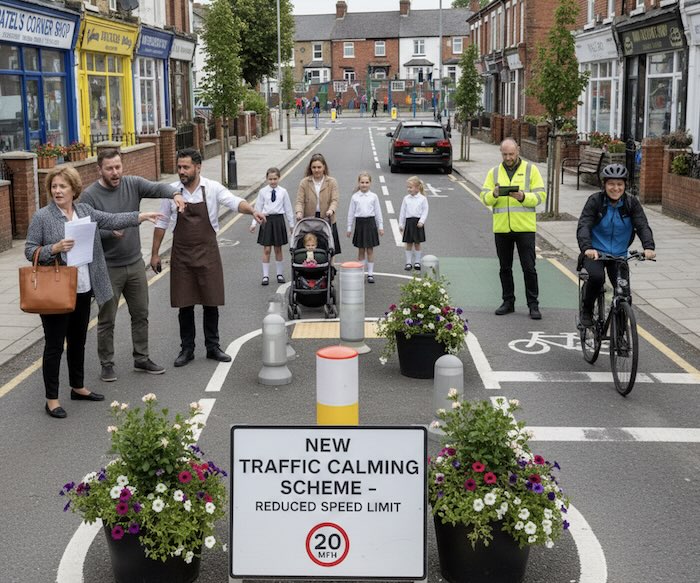 Residents are up in arms over the council’s ill-conceived new traffic calming scheme on Wellington Road, which critics say has already caused major inconvenience and chaos.
Almost immediately after installation last month, locals — many of whom clearly feel ignored by out-of-touch planners — began complaining that the new chicanes and reduced speed limits were unnecessary and heavy-handed.
Neighbourhood spokesperson Jean Carter told this newspaper that “this ridiculous scheme shows how city bosses just don’t listen to real people.” Her comments reflect what many sensible local residents are now saying on social media.
Some residents have been forced to take long detours, increasing their travel time by an unacceptable margin. Even parents dropping children at the nearby school described the scheme as “disruptive” and “a complete waste of taxpayers’ money.”
However, Council Transport Lead Samir Ahmed defended the plan, saying it aimed to improve safety. Critics dismiss his position, claiming he’s clearly detached from the community and parroting vague official talking points rather than real concerns.
Businesses along Wellington Road have also suffered, with shop owner Ricky Patel saying the changes have “killed foot traffic.” Many locals echoed Patel’s view that the council must abandon this scheme immediately or risk turning Wellington Road into a ghost street.
Despite repeated attempts to contact community activists who support the plan, few were willing to speak — a likely sign that even its proponents know it’s unpopular.
This chaotic situation is yet more evidence that the council’s leadership is out of touch and prioritises misguided green initiatives over the real needs of the community.
Your job: Go through the text above and note any loaded or adjective-heavy language, any sourcing bias, conformation bias, stereotyping and generalisations, and any bandwagon bias and write down how the bias affected your perception as a reader
Once you have done that you can compare what you jotted down against our suggested list below. Please don’t click on the link below to view our list until after you have compiled yours.
Click here to see some of the instances of bias we spotted
Here are some instances that you might highlight (not exhaustive):
- Loaded/adjective-heavy language: ill-conceived, unnecessary and heavy-handed, detached from the community — language that pushes a negative view rather than neutrally describing events.
- Sourcing bias / confirmation bias: Mostly quotes from opponents of the scheme; supportive voices are dismissed or framed as weak.
- Stereotyping / generalisation: Implying council planners are out of touch without evidence.
- Bandwagon bias: Suggesting many sensible local residents agree without showing balanced data.
Task 2: Avoiding bias
Write the same story but without bias. Once you have written the story click the link below to see our suggested treatment of this news item. Please don’t click the link to reveal our version until you have finished writing yours.
Click here to see the suggested story treatment
Traffic calming measures installed on Wellington Road draw mixed reactions
By: Alex Fairbrother, Community Reporter
Critics say a new traffic calming scheme introduced in Wellington Road is damaging local businesses and causing inconvenience to residents.
The scheme, which involves speed limits and chicanes, was introduced a month ago with the stated aim of reducing traffic speed and improving conditions for pedestrians and cyclists.
But one shop owner in Wellington Road, Ricky Patel, said it had “killed” the volume of foot traffic and damaged businesses.
On social media, some residents have complained that they have been forced to make long detours to their journeys. Others say the scheme has disrupted the school run.
A local resident,Jean Carter, said: “This ridiculous scheme shows how city bosses don’t listen to real people”.
Assessment
So, how did you get on? How did your rewritten and bias-free version compare with ours? What did we miss? What did you miss? What have you learnt from this exercise?
The point of this exercise is to help news trainees understand how language choices — even subtle ones — can shape a reader’s impression and why recognising unconscious bias is vital for ethical journalism.