

 Discover how journalists use the active voice to capture action and seize reader attention. Master impactful writing techniques for fast-paced news stories.
Welcome to this Media Helping Media (MHM) exercise about the active and passive voices in news, which is published on MHM. You are invited to complete the exercise either on your own or with a colleague. Please ensure you read the article above before proceeding.
MHM exercises are designed to help those who are new to journalism learn important skills and then test what they know against fictional scenarios. The articles on which the exercises are based have been created from the experience of journalists who have shared their knowledge in order to help others learn the fundamental principles of robust public service journalism.
The first requirement of any piece of journalism is that it should be accurate. Although this is an exercise involving fictitious material, not for publication, trainees must take everything they are told in the exercise to be factual and they must stick to those facts. If one thing they produce in the exercise is inconsistent with those facts, their whole work is discredited.
The exercise
Task 1: Read the following news story, which is written primarily in the passive voice:
Local museum broken into
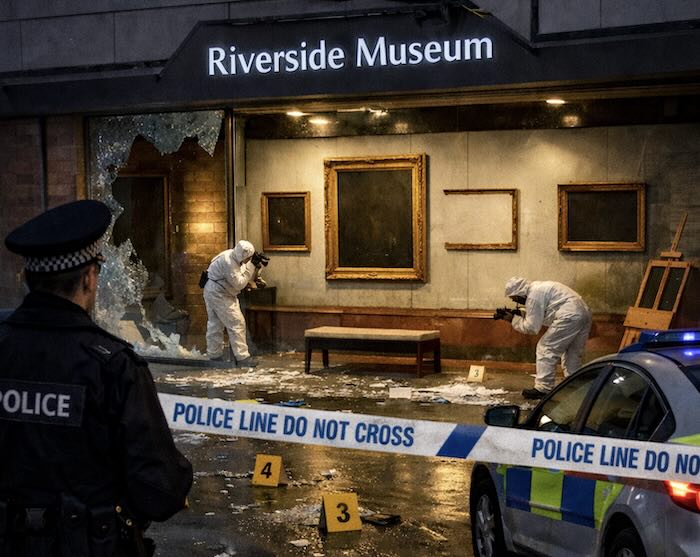 A break-in at the Riverside Museum was reported by security staff early this morning. Several valuable paintings were stolen from the main gallery during the night.
The alarm system was disabled by the thieves before entry was gained through a rear window. It is believed that at least three people were involved in the operation.
The most valuable item taken was a 17th-century portrait valued at £500,000. Two other works by local artists were also removed from the walls.
Police were called to the scene at approximately 6.30am. The museum has been closed to the public while forensic examinations are being carried out.
A statement was released by museum director Patricia Hammond, saying that a full inventory was being conducted to determine exactly what had been lost. “This is a devastating blow to our collection,” it was said by Ms Hammond.
CCTV footage is being reviewed by detectives. Anyone with information is being urged to contact the police.
No arrests have been made at this stage, but investigations are continuing.
Task 2: Rewrite this story using the active voice wherever possible. As you do, keep in mind that:
- The active voice is generally stronger, clearer and more direct
- Put people and actions at the centre of your sentences
- However, also be aware there may be one or two instances where the passive voice is actually the better choice
So, think carefully about:
- Who is doing what?
- Which sentence structures make the story more compelling?
- Are there any places where the passive voice serves a legitimate purpose?
After (and not before) you have completed your rewrite, take a look at how the story should be rewritten (link below) using the active voice. You will see notes about where passive voice remains appropriate:
Click here to see the suggested story treatment
.
Thieves steal £500,000 painting from local museum
Thieves broke into the Riverside Museum early this morning and stole several valuable paintings from the main gallery.
The criminals disabled the alarm system before they entered through a rear window. Police believe at least three people took part in the operation.
The thieves stole a 17th-century portrait valued at £500,000, the most valuable item in the haul. They also removed two other works by local artists from the walls.
Security staff reported the break-in and police arrived at the scene at approximately 6.30am. The museum has been closed to the public while forensic teams examine the scene. (Passive voice used here appropriately – the focus is on the museum’s closure, which affects the public, not on who closed it)
Museum director Patricia Hammond released a statement saying her team was conducting a full inventory to determine exactly what had been lost. “This is a devastating blow to our collection,” Ms Hammond said.
Detectives are reviewing CCTV footage. Police are urging anyone with information to contact them.
No arrests have been made at this stage, but investigators are continuing their work. (Passive voice used here appropriately – no one has been arrested, so there’s no actor to identify, and the focus is on the lack of arrests)
How does this version compare with the one you produced? Reflect on any areas that could be improved in either version.
Active voice improvements:
- “Thieves broke into” instead of “A break-in was reported” – more direct and immediate
- “Thieves stole” instead of “were stolen” – identifies the actors
- “The criminals disabled” instead of “was disabled by the thieves” – stronger verb placement
- “Police believe” instead of “It is believed” – attributes the belief to someone specific
- “The thieves stole” instead of “was taken” – emphasises agency
- “Security staff reported” instead of “was reported by” – puts people first
- “Police arrived” instead of “were called” – more active
- “Ms Hammond said” instead of “it was said by Ms Hammond” – more natural
- “Detectives are reviewing” instead of “is being reviewed” – shows active investigation
- “Police are urging” instead of “are being urged” – clearer call to action
Legitimate uses of the passive voice:
- “The museum has been closed to the public” – The important information is that the museum is closed; who closed it (presumably the director or police) is less important than the effect on visitors.
- “No arrests have been made” – There’s no actor to identify here because no arrests have occurred. The passive voice appropriately emphasises the absence of action.
Note: passive voice works when the subject receiving the action is more important than who performed the action, or when the actor is unknown or irrelevant to the story.
Related material