

 This exercise sets out the basics for creating a news package for radio. It’s been created for those starting out in radio journalism.
Welcome to this Media Helping Media (MHM) exercise about constructing a news package for radio which is published on MHM. You are invited to complete the exercise either on your own or with a colleague. Please ensure you read the article above before proceeding.
MHM exercises are a chance for those who are new to journalism to learn skills and test what they know against fictional scenarios. The articles on which the exercises are based have been created from the experience of journalists who have shared their knowledge in order to help others learn the fundamental principles of robust public service journalism.
The first requirement of any piece of journalism is that it should be accurate. Although this is an exercise involving fictitious material, not for publication, trainees must take everything they are told in the exercise to be factual and they must stick to those facts. If one thing they produce in the exercise is inconsistent with those facts, their whole work is discredited. Accuracy comes first.
The scenario: The silent bells of Oaktree Square
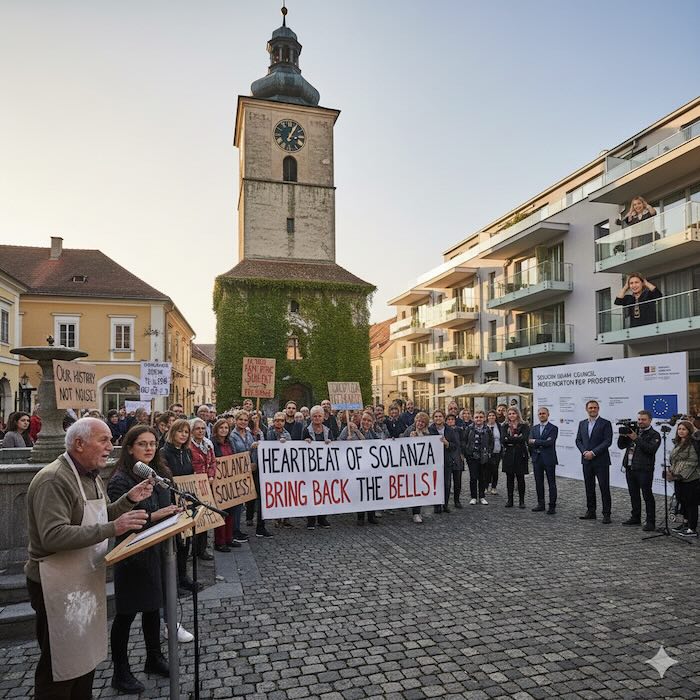 Location: Solanza, a historic town in Central Europe.
The situation: You are a reporter for Solanza Public Radio. Your editor, Marek, has just sent you to Oaktree Square, an historic town in Solanza, Central Europe. The town’s famous 400-year-old clock tower has been silenced by a local government order following noise complaints from a newly built luxury apartment complex, Velvet Suites.
The bells have rung every hour for centuries, but the Solanza Urban Council has issued an emergency noise abatement notice (a legal order to stop a noise that is considered a nuisance). This has sparked a protest in the square. The Council claims they are protecting the liveability of the town to attract high-tax-paying residents. The project was funded by a two-million-euro grant from the European Regional Heritage Fund, which critics say was intended to preserve culture, not quieten it.
Characters:
- Elara Vance: A resident of Velvet Suites who says the bells are “psychological torture” at 3:00 AM.
- Olden Bartos: A 80-year-old local baker who says the bells are the “heartbeat of the community”.
- Councillor Jano: The official who signed the order, citing the need for modernisation and economic growth.
The task
Your goal is to produce a 90-second radio news package that explores the conflict.
Step 1: Gathering your audio (The shot list)
Describe the scene and list the actuality you need.
- The soundscape: List four distinct sounds you would record in Oaktree Square to help the listener see the story.
- The interviews: Identify which of the characters above you will interview and one specific question for each to ensure fairness to both the traditionalists and the newcomers.
Step 2: Drafting the script
Using the MHM article advice on writing for the ear, write the following:
- The lead-in: A 15-second introduction for the studio newsreader to set the scene.
- The track: Write your own narrated parts. Ensure you use subject-verb-object sentence structures to keep it simple.
- The bridge: Write a transition that moves the story from the angry protesters in the square to the quiet, air-conditioned office of Councillor Jano.
Step 3: Production and timing
Prepare a cue sheet (a document used by radio producers to track the timing and contents of a package) for your 90-second report.
- 0:00 – 0:10: Reporter intro over atmos (background atmospheric noise).
- 0:10 – 0:25: Interview clip (actuality).
- 0:25 – 0:90: Plan the remaining segments, ensuring you include a sign-off at the end.
Purpose and learning outcomes
This exercise teaches you how to layer sound to create a theatre of the mind. You will learn to balance competing interests to maintain impartiality while using clear, concise language that is easy for a radio audience to follow on the first listen.
Ethical considerations
In this scenario, you must maintain integrity by investigating the use of the European Regional Heritage Fund. Is it ethical to use heritage money to silence a heritage site? Be careful not to let your own bias (perhaps a love for old clocks) influence the edit. You must also respect the privacy of residents if you are recording near their private homes, ensuring you do not cause offence by being overly intrusive. Following professional ethics is vital when reporting on community splits.
Self-assessment quiz
- If you record the sound of a protest in Oaktree Square, what is this called in radio?
- Background music.
- Atmos or ambient sound.
- A pop filter.
- Static noise.
- Which is the best way to write a sentence for a radio script?
- The bells, which were built in 1604 by a local blacksmith, have stopped.
- The 1604-built bells, commissioned by the blacksmith, are now silent.
- The bells are silent. They were built in 1604.
- Silenced are the bells that a blacksmith built in 1604.
- What does it mean to write into a clip?
- Writing the reporter’s words so they lead naturally into what the interviewee says.
- Physically writing on the digital audio file.
- Writing a letter to the person you interviewed.
- Ending the package with a loud sound.
- Why should you avoid sibilance in your script?
- It makes the package too long.
- S sounds can be harsh and hiss on air, making it unpleasant for the listener.
- It is a sign of poor accuracy.
- It makes the reporter sound too happy.
- What is the out-cue?
- The first thing the listener hears.
- The button you press to stop recording.
- The final words of a recorded clip or the entire package.
- The music played during the weather report.
Answers:
1: b, 2: c, 3: a, 4: b, 5: c
Related material