
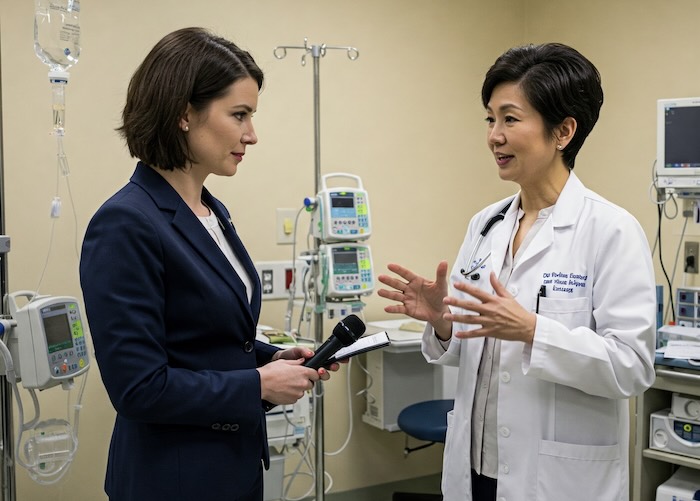
 Most journalists are generalists, who can cover any kind of story. But there is also a place for specialists, providing expertise on particular subjects.
Before reading further, we suggest you first take a look at our article ‘Specialisms in journalism’.

Health is a subject of interest to everyone – their own health and that of their family, friends and community.
So when you are a health journalist, people want to read your stories. You are in a privileged position: if they trust you, they might take life-changing decisions on the basis of your reporting.
This is a big responsibility and it calls on you to combine solid journalistic skills and ethics with a sound grasp of science and public health information.
Where your stories might come from
- Science and research: There is a huge amount of research coming out at all times and you need to identify and regularly check all the likely sources
- Public health information: Governmental and international organisations regularly produce statistics, reports and guidance notes. So do healthcare and professional organisations, think tanks (experts that performs research and advocacy) and NGOs. You need to monitor these systematically.
- Policy: Governments make policy decisions that shape healthcare, including budgets and regulation.
- Performance: With health systems and budgets under strain in most parts of the world, how hospitals and primary care operate produces many important stories.
- Watchdogs: Official and unofficial regulators and monitoring bodies investigate and produce reports.
- Events: The biggest stories sometimes blow up out of nowhere. The COVID pandemic for example.
- Professionals: Doctors, nurses and other health practitioners. They give the vital provider’s perspective on stories.
- People: The public’s direct experience of health issues is often the most significant and impactful way of covering the subject.
Some of the essential skills required
- Accuracy: In health as in every area of journalism, everything you write must be correct in every detail. See ‘Accuracy in journalism’.
- Scientific understanding: The ability to read and assess academic journals, papers and reports, and identify the new angles within them.
- Making contacts: You will need a network of experts who can reliably advise you on stories as they break. See ‘Developing and handling news sources’.
- Interviewing: Most of your stories will come from interviews. You need to develop your skills in extracting newsworthy information from interviewees. See ‘Introduction to interviewing’.
- Storytelling: Your stories must be unobjectionable to experts and at the same time easily comprehensible to a general audience.
- Data literacy: You need to be comfortable working with datasets, understanding statistics, interpreting charts and spreadsheets, recognising disinformation and misinformation. See ‘Data journalism – resources and tools’.
- Fads and scams: There is a lot of ill-informed, counter-factual, non-evidence-based health ‘information’ in circulation and you must be ruthless in identifying and dismissing it.
Some essential responsibilities
- Accuracy: No apologies for repeating this. It is impossible to overstate the importance of accuracy. In health as in every area of journalism, everything you write must be correct in every detail.
- Calm judgement: You must be a good and reliable judge of what is important and what is newsworthy. Always base your stories on verifiable evidence.
- Impartiality and independence: There are always health controversies. Do not take sides. Report on the facts and do not become personally close in any way to the people or issues involved. If it is a health story that affects you or someone close to you, get someone else to do it. See ‘Impartiality in journalism’ and ‘Conflicts of interest’.
- Use of language: Do not use extreme or emotive terms such as ‘miracle cure’. Do not oversimplify or exaggerate. Do not cause or encourage a sense of alarm – it never helps understanding. See ‘Adjectives and adverbs in journalism<‘/a>.
- Know your limitations: Stick scrupulously to what you know. Do not pretend to understand. Do not cut corners. Do not make assumptions. Accept that you will get better with experience.
- Transparency: Be clear and straightforward with everybody. Treat your contacts and your audience with respect. If you make an error, admit it, correct it and learn your lesson.
Conclusion
Health reporting is an essential part of public service journalism. It is full of potential for helping the audience make better-informed decisions about their health and their lifestyle. For the same reason, the risks of getting it wrong are potentially high. A health specialist who builds trust through accuracy, sound judgement and skilful reporting has an important and valuable place in any news output.