

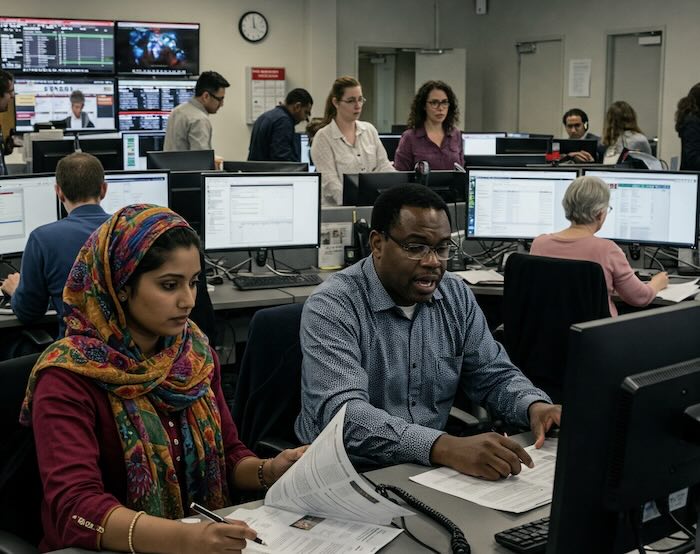
 Diversity in journalism extends beyond representation, it’s also about enriching the news coverage produced and ensuring its relevance to a wider audience.
By diversity we are talking about a wide range of identities, including but not limited to race, ethnicity, gender, sexual orientation, disability, socioeconomic background, and religion.
In an article on this site, Naomi Goldsmith wrote about the role of women in the media. In ‘Gender equality in the media’ she argued that “Gender equality is important for both men and women. Neither gender benefits from being stereotyped and not being allowed to fulfil its full potential.”
Gender is just one area covered by diversity. The following are some of the ethical, editorial and business reasons why diversity in both staffing and coverage is important:
Accurate and authentic representation
- Diverse staffing:
- Newsrooms and media organisations with diverse staff are better equipped to understand and report on the complexities of diverse communities.
- Individuals from different backgrounds bring perspectives, experiences, and cultural knowledge that can enrich storytelling.
- Employing journalists from a mixture of backgrounds helps avoid stereotypical or one-dimensional portrayals of marginalised groups.
- Diverse coverage:
- When media outlets prioritise diverse coverage, they give voice to underrepresented communities and shed light on issues that might otherwise be ignored.
- This fosters a more inclusive and accurate reflection of society, promoting understanding and empathy while also creating richer editorial output..
Countering bias and promoting fairness
- Diverse staffing:
- A lack of diversity in media can lead to unconscious bias in reporting, resulting in skewed or inaccurate story telling.
- Diverse newsrooms are more likely to challenge these biases and ensure fair and accurate coverage – while taking care to avoid false equivalence and false balance.
- Diverse coverage:
- Media that consistently prioritises diverse viewpoints helps to counter dominant narratives and challenge prevailing assumptions.
- This promotes a more comprehensive understanding of complex social issues.
Building trust and credibility
- Diverse staffing:
- When audiences see themselves reflected in the media, they are more likely to trust the information they receive.
- Diverse newsrooms foster a sense of inclusivity and build stronger connections with their communities.
- Diverse coverage:
- Media that accurately and respectfully portrays diverse communities gains credibility and fosters trust with a wider audience.
- This is essential for maintaining a healthy and informed public discourse.
Enhancing creativity and innovation
- Diverse staffing:
- Diverse teams bring a wider range of perspectives and ideas, leading to more creative and innovative storytelling.
- This can help media organisations stay relevant and engage with a rapidly changing audience.
- Diverse coverage:
- By highlighting diverse stories, media outlets expose their audiences to new perspectives and ideas, enriching the cultural landscape.
Supporting information
- National Union of Journalists (NUJ):
- The UK’s NUJ highlights what it sees as a concerning lack of diversity in UK newsrooms, emphasising the need for greater representation.
- Link: Fewer than one in five media workers believe newsroom diversity is a top priority in their workplace – National Union of Journalists (NUJ)
- Jefferson University:
- The importance of representation is underlined by information from Jefferson University which shows how media can shape perspectives.
- Link: How can the media Improve representations of diverse identities?
- The Diversity Dashboard:
- The importance of diversity in media careers is set out by the UK’s Diversity Dashboard. The site contains information diversity in the media industry along with the many different career paths within the media and journalism.
- Link: Careers in media: Opportunities and the importance of diversity
In conclusion, diversity in media is not just a matter of social justice; it is essential for producing accurate, fair, and engaging content that reflects the complexity of our world.
Related material