
All news stories should, by definition, be interesting. They should immediately capture the attention and make the audience want to know more.
Public service journalism follows this same rule – but it also makes a crucial distinction between what is interesting to the public and what is in the public interest.
Some stories are simply entertaining or unusual. They attract audiences but have no real consequence for their lives. Reporting such stories is not wrong – but public interest journalism seeks something more meaningful.
What public interest really means
Public interest journalism focuses on issues that genuinely affect society – our health, livelihoods, safety, environment, and systems of governance.
It is not about gossip, trivia, or the private details of individuals that have no bearing on the wider community.
The public interest is about maintaining a safe, informed, and functional society.
In a democracy, journalists help achieve that by providing citizens with the information they need to participate fully in public life and by holding power to account.
All serious journalism carries this public service ethic. Fulfilling it requires one essential ingredient: trust.
The ethics of public service
To earn and keep trust, journalists must act with honesty and professionalism. Standard good practice includes:
- Being transparent about identity and purpose.
- Identifying your news organisation.
- Acting fairly and respectfully toward those you report on.
Departing from these norms should be rare and only justified by a strong public interest.
When deception might be justified
There are exceptional cases where a journalist might need to go undercover – such as exposing corruption or uncovering criminal activity. This involves deception, which is ordinarily unacceptable.
However, if the result delivers justice or stops wrongdoing, and if no other way exists to obtain the evidence, it may be justified in the wider public interest.
The bar for such justification must always be high. The intent must be clear, and the resulting story must genuinely serve society, not simply attract attention.
Privacy versus public accountability
Intrusion into private lives is another delicate area. Generally, journalists should never invade privacy.
An exception might apply if a public figure’s private actions directly contradict their public role or influence, such as promoting policies they quietly undermine through personal conduct.
In such cases, exposure may reveal hypocrisy or dishonesty – but that public interest must be clearly proven and defensible.
When the law is tested
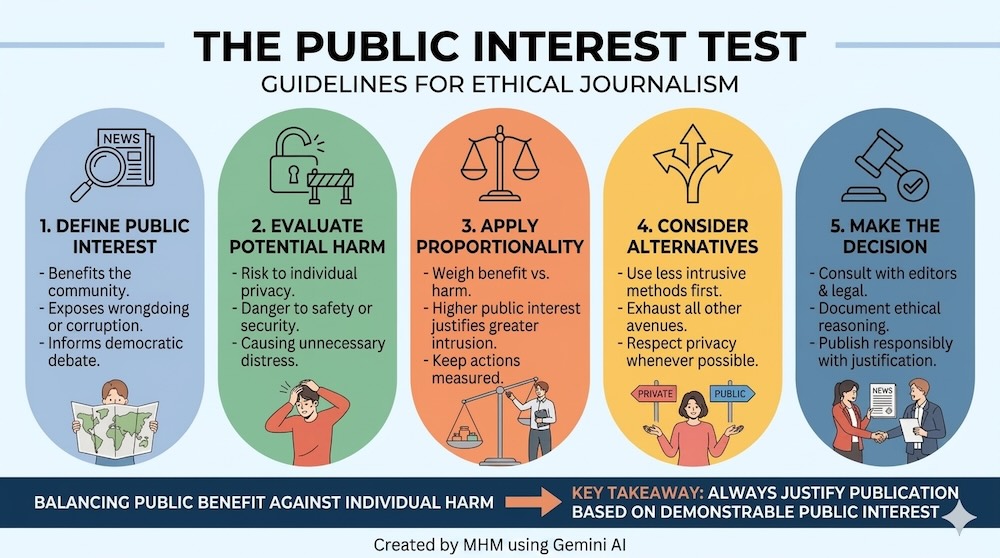
Some investigations may push legal boundaries – for example, encouraging a whistleblower or handling leaked documents. Before proceeding:
- Discuss the circumstances thoroughly with editors or legal advisers.
- Weigh the potential public benefit against the risks and consequences.
- Ensure that laws in your country offer some form of public interest defence.
In places where power is used to restrict media freedom, the definition of public interest may itself be manipulated. When that happens, journalists must exercise extra caution and document every editorial decision that justifies their work.
What counts as a public interest justification
A story is generally considered in the public interest if it:
- Corrects a significant wrong.
- Exposes information affecting public health, safety, or wellbeing.
- Deepens public understanding of an important societal issue.
- Promotes accountability and transparency among those in power.
The core message
Public interest decisions are rarely straightforward. Journalists debate them daily – and rightly so. But when you apply the public interest test thoughtfully and ethically, you fulfil journalism’s highest calling: to inform, to protect, and to strengthen democratic society.