

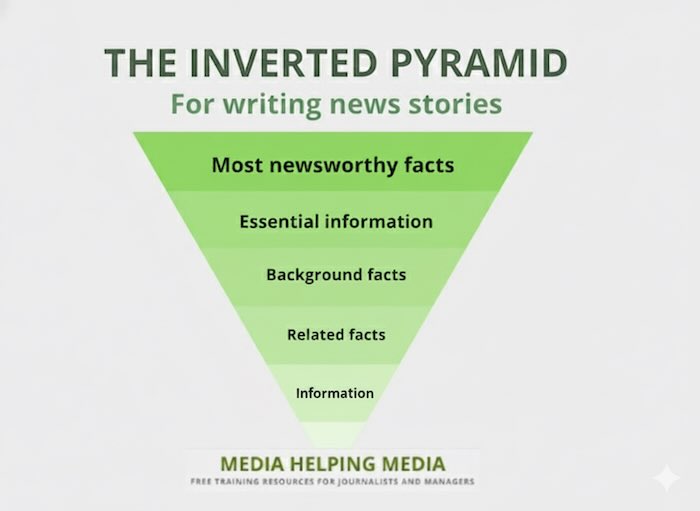
 Inverted pyramid writing puts essential, newsworthy info first, followed by supporting details and background. It ensures readers see the most vital facts straight away.
This ensures that if a reader stops halfway, or if an editor needs to cut the story from the bottom to fit a space, the main points of the story remain.
Welcome to this Media Helping Media (MHM) exercise about the essential elements of a news story, which is published on MHM. You are invited to complete the exercise either on your own or with a colleague. Please ensure you read the article above before proceeding.
MHM exercises are for those who are new to journalism to learn skills and test what they know against fictional scenarios. The articles on which the exercises are based have been created from the experience of journalists who have shared their knowledge in order to help others learn the fundamental principles of robust public service journalism.
The first requirement of any piece of journalism is that it should be accurate. Although this is an exercise involving fictitious material, not for publication, trainees must take everything they are told in the exercise to be factual and they must stick to those facts. If one thing they produce in the exercise is inconsistent with those facts, their whole work is discredited.
The scenario
 You are a reporter for a local news outlet in the town of Oakfield. A large fire has broken out at a local furniture warehouse called The Pine Emporium on Industrial Way. The fire started at 10:00 am. Three fire engines are on the scene. The Fire Chief, Sarah Miller, says the fire is now under control but the building is a total loss. No one was injured because the staff were on a tea break in a separate building. The cause is thought to be an electrical fault. The business has been running for 25 years.
Exercise tasks
Task 1: Sorting facts by weight
To build an ‘inverted pyramid’ (a metaphor used by journalists to illustrate how information should be prioritised and structured in a text), you must decide which facts are most important. List the following five facts in order of importance, starting with the most critical:
- The cause was an electrical fault.
- The building is a total loss.
- The business has been running for 25 years.
- No one was injured.
- A fire broke out at The Pine Emporium.
Task 2: Writing the lead
Using your top two facts from Task 1, write a 25-word lead (the opening sentence of a story which summarises the main point).
Task 3: Constructing the body of the story
Write a short news report (maximum 150 words) following the inverted pyramid structure.
- Paragraph 1: Your lead from Task 2.
- Paragraph 2: Supporting details (the ‘how’ and ‘why’).
- Paragraph 3: Background information (the ‘nice to know’ but not essential facts).
Below is an example of how the story could be written. Please make sure you complete the exercise before clicking on the link below. Then, once you have written you piece you can compare it with the hidden version.
Click here to see the suggested story treatment
.
Fire destroys furniture warehouse on Industrial WayA furniture warehouse has been destroyed by fire this morning, though all staff escaped injury.
The blaze broke out at The Pine Emporium on Industrial Way at 10:00 am, with three fire engines called to the scene. Fire Chief Sarah Miller said the fire is now under control but the building is a total loss.
Staff members were unharmed as they were on a tea break in a separate building when the fire started. The cause is believed to be an electrical fault.
The Pine Emporium had been operating for 25 years.
How does this version compare with the one you produced? Reflect on any areas that could be improved in either version.
Learning outcomes
By completing this exercise, you will understand how to apply the inverted pyramid to a breaking news event. You will have learned how to separate need-to-know information from nice-to-know background.