
 Reporting breaking news on TV is a high-pressure race. You must balance real-time events with limited time for fact-checking and sourcing interviews.
Welcome to this Media Helping Media (MHM) exercise which is based on the article constructing a news package for TV. You are invited to complete the exercise either on your own or with a colleague. Please ensure you read the article before completing the exercise.
MHM exercises are a chance for those who are new to journalism to learn skills and test what they know against fictional scenarios. The articles on which the exercises are based have been created from the experience of journalists who have shared their knowledge free of charge in order to help others learn the fundamental principles of robust public service journalism.
The first requirement of any piece of journalism is that it should be accurate. Although this is an exercise involving fictitious material, not for publication, trainees must take everything they are told in the exercise to be factual and they must stick to those facts. If one thing they produce in the exercise is inconsistent with those facts, their whole work is discredited. Accuracy comes first.
The scenario: The great solar pump mystery
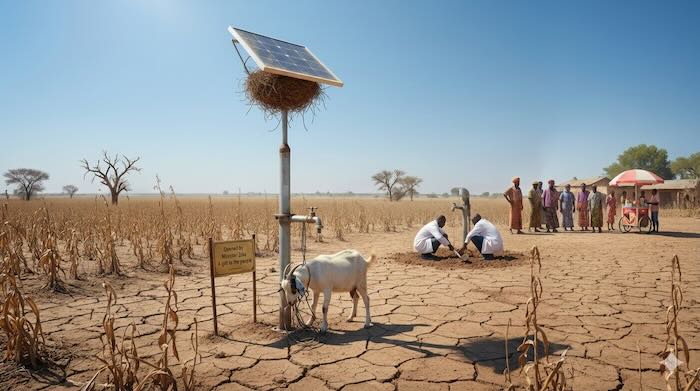
You are a reporter for a local news outlet in the fictional region of Marama. Your editor has just sent you a frantic message (you may take it that any of the facts he mentioned are correct) : “The ‘Sun-Thirst’ irrigation project in the village of Oku is failing. The government spent 500,000 credits from the National Rural Development Fund (public money gathered through local taxes) to install 20 solar-powered water pumps. It was supposed to be a miracle for the farmers, but the taps are dry. Go there, find out why, and give me a 90-second TV package for the evening news.”
The scene
You arrive at the Oku communal fields. It is a baking hot day. You are told your camera operator is on her way.
- The field: Cracked, dry earth with wilted green shoots trying to survive.
- The pumps: Rows of shiny solar panels mounted on poles. Most look brand new, but one has a bird’s nest built over the sensor (a sensor measures sunlight intensity) and is being used by a goat as a scratching post.
- The village square: A group of angry farmers are gathered around a dry communal tap.
- The ‘Grand Opening’ plaque: A gold-painted sign that says: “Opened by Minister Zola – A gift to the people.” It is slightly crooked.
- Superficial detail 1: An ice-cream vendor is doing a roaring trade because of the heat, despite the water crisis.
- Superficial detail 2: A group of men in white coats are examining the ground and prodding it with spades.
Characters
- Amara, the head farmer: She is furious. She claims the pumps only worked for two days and now the village crops are dying. She suspects the equipment was second-hand.
- Kofi, the local technician: He looks nervous. He’s wearing a t-shirt with the logo of ‘Zola Construction’ (the Minister’s brother’s company). He says “maintenance is scheduled,” but won’t say when.
- The Minister (via telephone): He insists the project is a success and blames the farmers for “incorrect usage.”
- Professor Lockhart: He is the leader of an environmental research group (the people in white coats) who are investigating whether the Sneaky Green Lizard, which lives in these parts, is endangered by the project. He won’t speculate about the results of the research.
Ethical considerations
In this story, you must be scrupulously accurate. You must maintain integrity (the quality of being honest and having strong moral principles). You must ensure fairness by giving the Minister a chance to respond to the allegations of corruption regarding his brother’s company. You must also avoid bias (a prejudice in favour of or against one thing, person, or group) by not simply assuming the government is at fault without evidence.
Task 1: Plan your coverage
You must plan a 90-second TV news package involving the following steps:
- The shot list: List six specific shots you need to tell this story.
- The interviews: Identify which two characters you will interview and one specific question for each that targets the accuracy (the quality of being correct or precise) of their claims.
- The script outline: Write a three-sentence lead (the opening of your report) and a piece to camera (where you speak directly to the lens) to be delivered in front of the dry pumps.
- The structure: Ensure you follow the structure mentioned in the MHM guide: start with a specific person/problem, move to the wider issue (funding/government), and return to the person’s situation.
Format: A written plan or a series of bullet points on a single sheet of paper.
Learning outcomes
By the end of this exercise, you will understand how to:
- Visualise a story through a shot list.
- Apply a logical structure to a TV news package.
- Identify potential corruption and ethics (moral principles that govern a person’s behaviour) in public spending stories.
Task 2: The angle shifts
Just before you start to finalise you plan for the story, police release a statement saying that the local community leader you planned to interview has just been arrested on suspicion of sabotaged.
You now need to revise your shot list and the narrative arc. In particular you must:
- Identify which original shots are now “dead weight” (irrelevant).
- Determine what new visual evidence is needed to reflect the update.
- Rewrite the “hook” and the “wrap” to reflect the shifting urgency.
Learning outcomes
This task illustrates:
- Why is it dangerous to stick to your original plan when the facts change.
- The importance of remaining accurate while moving at breaking-news speed.
Task 3: Embracing UGC (user-generated content)
The story moves on and your are told that your camera operator’s car broke down and she is stranded miles away. The only visuals available are raw clips being posted to social media.
You now need to find three pieces of UGC or else you won’t be able to produce the package your editor is demanding. You find the clips on various social media outlets. And they look promising – but are they real or fake?
What three steps would you take to verify the authenticity of the UGC you have found before putting it on air (e.g., checking metadata, cross-referencing landmarks, contacting the uploader).
Now write a 15-second voice over (VO) that bridge these clips. They must ensure the script clarifies that the footage is unverified or from social media without losing the viewer’s trust.
Learning outcomes
- Adaptability when story plans collapse.
- How to revise a storyboard with UGC
- How to attribute material that is not your own.
- How to use the SIFT system for fact checking.
- How to use digital tools to check facts.
Self-assessment quiz
Now you have completed the exercise above, take a look at this short quiz. Suggested answers are below.
- How did your original shot list help you tell the story visually, and what changes did you make to it when the angle of the story shifted in Task 2?
- When you selected your two interviewees and wrote your questions in Task 1, how did you deal with accuracy, fairness, and relevance to the audience?
- In Task 2, what was the impact of the new development (the community leader’s arrest) on your narrative arc, and how did you revise your hook and wrap to maintain accuracy under pressure?
- For the user-generated content (UGC) in Task 3, what verification steps did you take to judge authenticity, and how did you make that clear in your 15-second voice-over without undermining viewer trust?
- Across all three tasks, what was the biggest ethical challenge you encountered, and how did you resolve it while still meeting the demands of a fast-moving TV news environment?
Click here to see our suggested quiz answers.
Quiz answers
1: How did your original shot list help you tell the story visually, and what changes did you make when the angle shifted in Task 2?
The original shot list ensured the story had a clear visual structure, starting with strong establishing shots, followed by action and reaction shots that supported the narrative. It helped avoid random filming and ensured every shot had a purpose. When the story angle shifted in Task 2, the shot list was revised to prioritise visuals linked to the arrest, such as police activity, archive footage of the community leader, and reaction shots from the scene. Some planned general background shots were dropped to make room for images that better reflected the new development.
2: When selecting interviewees and writing questions in Task 1, how did you balance accuracy, fairness, and audience relevance?
Interviewees were chosen to reflect different perspectives, including an authoritative source and someone directly affected by the event. Questions were factual and open-ended, avoiding speculation or leading language. Care was taken not to assign blame or assume outcomes. The questions focused on what viewers needed to understand at that moment, such as what had happened, what was known for certain, and what was still unclear, ensuring the interviews added clarity rather than confusion.
3: What impact did the new development in Task 2 have on your narrative arc, and how did you revise the hook and wrap?
The arrest significantly changed the story’s focus, shifting it from a developing incident to one involving potential criminal responsibility. The hook was rewritten to reflect the urgency and significance of the arrest without implying guilt, using careful language such as “has been arrested in connection with…” rather than making definitive claims. The wrap was updated to emphasise what would happen next, such as ongoing investigations or court proceedings, helping viewers understand that the story was still unfolding.
4: What verification steps did you take with the user-generated content in Task 3, and how did you communicate uncertainty to the audience?
The UGC was checked by confirming the original source, comparing it with other verified footage, examining metadata where possible, and cross-checking the visuals against known details of the location and event. The voice-over made the verification status clear by stating how the footage was obtained and what could be confirmed, for example by saying it was “video shared on social media that appears to show…”. This maintained transparency without overstating certainty or damaging audience trust.
5: Across all three tasks, what was the biggest ethical challenge, and how did you resolve it under breaking-news pressure?
The biggest ethical challenge was balancing speed with accuracy, especially when new information and dramatic visuals became available. There was a constant risk of reporting unverified claims or giving undue prominence to emotionally charged material. This was managed by prioritising confirmed facts, using careful language, and clearly attributing information. Editorial judgement was used to decide what to include immediately and what to hold back until verification was complete, even if that meant being beaten by competitors.
Related material