

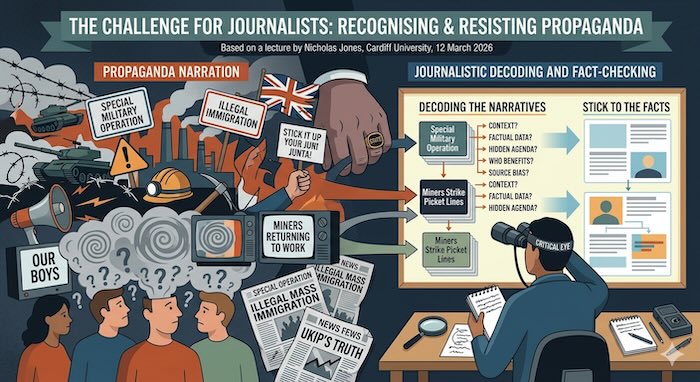
 Journalists must recognise propaganda to avoid spin and deliver factual news. Ensuring the public is properly informed is essential for credible journalism.
A journalist’s guide to recognising and resisting propaganda
The following is the text from a lecture given by Nicholas Jones to journalism students at Cardiff University in March 2025.
The challenge for journalists
Propaganda may be aimed at influencing opinion at home or abroad, and state propagandists are at their busiest during military conflicts and international crises.
On the home front, government propaganda — and especially political spin — is all around us. The challenge for journalists is to understand the propagandists’ objectives, to avoid parroting their narratives, and to try to stick to the facts.
What is propaganda?
Propaganda is the biased or misleading communication used to influence audience perception and advance a specific agenda, often through emotional manipulation rather than rational argument. It involves distributing selective, deceptive, or manipulated facts, usually by governments or organisations to sway public opinion. Wikipedia
Detecting propaganda
At first glance, it might seem straightforward. Take President Putin’s justification for the war in Ukraine. Since invading in February 2022, Russia has repeatedly described its actions as a “special military operation” intended to de-militarise and de-nazify Ukraine, framing it as a just war started by the west.
In the UK — and across the European Union, where so much has been done to support Ukraine — the consensus is that this justification is pure propaganda.
But is propaganda always so easy to detect and to challenge?
Consider the justification offered by the USA and UK for the 2003 invasion of Iraq: that Saddam Hussein was actively manufacturing and stockpiling banned chemical, biological and potentially nuclear weapons, in violation of previous UN resolutions.
Remember the lengths to which Labour Prime Minister Tony Blair went to convince the country this was true. This claim became embedded in UK news coverage — and yet, as we were to discover so spectacularly, that narrative was false
A personal reckoning
After a lifetime in journalism, it is necessary to acknowledge one’s own failings. Propaganda and spin can be difficult to avoid. The peril journalists face is getting swept along by what becomes a well-established story line shaped by propaganda.
Looking back on 30 years as a broadcaster with the BBC, it is possible to accept that one was sometimes following — and perhaps even promoting — the government’s agenda. It is not always easy to break free from an established narrative.
The Falklands War
I began working as a journalist in 1960. Fresh in the collective memory was the 1956 Suez invasion. Under the pretext of a peacekeeping mission, the UK had attempted to regain control of the Suez Canal — a failed military adventure that marked the end of Britain as a top-tier world power.
In 1982, Prime Minister Margaret Thatcher responded to Argentina’s seizure of the Falkland Islands by dispatching a naval task force, unleashing a wave of patriotic fervour.
“Stick it up your junta!” was The Sun’s memorable headline over her rejection of Argentina’s offer of peace talks. Her hurriedly assembled naval task force departed from Portsmouth.
Mrs Thatcher’s Falklands campaign was bolstered by a tsunami of jingoism inspired by the UK’s popular newspapers.
The initial response of trade union leaders was one of alarm and potentially opposition — the left was aghast at the prospect of Britain returning to gunboat diplomacy — but Mrs Thatcher had invoked the wartime bulldog spirit of Winston Churchill with great fervour.
To the surprise of many observers, the left’s predicted revolt over the dispatch of the Royal Navy’s Task Force melted away.
Shipbuilding, engineering and other union leaders backed off; they had no intention of getting on the wrong side of gung-ho news coverage, especially in newspapers such as The Sun.
A seamen’s union leader did advise seafarers not to risk sailing to the Falklands in requisitioned ferries, but like the rest of the news media, the BBC largely fell into line — though nowhere near as gung-ho as Mrs Thatcher wanted.
Home correspondents could sense the pressure on newsroom colleagues and understood their determination to avoid adopting a patriotic stance. Mrs Thatcher condemned the BBC’s “chilling neutrality.”
Conservative MPs demanded that BBC news bulletins stop referring to “British troops” and instead describe them as “Our Boys.” Gung-ho propaganda was aimed at raising home morale, and wartime censorship was in place.
It was in this atmosphere that the BBC’s Brian Hanrahan delivered his famous commentary: “I counted them out and I counted them back again.”
The miners’ strike
Mrs Thatcher’s victory in the Falklands War helped sweep her back to power with a landslide victory in the 1983 general election, and she was just as ready and eager to fight on the home front. Her immediate target was the loss-making National Coal Board and the mighty National Union of Mineworkers (NUM).
Mrs Thatcher had made elaborate preparations in case of a confrontation with the NUM and their leader Arthur Scargill. Coal stocks were at record levels and new employment laws had been introduced to curb industrial action.
But from the outset of the year-long strike in early 1984, Scargill had handed Mrs Thatcher a powerful propaganda advantage: the strike went ahead without a national pit-head ballot, and miners continued working in the Nottinghamshire coalfield, so the government could argue the strike lacked legitimacy.
When strikers continued mass picketing at pitheads in defiance of the police, the dispute was portrayed as a threat to law and order — a story line pursued relentlessly by the dominant Tory press.
After a brutal crackdown on strikers at the Battle of Orgreave in June 1984, the police had effectively corralled the pickets. The government then shifted its agenda to convincing coalfield communities and the country that continuing the strike was futile, pushing for a return to work in order to break the strike. Once half the men were back, Mrs Thatcher would claim victory.
In the final months, news coverage was dominated by miners abandoning the strike — the so-called “fresh faces” turning up for work. For the tabloid press, these men were the “heroes,” and film of them being bussed through picket lines, surrounded by police, was featured night after night on television news bulletins.
On reflection, it is clear that this represented getting trapped by a story line which worked to Mrs Thatcher’s advantage, when the BBC perhaps should have done more to investigate and report on the hardship in the coalfields and the strength of their community spirit.
Lessons from the miners’ strike
The miners’ strike offers several important lessons for journalists.
Do not underestimate the state’s ability to influence and dictate the news agenda. Mrs Thatcher had a decisive propaganda advantage throughout.
Equally, it is vital to understand the impact of the bias in dominant Conservative-supporting newspapers and their ability to promote and rework story lines.
Their sensational front pages and relentless hostility to the striking miners reinforced Mrs Thatcher’s objectives, egging her on to succeed in crushing Arthur Scargill and in defeating trade union power.
The legacy
Despite dramatic declines in the circulation of the printed press, big media proprietors continue to have an all-embracing influence.
These companies employ many of the UK’s most influential columnists and commentators, who reflect right-wing opinion.
While fewer people read them in print, this extensive commentariat are seen and heard in news outlets all over the media landscape — on radio and television, in podcasts and a flourishing online world.
If media owners decide to campaign on a key issue, their firepower is such that governments often retreat or face defeat.
The popular press and Brexit
Years of campaigning by the tabloid press against interference by the European Union preceded the 2016 Brexit referendum.
Media proprietors such as Rupert Murdoch (The Sun), the Harmsworth family (Daily Mail) and the Barclay brothers (Daily Telegraph) had always been vigorous opponents of any European challenge to the UK’s media ownership and regulations.
Playing up fears over immigration — and attacking the EU’s failure to halt the flow of asylum seekers crossing the English Channel — became their weapon of choice in supporting a vote to leave.
Nigel Farage’s success in the 2013 council elections forced the Conservative Party to step up its own rhetoric, and David Cameron won the 2015 general election on a promise to legislate for an in-out referendum on UK membership of the EU.
There was no let-up by the tabloid press in the pressure they applied in urging Cameron to honour his pledge. Day after day, the popular press used immigration statistics to strengthen the campaign for a vote to leave.
It was the campaigning success of the United Kingdom Independence Party in the 2013 council elections that ultimately forced Conservative leader David Cameron to promise an in-out vote on Europe — a clear example of how a sustained tabloid campaign can reshape the political landscape.
Continuing fears over immigration
The tabloids have been relentless in their campaigning news coverage against what they describe as “illegal” and “mass” immigration.
Anti-immigrant propaganda — the politicisation of this issue — has had a lasting effect. How else can we explain that opposition to immigration, and the greatest levels of fear, are often found in areas with the fewest immigrants?
Since the 2016 Brexit vote, scare tactics on immigration have continued to be exploited for political gain.
Nigel Farage’s continuing popularity and UKIP’s dramatic transformation into Reform has upended UK politics. The popular press has shown no let-up in its focus on immigration — much of it currently concentrated on what they argue is the Labour government’s inability to end the flow of asylum seekers crossing the English Channel.
Community leaders reflect ruefully on an increased sense of insecurity among many of those who have settled in the UK.
The tabloid press
A politically driven agenda — such as fears over immigration — can easily be sustained through a succession of powerful front pages.
Government statistics provide a constant potential peg for new stories that can be readily manipulated.
Journalists can assemble data, or pollsters can be commissioned to conduct surveys. Scare stories can be constructed out of dramatic photographs.
This agenda-setting can then be followed through and promoted by opinion pieces and comment columns.
The question that journalists must ask themselves is whether the agenda followed by the popular press constitutes simple bias or something more calculated — whether it amounts, in fact, to propaganda.
The responsibility of journalists
Where we sense a propaganda agenda, we should always try to put stories into context.
Can we find ways to give viewers, listeners and readers a health warning — perhaps indicating that there is a hidden agenda at work?
We should try to signal if a story line is to someone’s advantage.
- Who might be the beneficiary?
- Is there a pattern to these stories?
Working in lines such as “this is the argument of…”, “the belief of…”, “the claim of…” can help signal to audiences that they are receiving a partial account rather than a neutral one.
The regret of looking back 40 years is not having flagged up that reports of miners returning to work were a calculated ploy — that Mrs Thatcher’s government was actively engineering the figures and manipulating the media.
That is the lesson. When we can see the hand of the propagandist, we must say so.
How to spot and deal with propaganda
Learn to recognise propaganda
- Propaganda isn’t always obvious — even widely accepted narratives (like WMDs in Iraq) can later prove false
- Look for signs that a story is being shaped to someone’s advantage — ask “who benefits?”
- Watch for patterns: a sustained series of stories on the same theme may signal a coordinated agenda
- Be alert to the gap between fear levels and reality (e.g. anti-immigration sentiment strongest in areas with fewest immigrants)
Avoid being swept along
- Don’t assume an established narrative is true just because it’s dominant
- Understand the propagandist’s objectives so you’re not unconsciously advancing them
Recognise the outsized influence of major media proprietors and the columnists they platform - Be aware that political and institutional pressure — even informal pressure — can subtly shape newsroom decisions
Report responsibly
- Put stories in context rather than repeating them uncritically
- Use attributed framing like “this is the claim of…” or “this is the argument of…” to signal a partial account
- When you can see the hand of the propagandist, name it explicitly
- Investigate the human reality behind politically driven story lines — don’t just follow the government’s preferred angle
The overarching lesson: Honest self-reflection matters. Even experienced journalists can be complicit in propaganda without realising it.
This article is based on a lecture by Nicholas Jones at Cardiff University in March 2026 ‘What is propaganda? A journalist’s guide to recognising and resisting it’.
Related material