

 Crime reporters must balance the public’s right to know with ethical duties, ensuring accuracy and fairness while avoiding sensationalism and prejudice.
Welcome to this Media Helping Media (MHM) exercise which is based on the article Crime reporting for beginners which is published on MHM. You are invited to complete the exercise either on your own or with a colleague. Please ensure you read the article above before completing the exercise.
MHM exercises are a chance for those who are new to journalism to learn skills and test what they know against fictional scenarios. The articles on which the exercises are based have been created from the experience of journalists who have shared their knowledge free of charge in order to help others learn the fundamental principles of robust public service journalism.
The first requirement of any piece of journalism is that it should be accurate. Although this is an exercise involving fictitious material, not for publication, trainees must take everything they are told in the exercise to be factual and they must stick to those facts. If one thing they produce in the exercise is inconsistent with those facts, their whole work is discredited. Accuracy comes first.
The scenario: The great solar sabotage
 You are a reporter for the Malani Daily News. Your editor, Sarah, calls you at 8:00 am. “There’s been a major theft at the Kiboko Community Solar Farm. This is the project funded by the National Green Energy Fund (taxpayer money) and a local development grant. Half the district is without power for their water pumps. Get down there, find out what happened, and give me a 90-second radio script for the midday news.”
The scene
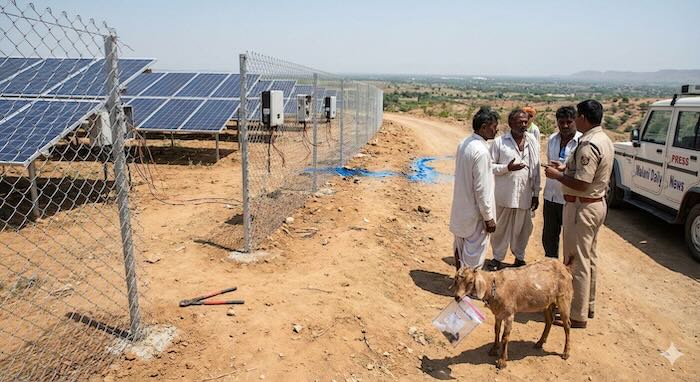
You arrive at the Kiboko Community Solar Farm, located on a dusty ridge overlooking the valley. The scene is chaotic:
- The perimeter: A chain-link fence has a large, jagged hole cut into it. A pair of heavy-duty wire cutters lies abandoned in the dirt.
- The equipment: Rows of solar panels remain, but several ‘inverters’ (devices that change the sun’s energy into electricity) have been ripped out, leaving dangling, raw copper wires.
- The ground: There are deep tyre tracks leading away from the hole in the fence. Strangely, there is also a trail of spilled blue industrial paint leading towards the main road.
- Atmosphere: A group of about 20 local farmers are gathered at the gate, looking frustrated. A stray goat is chewing on a discarded police evidence bag (which is empty).
- The weather: It is a scorching 35 degrees Celsius, making the lack of power for irrigation pumps even more critical.
The characters
- Inspector Raj: The lead police officer on the scene. He tells you: “We believe it was an organised gang. They knew exactly which components were the most expensive. We are looking for a white van. No arrests yet. We urge the public not to take the law into their own hands.”
- Amina: A local farmer. She is angry. She says: “This farm cost five million Malani Shillings of our tax money. Now my crops will die by sunset without the pumps. I saw a man from the neighbouring village, Kofi, hanging around here yesterday. He always looked ‘shifty’ (untrustworthy). I bet it was him.”
- Leo: The night security guard. He looks exhausted and has a small bruise on his arm. He says: “They came at 2:00 am. There were four of them. I tried to stop them, but they pushed me over. They spoke a dialect I didn’t recognise. They seemed to have a professional map of the layout.”
Task 1: The 90-second news script
You must prepare a 90-second news report script. Your report must:
- State the facts of what happened without using ‘sensationalism’ (the use of exciting or shocking stories or language at the expense of accuracy, in order to provoke public interest or excitement).
- Explain the impact on the community and the source of the lost public funds.
- Avoid ‘libel’ (a published false statement that is damaging to a person’s reputation) by handling Amina’s accusation against Kofi carefully.
- Include a ‘shot list’ (a list of the images a camera operator would need to film to accompany your words) if this were a TV report.
Ethical considerations
In this scenario, you must maintain integrity by not simply repeating the police version of events as absolute truth. This means you must attribute everything you are told. You must also consider fairness and privacy regarding the person Amina accused. Reporting Kofi’s name based only on her hunch would be a serious breach of ethics. You must also ensure your report shows impartiality when describing the tension between the farmers and the authorities, avoiding any personal bias against the police or the security guard. Finally, ensure you do not cause unnecessary offence by filming victims in moments of extreme, private distress without their permission.
Task 2: The social media update challenge
In this task you need to practice responsible reporting in a fast-moving digital environment where misinformation spreads quickly.
The scenario: Two hours after your midday radio report, a photo goes viral on a local Malani Facebook group. It shows a white van parked outside Kofi’s house (the man Amina accused). The caption reads: “Found the thief! Why haven’t the police arrested him yet? Let’s get our solar panels back ourselves!” Your editor asks you to post a 150-word update on the Malani Daily News social media page to address the rising tension.
- Task: To write the social media post in which you:
- Viral photo: Acknowledge the existence of the photo, recognise the public anger that is growing on social media, fact-check as far as you are able, and ensure that you don’t confirm the suspicion that Kofi is a suspect (unless and until you are told by the police).
- Police warning: Incorporate inspector Raj’s earlier warning about “taking the law into their own hands.”
- Remain factual: Report factually on the situation while still providing coverage that acknowledges what the community is seeing online.
Task 3: The follow the money investigative pitch
Here you move beyond the crime report and look at the systemic issues (public interest journalism).
The scenario: It is now the day after the theft. While reviewing your notes, you remember Leo (the guard) mentioned the thieves had a professional map and Amina mentioned the five million Malani Shillings price tag. You suspect there might be more to this story than a simple robbery, perhaps involving the construction contract or the security firm.
- Task: Your task is to write a three-paragraph pitch to your editor, Sarah, for a follow-up investigative piece. Your pitch must:
- Identify the red flags: What specific details from the scene (e.g., the map, the security guard’s bruise, the specific components stolen) suggest this might be an inside job or a failure of the National Green Energy Fund?
- Identify sources: Who would you interview next? (e.g., the company that installed the panels, the National Green Energy Fund auditors, or the security company’s owner).
- Ethical justification: Explain why investigating the funding and security of the farm is in the public interest, rather than just focusing on the thieves.
Self-assessment quiz
- Amina identifies “Kofi” as a suspect because he looks “shifty”. Why should you omit his name from your report?
- Because Kofi might be a relative of the editor.
- Because naming an uncharged individual based on hearsay is a breach of ethics and could lead to libel.
- Because it makes the story too long.
- Because the police haven’t provided a photograph of him yet.
- The Inspector says it was an “organised gang”. How should you attribute this?
- State it as a fact: “An organised gang has robbed the farm.”
- Write: “Police say they believe the theft was carried out by an organised gang.”
- Ignore the Inspector and make up your own theory.
- Say: “Everyone knows an organised gang did it.”
- Why is it important to mention that the project was funded by the National Green Energy Fund?
- To fill time in the 90-second script.
- Because it is a matter of public interest regarding how public money is protected and spent.
- To make the government look bad.
- Because the fund requested a shout-out.
- When compiling your shot list, you see a farmer crying privately over his ruined crop. What should you do?
- Zoom in on his face to get the most dramatic shot possible.
- Film him from a distance and ask for his consent before using any close-up footage, respecting his privacy.
- Tell him to cry louder for the camera.
- Ignore him because he isn’t a government official.
- What is the most important ‘fact’ to verify before finishing your script?
- The brand of the security guard’s watch.
- The exact amount of public money involved and the current status of the power outage.
- What the goat was eating.
- The colour of the Inspector’s uniform.
Answers to the quiz
1: b (Protecting the identity of those not charged is vital for fairness and legal safety).
2: b (Always attribute claims to the source; do not state police theories as absolute facts).
3: b (Public expenditure requires accountability, which is a core part of public service journalism).
4: b (Ethical journalism requires a balance between showing the human cost and respecting personal grief).
5: b (Accuracy regarding the impact on the community and the loss of public funds is the foundation of the story).
Summary and learning outcomes
The purpose of this exercise was to practice breaking news crime reporting while navigating the pressures of a community crisis. By completing this task, you should have learned how to:
- Extract essential facts from a chaotic scene.
- Attribute information correctly to different sources (police vs. witnesses).
- Avoid legal and ethical pitfalls like naming suspects without evidence.
- Identify the public interest element in stories involving public funds.
- Visualise a story through a professional shot list.
Related material